Surface Defect Sorting Machine
Internal Defect Sorting Machine
Structural Anomaly Sorting Machine
Foreign Matter Sorting Machine
Crack Sorting Machine
Scratch Sorting Machine
Dent Sorting Machine
Deformation Sorting Machine
Discoloration Sorting Machine
Size Sorting Machine
What is Defect Sorting
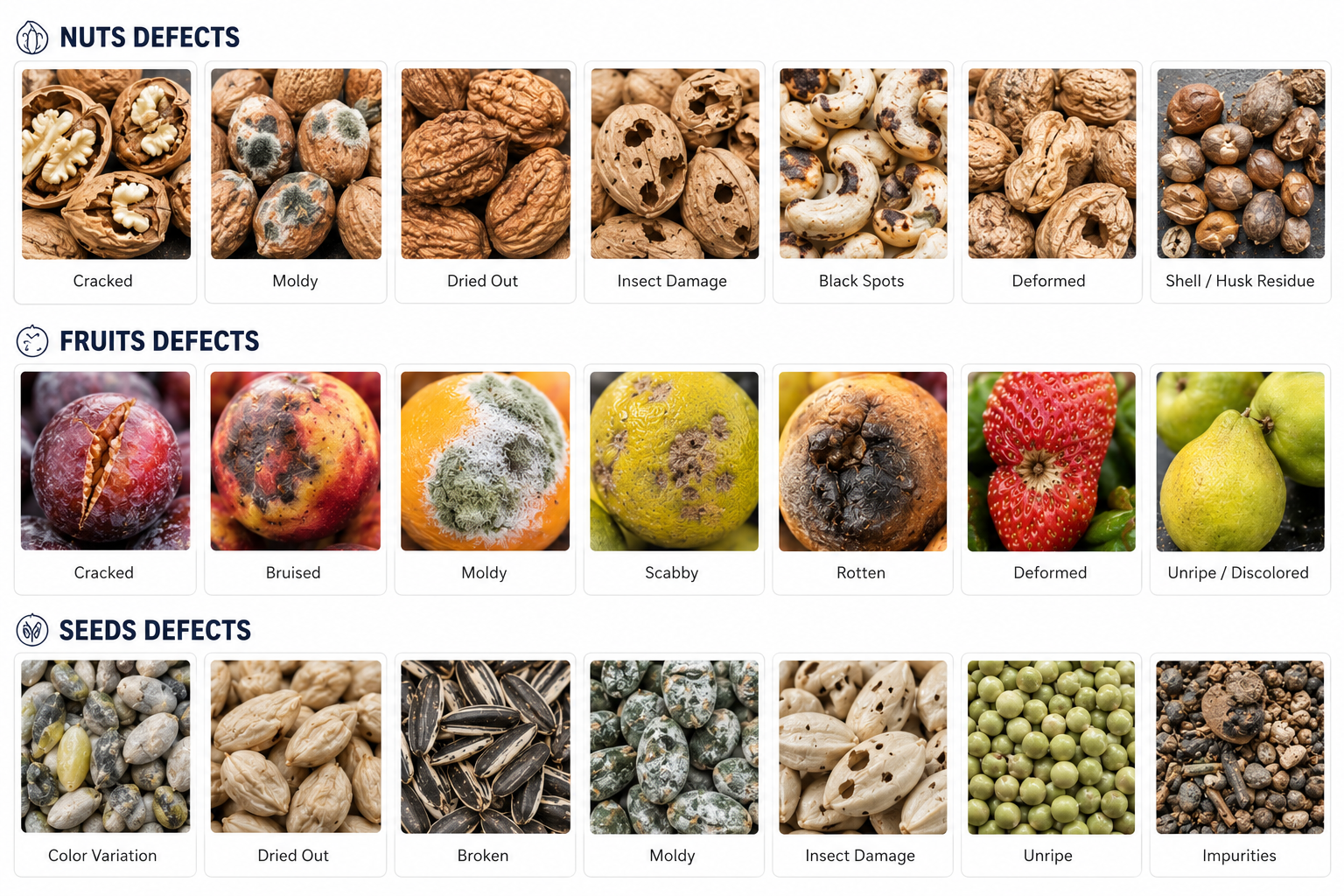
Defect sorting refers to the advanced process of identifying and removing defective products based on surface imperfections, structural anomalies, internal flaws, and contamination using high-precision optical sorting systems. This technology ensures that only products free from cracks, blemishes, deformities, rot, mold, or insect damage reach the final packaging. With increasing quality standards in food and industrial processing, defect sorting has become an indispensable step in modern production lines.
Modern defect sorting solutions cater to a wide variety of products including fruits, vegetables, nuts, seeds, plastics, ceramics, and electronic components. These machines help manufacturers maintain consistency, reduce waste, improve safety, and meet international quality certifications. Whether it's removing superficially blemished produce or detecting internal cracks invisible to the human eye, automated defect sorting provides accuracy and throughput that manual inspection simply cannot achieve.
Why Choose a Defect Sorting Machine?
Drawbacks of Manual Defect Sorting: High labor intensity, eye fatigue leading to missed defects, inconsistent quality standards between workers, rising labor costs, and poor hygiene compliance. Manual inspection struggles to detect micro-cracks, internal flaws, or subtle color variations, especially when processing thousands of items per minute.
Advantages of Defect Sorting Machines: Fully automated with exceptional precision and high-speed throughput. Integrating multi-spectral imaging, AI-driven pattern recognition, and deep learning algorithms, these machines identify and remove defective items in a single pass, maximizing yield while ensuring zero-defect output.
High-Speed Defect Sorting System Components
Multi-Spectral Vision System
High-Precision Ejection System
X-Ray & NIR Internal Inspection
Intelligent Control & Monitoring
Multi-Spectral Vision System
Utilizes high-resolution CCD, CMOS, and hyperspectral cameras to capture surface defects including cracks, bruises, discolorations, spots, and deformities. Advanced optics enable 360-degree inspection with no blind spots.
X-Ray & NIR Internal Inspection
Employs near-infrared (NIR) spectroscopy and X-ray transmission technology to detect internal flaws such as hollow centers, insect damage, rot, foreign objects, and density variations invisible to surface cameras.
High-Precision Ejection System
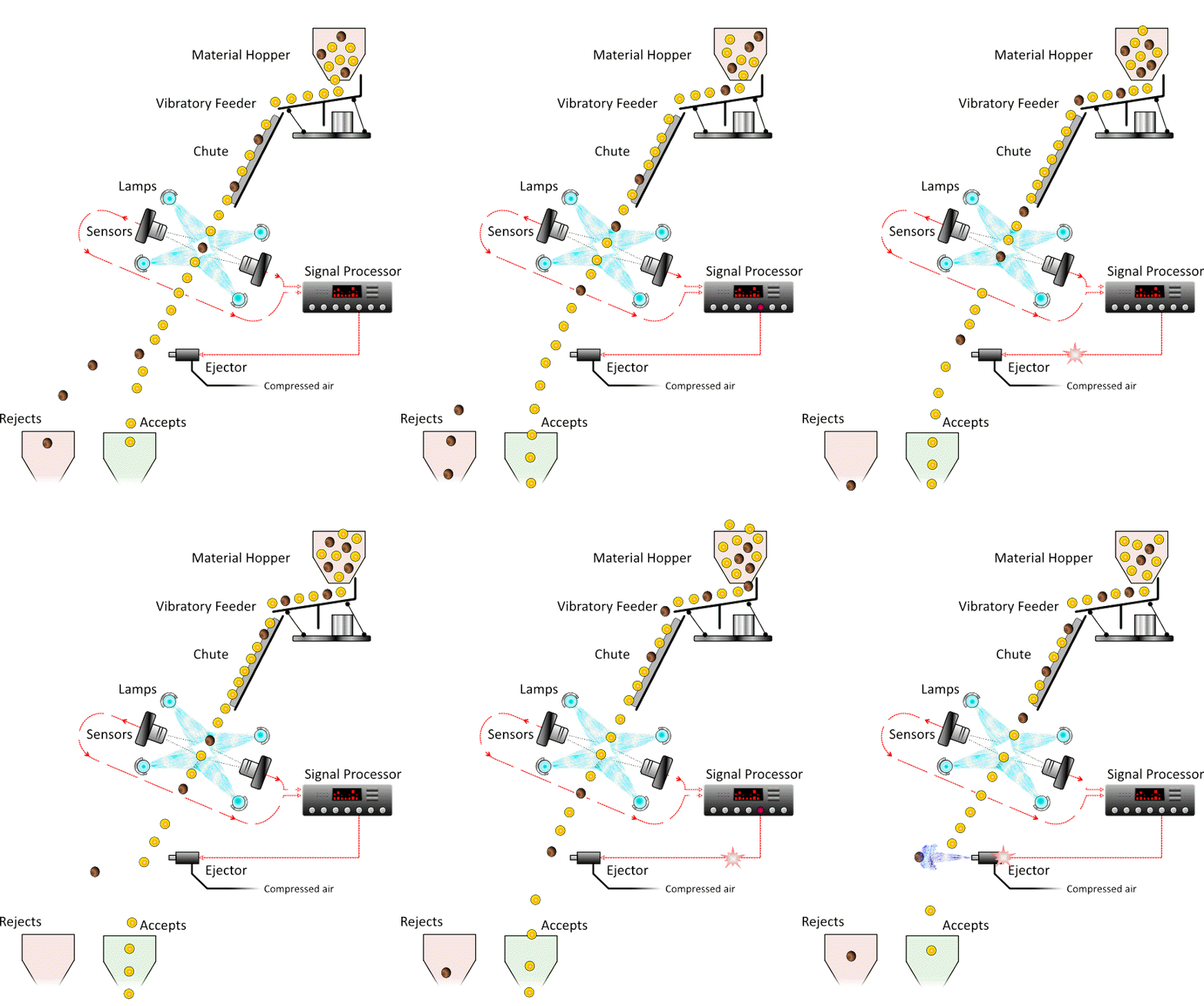
High-speed pneumatic actuators with millisecond response times remove defective items with minimal good product loss. Multi-nozzle arrays ensure precise targeting even at high throughput rates.
Intelligent Control & Monitoring
Feeding System: Evenly distributes products into single-layer flow. Smart Algorithms: Deep learning continuously improves defect recognition. Data Dashboard: Real-time monitoring of defect rates, yield, and machine performance.
Technical Highlights
Defect Detection Accuracy
Surface defects ≥ 99.5%
Internal defects ≥ 97%
Processing Throughput
0.5-15 tons/hour (product dependent)
Camera System
2-6 high-speed cameras per channel
Hyperspectral & RGB options
Minimum Defect Size
down to 0.05mm² (surface)
0.3mm (internal via X-ray)
Ejection Precision
<1ms response time
98% good product retention
AI Learning Capability
Deep learning model updates
New defect pattern recognition
Comprehensive Range of Defect Types Sorted
| Defect Category | Specific Defect Types | Detection Method |
|---|---|---|
| Surface Imperfections | Cracks, Bruises, Scratches, Pits, Spots, Discoloration | RGB/Hyperspectral Imaging |
| Structural Defects | Deformities, Broken pieces, Irregular shape, Hollow centers | 3D Laser / X-Ray |
| Biological Contamination | Mold, Fungus, Insect damage, Rot, Germinated | UV Fluorescence / NIR |
| Internal Flaws | Hollow heart, Internal browning, Hidden cracks | X-Ray / NIR Spectroscopy |
| Foreign Material | Stones, Glass, Metal, Plastic, Wood fragments | X-Ray / Metal Detection |
Defect Sorting Parameters by Product Type
| Product Category | Common Defects Sorted | Typical Accuracy | Throughput (kg/h) |
|---|---|---|---|
| Nuts (Almonds, Walnuts) | Cracks, mold, insect holes, shell fragments | 99.5% | 800-3000 |
| Fresh Fruits (Berries, Cherries) | Bruises, soft spots, rot, under-ripe | 98.5% | 500-2000 |
| Vegetables (Potatoes, Carrots) | Green spots, cracks, rot, irregular shape | 99.0% | 2000-8000 |
| Coffee Beans | Black beans, sour beans, insect damage, shell | 99.8% | 500-2500 |
| Plastics & Recyclables | Discolored, degraded, wrong polymer type | 98.0% | 1000-15000 |
How Defect Sorting Works
Defect sorting machines utilize high-resolution multi-spectral sensors and advanced imaging technology to analyze each product as it passes through the system. The sensors capture detailed surface and internal characteristics, detecting even the slightest imperfections or anomalies. When a defective item or contaminant is identified, the machine triggers a high-speed air ejection system to remove it from the production line with surgical precision.
The sorting process begins with feeding products into the machine, where they are evenly distributed into a single-layer flow to ensure each item is inspected individually. Advanced AI algorithms process the images and sensor data in real-time, distinguishing between acceptable and defective products with remarkable accuracy. This ensures that only premium-quality items proceed to packaging, significantly reducing waste and improving overall product value.
Beyond basic defect removal, modern defect sorters integrate deep learning and adaptive classification. As thousands of items flow through the inspection zone each second, the system continuously refines its decision boundaries based on real-time feedback. This means that over time, the machine becomes increasingly accurate at distinguishing subtle defect variations—such as early-stage rot versus healthy tissue, or micro-cracks versus surface scratches—or identifying foreign materials that resemble good products in shape but differ in spectral signature. The result is a sorting process that not only replaces manual labor but consistently outperforms human vision, delivering uniform product quality that meets the most stringent food safety and industrial standards.
Core Features and Benefits of Defect Sorting
Modern defect sorting solutions offer unparalleled accuracy in detecting and removing surface imperfections, structural flaws, and internal defects. These machines can process thousands of items per second, significantly outperforming manual inspection in both speed and consistency. The ability to customize defect parameters allows processors to adapt the machine for different product types and quality requirements, making it a versatile solution for diverse applications across food and industrial sectors.
Beyond quality control, defect sorting machines contribute to food safety by eliminating potentially contaminated or rotten products that could cause health issues. They also help reduce labor costs while increasing throughput, providing a rapid return on investment for processing facilities. The non-destructive nature of optical and X-ray sorting preserves good product integrity, ensuring that nutritional value and appearance remain intact throughout the process.
Technical Specifications of Defect Sorting Machines
High-performance defect sorters typically feature multi-spectral CCD/CMOS cameras with resolutions capable of detecting minute defects as small as 0.05mm². Processing capacities range from 0.5 to 15 tons per hour depending on the model and product type, with defect removal accuracy rates exceeding 99% for most applications. These machines often incorporate AI-powered deep learning algorithms that continuously improve detection accuracy over time as they process more material.
Modern defect sorters come equipped with user-friendly touchscreen interfaces for easy operation and parameter adjustment. Many models feature dual-camera and X-ray systems for simultaneous surface and internal inspection, ensuring comprehensive quality control. Energy efficiency is another key consideration, with advanced models consuming minimal power while delivering maximum sorting performance. IP65-rated stainless steel construction ensures durability and easy sanitation in food processing environments.
Applications of Defect Sorting Technology
Defect sorting technology finds application across numerous industries, from food processing to recycling and manufacturing. It is particularly valuable for premium products like nuts, coffee, dried fruits, and fresh produce where appearance and purity significantly impact market value. The technology also plays a crucial role in organic processing, where chemical treatments aren't an option for quality improvement.
Beyond food production, defect sorters are used in plastic recycling to separate degraded or discolored materials, in pharmaceutical manufacturing to detect damaged tablets, and in electronics recycling to identify defective components. The adaptability of these machines allows them to handle everything from small seeds and grains to larger items like potatoes, apples, and industrial parts with equal efficiency.
Buying Guide
When selecting a defect sorting machine, consider the specific types of defects prevalent in your products and the required detection sensitivity. Processing capacity requirements should match your production volume, while machine flexibility becomes important if you handle multiple product varieties. Look for machines with easy-to-clean designs and robust construction suitable for your operating environment.
Advanced features like AI-based defect learning, remote diagnostics, and cloud connectivity can provide long-term value. Consider the availability of local service support and the machine's compatibility with your existing processing line. Many manufacturers offer material testing services or trial periods to help evaluate a machine's performance with your specific products.
Maintenance Guide
Regular maintenance is crucial for optimal defect sorting performance. Daily cleaning removes dust and product residues that could affect optical sensors and X-ray windows. Periodic calibration using standard reference samples ensures sorting accuracy remains consistent. Air filters, ejection nozzles, and conveyor belts require particular attention as wear or clogging can significantly impact sorting efficiency.
Scheduled professional servicing helps identify wear components before they fail and maintains the machine's precision over time. Keeping detailed maintenance records can help predict when parts like X-ray tubes or camera modules need replacement and ensure uninterrupted operation. Proper storage and climate control during off-seasons protects sensitive electronic components and extends the machine's operational lifespan.