What is a Size Sorting Machine?
A size sorting machine is an industrial sorting device designed to classify products based on their physical dimensions including diameter, length, width, and shape using precision rollers, screens, or optical measurement systems. It separates products into different size categories for consistent packaging, processing, and market standards across fruits, vegetables, grains, seeds, and industrial materials. This technology plays a critical role in quality assurance by ensuring product uniformity and meeting consumer expectations.
Modern size sorters combine high-speed processing with exceptional accuracy, capable of handling 1-30 metric tons per hour with sorting accuracy exceeding 99%. The automated operation significantly reduces labor costs and human error compared to manual sorting methods, while providing consistent, objective size classification across production runs. These machines are essential in industries where product size directly impacts market value, processing efficiency, and customer satisfaction.
How a Size Sorting Machine Works
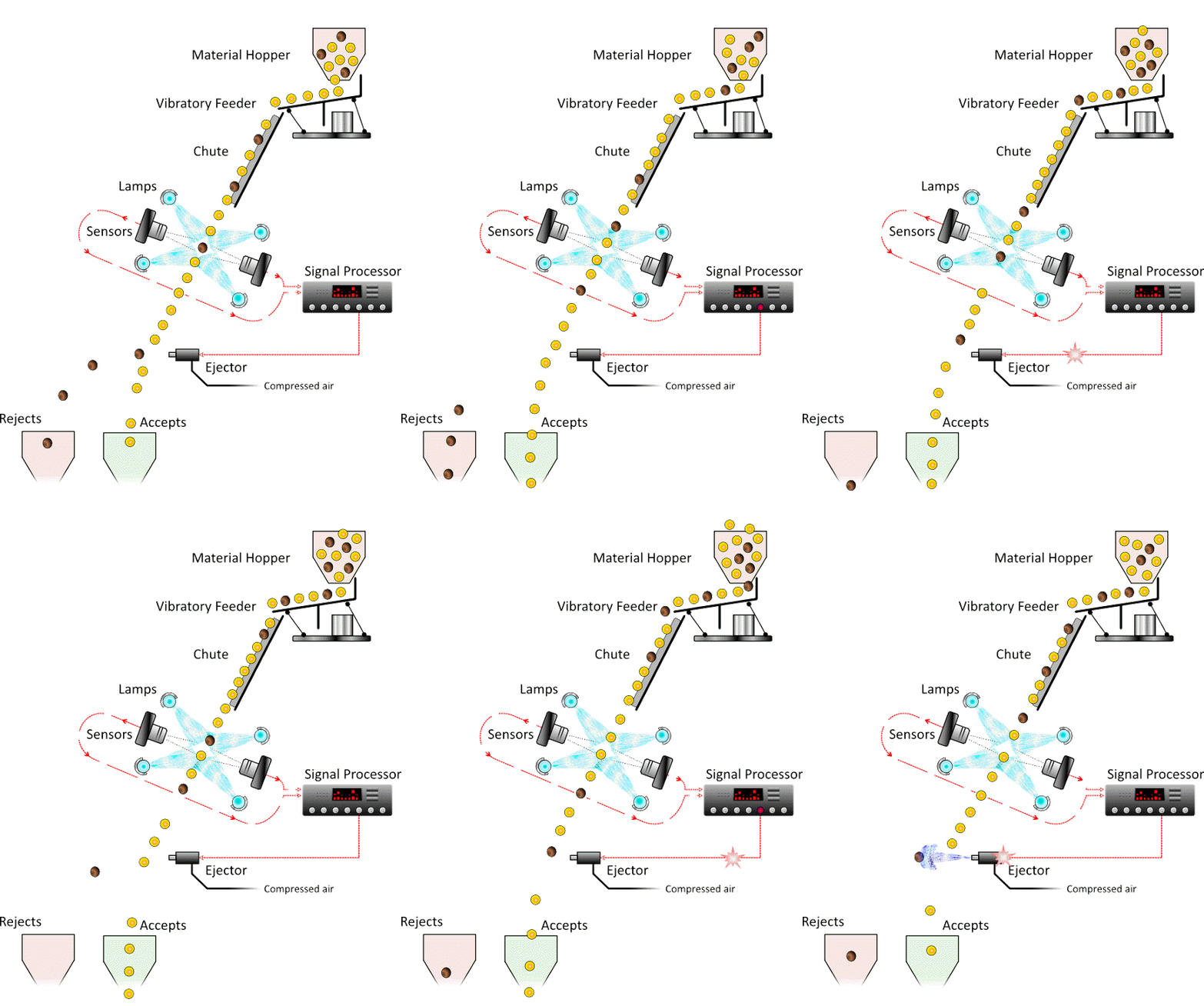
| Stage | Operation | Key Technology / Parameters |
|---|---|---|
| 1. Feeding | Vibration feeder or conveyor spreads products into single layer | Speed adjustable · Uniform distribution · No overlapping |
| 2. Size Measurement | Roller gaps or optical scanning measure dimensions | Precision rollers · CCD camera · Resolution ≤ 0.1mm · Multi-angle |
| 3. Classification | AI or mechanical system assigns size categories | Deep Learning · Diameter analysis · Length measurement · Shape recognition |
| 4. Separation | Pneumatic or mechanical diversion to output channels | Response time ≤ 30ms · Sorting accuracy ≥ 99% |
| 5. Collection | Products collected in multiple size grade bins | 3-5 output channels · Size reporting · Quality tracking |
Core Features and Advantages of Size Sorting Machines
📏 Precision Size Classification
Separates products by diameter, length, and width with 0.1mm accuracy.
⚙️ Multiple Grading Technologies
Roller-based, screen-based, and optical systems for diverse applications.
⚡ High-Throughput Processing
Handles 1-30 tons per hour with consistent classification accuracy.
🧠 AI-Enhanced Grading
Deep learning improves classification for irregularly shaped products.
Modern size sorting systems offer remarkable processing capabilities with capacities ranging from 1 to 30 metric tons per hour while maintaining sorting accuracy above 99%. Their key advantage lies in the ability to handle diverse product types including spherical, elongated, and irregularly shaped items using multiple grading technologies. The machines can produce 3-5 different size grades simultaneously, maximizing product value by optimizing size distribution for different market requirements.
The combination of precision mechanics and advanced vision systems ensures consistent size classification regardless of product variability. Roller-based systems provide reliable, low-maintenance operation for uniform products, while optical systems offer flexibility for irregular shapes and size ranges. The latest generation incorporates self-learning capabilities that continuously improve classification accuracy by analyzing patterns in sorted materials and adapting to new product varieties as they emerge in production. Integrated data tracking provides comprehensive size distribution reports for quality management and process optimization.
Technical Specifications of Size Sorting Machines
Standard industrial size sorters feature processing capacities ranging from 1 to 30 metric tons per hour depending on product type and model configuration. They operate at sorting accuracies exceeding 99% when properly calibrated and maintained. Most systems require 380V three-phase power with typical power consumption ranging from 3-15kW depending on capacity and technology type.
Advanced models offer size resolution down to 0.1mm with optical camera systems capable of measuring dimensions at speeds exceeding 5,000 frames per second. Roller-based systems provide gap adjustment from 5mm to 100mm for versatile grading applications. Many machines now incorporate IoT capabilities for remote monitoring, size distribution tracking, and predictive maintenance features.
Applications of Size Sorting Machines
Size sorting technology serves critical functions across multiple industries where product size directly impacts value and application. In agriculture and food processing, it classifies fruits, vegetables, nuts, and grains for consistent packaging and processing. The recycling industry uses size sorters to separate materials for efficient processing. Mining and construction rely on these machines for aggregate sizing and material classification.
The seed industry utilizes size sorting to separate seeds by size for uniform planting and germination. Plastics manufacturing employs size sorters for pellet classification and material recovery. The technology also plays an important role in pharmaceutical and chemical processing where consistent particle size is critical for product quality.
| Industry / Sector | Typical Products | Size Sorting Applications |
|---|---|---|
| Agriculture & Food | Fruits, vegetables, nuts, grains, seeds | Diameter grading · Length sorting · Shape classification |
| Recycling | Plastics, metals, glass, paper | Material separation · Size reduction · Recovery sorting |
| Mining & Construction | Aggregates, gravel, sand, ores | Particle sizing · Material classification · Quality grading |
| Seed Processing | Corn, wheat, soybean, vegetable seeds | Seed sizing · Uniformity grading · Quality selection |
| Plastics Manufacturing | Resin pellets, regrind materials | Pellet sizing · Material classification · Quality control |
| Pharmaceuticals | Powders, granules, tablets | Particle sizing · Granule classification · Quality assurance |
Purchasing Guide
When selecting a size sorting machine, key considerations include product type, required size ranges, processing capacity, and grading accuracy. Consider whether roller-based, screen-based, or optical technology best suits your application—roller systems for durable products, screens for smaller particles, and optical for irregular shapes. For operations handling multiple product types, modular systems with adjustable parameters provide significant advantages.
Evaluate the machine's capability to handle your specific product characteristics including moisture content, shape variations, and fragility. Consider future expansion capabilities and the availability of different screen or roller configurations for different products. Service availability, spare parts supply, and technical support should be evaluated, particularly for continuous production operations. Many manufacturers offer testing services to validate sizing performance for specific products and size requirements.
Maintenance Guide
Proper maintenance is essential for consistent sizing accuracy. Daily procedures include cleaning of screens or rollers, checking for product buildup, and verifying feeding system operation. Weekly maintenance should include inspection of wear parts, belt tension checks, and lubrication of moving components. Monthly maintenance should focus on calibration verification and detailed inspection of the grading mechanism.
Annual professional inspection and calibration ensures optimal classification performance as mechanical components may wear over time. Screen or roller replacement should be scheduled based on product throughput and wear patterns. Software updates for optical systems should be installed as they become available to access improved grading algorithms. Many modern systems include self-diagnostic features that alert operators to potential issues before they impact sorting quality. Maintain detailed maintenance logs with size verification records for quality compliance and performance tracking.