What is a Foreign Matter Sorting Machine?
A foreign matter sorting machine is an advanced optical sorting device designed specifically for detecting and removing contaminants, impurities, and foreign objects from product streams using high-resolution cameras and intelligent algorithms. It identifies and separates foreign materials including stones, glass fragments, metal pieces, plastic particles, wood chips, and other undesirable contaminants from food, agricultural, and industrial products without relying on X-ray technology. This equipment plays a crucial role in quality assurance and product safety by ensuring purity while preventing foreign objects from reaching consumers.
Modern foreign matter sorters combine food safety requirements with industrial efficiency through purely optical and near-infrared detection methods. They can process thousands of kilograms per hour while maintaining exceptional accuracy in identifying contaminants as small as 0.1mm. The automated operation significantly reduces labor costs and human error compared to traditional manual inspection methods, while providing comprehensive safety protection across processing facilities.
How a Foreign Matter Sorting Machine Works
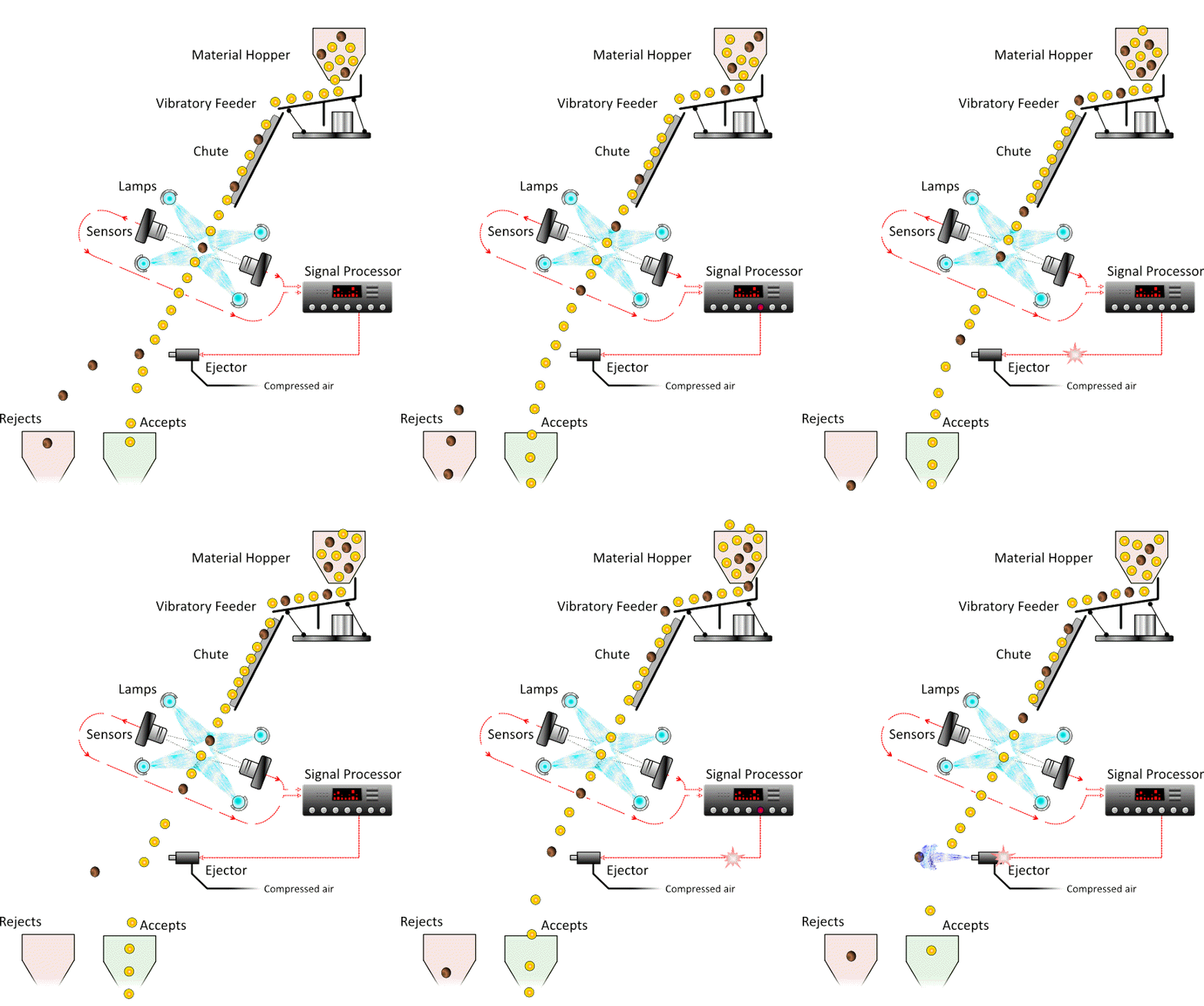
| Stage | Operation | Key Technology / Parameters |
|---|---|---|
| 1. Feeding | Vibration feeder spreads materials into single layer | Speed adjustable · Uniform distribution · No overlapping |
| 2. Detection | Multi-spectral optical scanning identifies contaminants | CCD cameras · NIR sensors · Resolution ≥ 4096 px |
| 3. Analysis | AI compares signals against contaminant models | Deep Learning · Spectral analysis · Color + shape recognition |
| 4. Ejection | Pneumatic valves remove contaminated particles | Response time ≤ 20ms · Ejection accuracy ≥ 99.8% |
| 5. Collection | Clean product and contaminants collected separately | Multi-channel output · Contaminant reporting |
Core Features and Advantages of Foreign Matter Sorting Machines
🛡️ Broad Contaminant Detection
Identifies stones, glass, metal, plastic, wood, and foreign materials.
🔬 Multi-Spectral Optical Technology
Combines visible light and NIR detection for comprehensive contaminant identification.
⚡ High-Speed Processing
Processes up to 15,000 particles per minute with real-time rejection.
🧠 AI-Powered Precision
Deep learning algorithms continuously improve contaminant recognition.
Modern foreign matter sorting systems offer remarkable processing capacities ranging from 2 to 15 tons per hour while maintaining sorting accuracy above 99.8%. Their key advantage lies in the ability to customize sorting criteria for specific contaminant types and product materials, allowing processors to meet stringent food safety standards and regulatory requirements without the complexity and cost of X-ray systems. The machines can distinguish foreign objects as small as 0.1mm and remove contaminants based on color, shape, texture, and chemical composition using purely optical methods.
Energy efficiency represents another significant benefit, with many models designed to minimize compressed air consumption through intelligent nozzle control systems. The latest generation incorporates self-learning algorithms that improve sorting performance over time by analyzing patterns in rejected materials. This continuous optimization reduces false rejection rates of good product while increasing contaminant removal effectiveness and overall operational efficiency. The absence of X-ray technology means lower operating costs, simplified regulatory compliance, and no radiation safety concerns.
Technical Specifications of Foreign Matter Sorting Machines
Standard industrial foreign matter sorters typically feature processing capacities between 2,000-15,000 kg/h depending on product density and model configuration. They operate at sorting accuracies exceeding 99.8% for foreign contaminant detection when properly calibrated. Most systems require 380V three-phase power with typical power consumption ranging from 2.5-6kW, while compressed air requirements average 0.6-0.8MPa at 2-4m³/min flow rate. The purely optical design eliminates the need for radiation shielding and special licensing.
Advanced models offer resolutions up to 0.05mm/pixel with camera systems capturing images at speeds exceeding 5,000 frames per second. The latest multi-spectral imaging technology combines visible light and NIR detection to identify foreign materials based on their unique spectral signatures without X-ray exposure. Many machines now incorporate IoT capabilities for remote monitoring, contaminant tracking, and predictive maintenance features. The optical-only approach makes these systems more affordable and easier to install compared to X-ray alternatives.
Applications of Foreign Matter Sorting Machines
Foreign matter sorting technology serves critical functions across multiple industries using purely optical methods. In food processing, it ensures product safety by removing stones, glass fragments, and metal pieces from nuts, grains, fruits, and vegetables. For agricultural products, it separates foreign plant materials, soil contaminants, and discolored particles. The recycling industry utilizes these machines to recover valuable materials from waste streams by sorting based on color and material composition using optical recognition.
The pharmaceutical industry benefits from advanced optical sorting capabilities that identify foreign particles in raw materials and finished products without radiation. Plastics manufacturing relies on these systems to remove contaminants during recycling processes based on color and polymer type detection. Certified organic operations depend on these machines to ensure contaminant-free products without chemical treatments, with no X-ray concerns for organic certification.
| Industry / Sector | Typical Products | Contaminants Detected |
|---|---|---|
| Food Processing | Nuts, grains, dried fruits, vegetables, coffee beans | Stones, glass, metal fragments, plastic, wood chips |
| Agriculture | Seeds, rice, wheat, corn, barley, soybeans | Foreign seeds, soil clods, plant debris, discolored grains |
| Pharmaceuticals | Raw materials, tablets, capsules, powders | Foreign particles, packaging fragments, color variations |
| Plastics Recycling | PET, HDPE, PP flakes and pellets | Different polymer types, color contaminants, labels |
| Mining & Minerals | Ore, aggregates, industrial minerals | Waste rock, foreign minerals, clay lumps |
| Beverage Manufacturing | Malt, hops, barley, fruit concentrates | Foreign bodies, discolored materials, stones |
Purchasing Guide
When selecting a foreign matter sorting machine, key considerations include required throughput capacity, the types of contaminants to be removed, and available facility space. Higher capacity models generally require more power and compressed air resources. For operations handling multiple product types, modular systems that allow quick changeovers provide significant advantages. It's advisable to request demonstration trials with actual product samples containing known contaminants to verify detection capabilities.
Future expansion capabilities represent another important factor, with some systems designed for easy upgrades as contaminant detection requirements evolve. Service availability and technical support should be evaluated, particularly for operations in remote locations. Many manufacturers offer leasing options or productivity-based pricing models that can make advanced sorting technology accessible to smaller operations. Consider systems with integrated contaminant tracking and reporting for regulatory compliance. The optical-only design offers simplified installation, lower operating costs, and eliminates radiation safety training requirements.
Maintenance Guide
Proper maintenance begins with daily inspection of optical surfaces and cleaning of camera lenses using approved methods and lens-safe cleaning solutions. Light sources require regular monitoring as brightness degradation can affect detection accuracy. Air filters require regular replacement according to operating environment conditions, typically every 1-3 months. Nozzle performance should be verified weekly using test patterns, with individual nozzles cleaned or replaced as needed to maintain ejection accuracy.
Annual professional calibration using certified reference materials ensures optimal sorting performance as optical sensor characteristics may drift over time. Software updates should be installed as they become available to access improved contaminant detection algorithms and new foreign matter identification capabilities. Many modern systems include self-diagnostic features that alert operators to potential issues before they impact sorting quality. Maintain detailed maintenance logs for compliance and performance tracking. The absence of X-ray components simplifies maintenance requirements and reduces service costs.