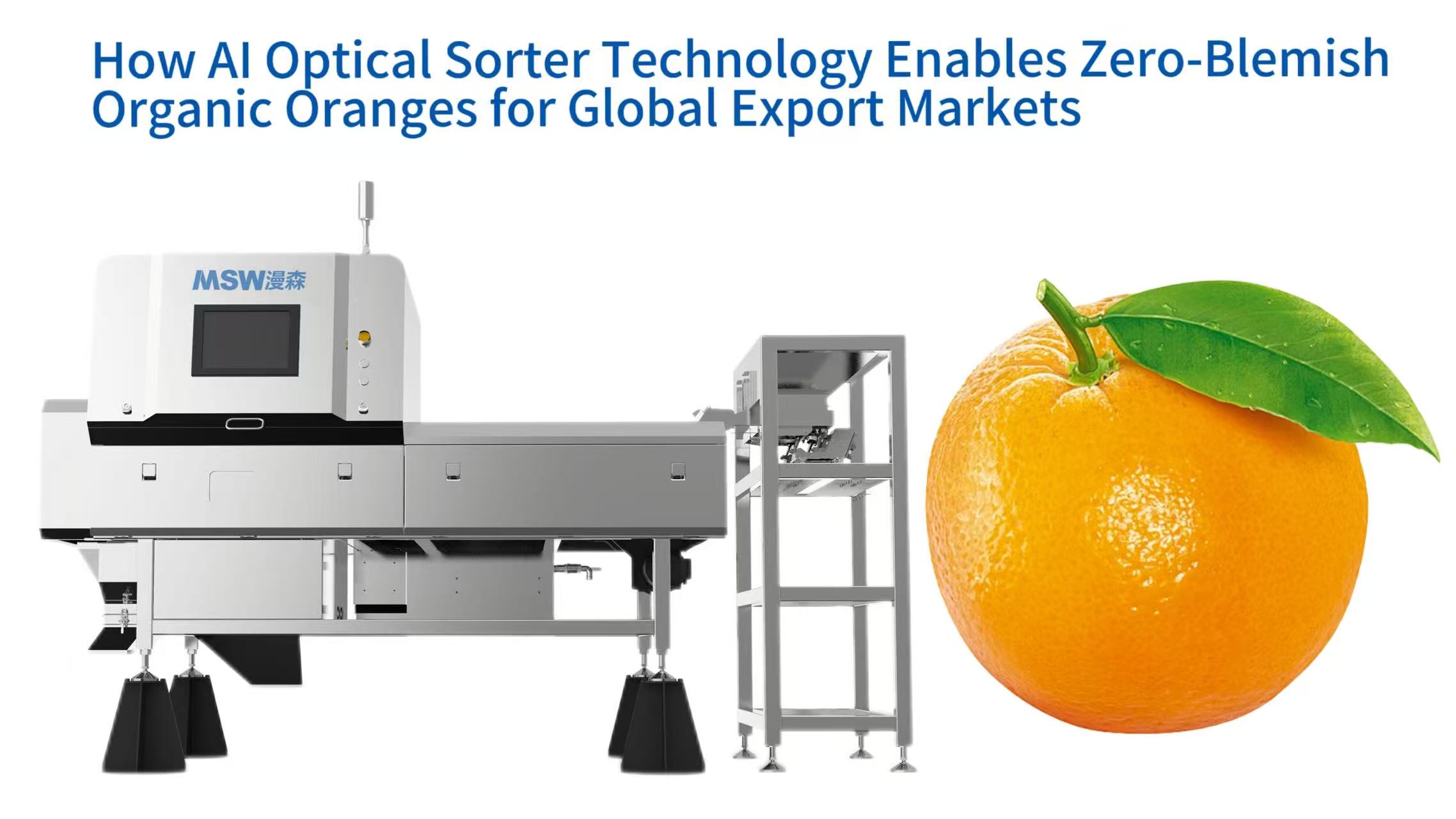
This comprehensive guide explores how advanced AI sorter technology transforms organic orange export operations by achieving perfect surface quality standards required by international buyers. Readers will discover the underlying machine vision principles, sensor fusion techniques, and deep learning algorithms that detect microscopic blemishes invisible to human inspectors. The article covers how modern AI sorter systems integrate with packing lines, the economic benefits of automated defect removal, maintenance practices for consistent performance, and real-world application scenarios where zero-defect sorting has opened premium market access. By understanding these technologies, organic citrus producers can meet the most stringent zero-blemish requirements while maintaining processing speeds of several tons per hour.
Why Organic Orange Exporters Face Unique Surface Quality Challenges
Organic vs Conventional Orange Quality Risk Comparison
Organic orange production presents distinct quality control difficulties compared to conventional citrus farming because producers cannot use synthetic fungicides or wax coatings that normally mask minor skin imperfections. Organic certification standards prohibit many post-harvest treatments that conventional exporters rely upon to create visually perfect fruit, meaning any natural scarring, insect marking, or weather-related blemishes remain fully visible at the packing stage. Furthermore, organic oranges often develop more pronounced color variations due to natural pest management practices and the absence of uniform ripening agents, making consistent grading substantially more complex than conventional fruit sorting operations.
International produce buyers, particularly those supplying premium supermarket chains and organic specialty retailers, impose extremely strict cosmetic standards that often reject entire pallets containing more than one to two percent blemished fruit. These rejection rates create devastating financial consequences for exporters who have already invested in harvesting, cold storage, and transoceanic shipping costs that can exceed several thousand dollars per container. Traditional manual sorting lines struggle to achieve these demanding quality thresholds because human inspectors experience visual fatigue, inconsistent judgment between different workers, and cannot inspect the entire fruit surface simultaneously without rotating each orange individually at speeds impractical for commercial operations.
Understanding How AI Sorter Vision Systems Detect Microscopic Blemishes
Micro‑Blemish Detection Workflow of Chute‑Type AI Sorter
(RGB + NIR)
(≤3 m/s)
Modern chute type AI sorting machine systems employ multispectral imaging arrays that capture fruit surface data across multiple light wavelengths simultaneously, including visible red-green-blue spectra alongside near-infrared channels that reveal subsurface tissue damage invisible to conventional cameras. These advanced sensors generate up to several hundred megabytes of image data per second, with each orange being photographed from multiple angles as it travels through the inspection zone at speeds reaching three meters per second. The system's proprietary illumination chambers use specifically calibrated LED arrays that eliminate shadows and specular reflections that would otherwise obscure tiny surface defects such as scale insect scars or wind rub marks measuring less than one millimeter in diameter.
The machine's deep learning algorithms have been trained on databases containing millions of annotated orange images, allowing the neural network to distinguish between harmless natural markings and genuine quality defects that would trigger export rejection. For organic oranges specifically, the AI models learn to accept certain permissible characteristics like minor sooty mold residue that washes off easily while rejecting penetrating defects such as split navels, deep scratches from branch rub, or early-stage fungal lesions that would develop into rotten spots during shipping. This sophisticated discrimination capability reduces false rejection rates significantly compared to conventional color sorters that cannot differentiate between acceptable natural variations and genuine defects requiring removal.
Sensor Fusion Technology for Complete 360-Degree Surface Inspection
Camera Quantity Distribution for 360° Inspection
Object
Comprehensive blemish detection requires inspecting every square millimeter of each orange's surface, a challenge that optical sorter manufacturers have solved through multiple camera arrangements that capture images from overlapping viewpoints. Typical industrial configurations position between four and eight high-speed CCD cameras around the inspection zone, with some systems adding additional sensors above and below the fruit stream to eliminate blind spots near the stem and calyx ends. These cameras synchronize their image capture at intervals measured in microseconds, ensuring that even as oranges tumble randomly during free fall or belt transport, every surface region appears in at least two camera views for redundant defect verification.
The processing unit then reconstructs a three-dimensional surface map of each fruit, applying sophisticated image stitching algorithms that compensate for variable orientation and rotation speeds. This complete surface coverage proves particularly critical for organic oranges because blemishes frequently cluster on specific fruit regions, such as the sun-exposed side where UV damage occurs or the bottom contact area where moisture accumulates during humid growing conditions. Without true 360-degree inspection, conventional sorting systems would miss defects located in these characteristic zones, allowing unacceptable fruit to reach export packing where inspectors would inevitably discover the flaws during final quality checks.
Deep Learning Algorithms That Continuously Improve Detection Accuracy
AI Sorting Accuracy Improvement Over Operation Weeks
The artificial intelligence powering modern belt type AI sorting machine systems differs fundamentally from traditional rule-based sorting because the neural networks actively learn from each sorting decision to refine their defect recognition capabilities. When operators confirm or correct sorting outcomes during quality audits, the machine updates its internal feature weights, gradually developing specialized expertise for specific organic orange varieties, growing region characteristics, and seasonal variation patterns. This continuous learning mechanism means that a sorting line processing organic Valencia oranges in summer will develop different detection priorities than a line handling organic Navel oranges during winter harvest, optimizing performance for each unique product stream.
Field data from high-volume packing facilities demonstrates that AI-based sorting accuracy for minor surface defects improves measurably during the first several weeks of operation, with false positive rates declining by a substantial margin as the system adapts to that facility's specific fruit characteristics. Unlike conventional sorters that require manual threshold adjustments whenever fruit quality changes, AI-driven systems automatically recalibrate their detection parameters based on real-time statistical analysis of incoming fruit quality distributions. This adaptive capability proves especially valuable for organic orange exporters who source from multiple small growers, each producing fruit with distinctive blemish patterns determined by their unique orchard microclimates and pest management practices.
High-Speed Ejection Precision for Loss-Free Defect Removal
Good Fruit Carryover Ratio Comparison
| Sorting System | Good Fruit Rejected | Defects Removed |
|---|---|---|
| Premium AI Sorter | ≤1 | Several Hundred |
| Conventional Color Sorter | 10–20 | Several Hundred |
| Manual Sorting | 30+ | Several Hundred |
Once the AI vision system identifies a blemished organic orange, the high-speed ejection mechanism must remove that specific fruit from the product stream without touching adjacent acceptable oranges or causing damage through excessive impact forces. Modern systems achieve this through arrays of miniature solenoid valves connected to precision-machined air nozzles spaced at intervals matching typical fruit diameters, with each nozzle capable of firing individually within a few milliseconds of the detection decision. The ejection timing calculations account for the precise distance between the camera inspection plane and the ejection point, the instantaneous velocity of each fruit, and aerodynamic drag variations based on fruit size and surface texture characteristics.
The economic importance of ejection accuracy cannot be overstated for organic orange exporters, since removing acceptable fruit along with defects reduces yield and directly impacts profitability on high-value organic produce. Premium AI sorting systems achieve what the industry terms a low "good fruit carryover" ratio, meaning less than one acceptable orange is rejected for every several hundred defective fruits removed. Some advanced implementations incorporate secondary inspection zones that re-evaluate rejected fruit before final ejection, allowing borderline cases to be recovered if the first assessment was overly conservative, further improving net yield while maintaining strict zero-blemish standards for export shipments.
Integrating NIR Spectroscopy for Internal Quality Correlation
NIR Multi‑Parameter Internal Quality Inspection Flow
(Sweetness)
(Flavor)
Surface blemish detection represents only one dimension of organic orange quality sorting, because NIR sorter technology simultaneously evaluates internal quality parameters that correlate with export market acceptance. Near-infrared spectroscopy measures how each orange absorbs and reflects light at wavelengths beyond human vision, allowing the system to calculate soluble solids content which indicates sweetness, titratable acidity affecting flavor balance, and internal flesh color development that signals proper ripening. These internal measurements prove particularly valuable for organic oranges because without synthetic ripening agents, natural maturity variation between individual fruits can be substantial even when surface color appears uniform.
The integration of surface and internal inspection creates comprehensive quality grading that meets the expectations of sophisticated export buyers who demand both cosmetic perfection and excellent eating quality. Organic oranges that pass surface inspection but show inadequate sugar content can be redirected to processed product channels such as juicing or dried fruit manufacturing, while those meeting both external and internal criteria command premium pricing for fresh export markets. This multi-parameter sorting capability would be impossible to achieve through manual inspection alone, since human workers cannot assess internal quality without destructive sampling that destroys the fruit being evaluated.
Processing Capacity and Line Integration for Export Operations
AI Sorter Throughput for Organic Orange Export Plants
Commercial organic orange export facilities require sorting throughput that matches their packing line capacities, typically ranging from several metric tons per hour for medium-scale operations up to much higher volumes for major export packing houses. Modern AI sorting systems achieve these throughputs through parallel processing architectures where multiple chutes or wide belt conveyors operate simultaneously, each with its own camera array and ejection system but controlled by centralized computer hardware. The modular nature of these designs allows exporters to start with smaller configurations and expand by adding additional sorting lanes as their organic certified production volume increases over multiple growing seasons.
Successful line integration requires careful attention to upstream material handling systems that present oranges to the sorter in properly singulated flow without overlapping or touching each other. Smart material feeding systems using vibratory tray technology with adjustable amplitude and frequency settings ensure consistent fruit spacing even when processing variable sizes common in organic production. Downstream integration includes automated rejection collection systems that separate defective fruit into categorized bins, allowing quality control personnel to periodically audit rejected batches for verification that acceptably low numbers of good fruit are being removed during the sorting process.
Real-Time Data Analytics for Export Documentation
Data Analytics Loop for Export Quality Management
Premium AI sorting systems generate comprehensive statistical reports that document the quality characteristics of every batch processed, creating valuable data for export documentation and quality certification purposes. These reports include detailed breakdowns of defect types detected and removed, size distribution analysis, color grade statistics, and for NIR-equipped systems, average sugar content and maturity profiles for each production lot. Exporters can provide this data to buyers as objective evidence of quality assurance practices, building trust and potentially reducing the need for costly third-party inspections at destination ports.
The same data analytics capabilities enable process optimization by identifying correlations between incoming fruit quality and specific orchard sources, harvest dates, or storage conditions. When the AI sorter consistently detects elevated levels of particular blemish types from certain supplier orchards, exporters can provide targeted feedback to those growers about specific cultural practice adjustments that would reduce defect incidence in future seasons. This data-driven continuous improvement cycle represents a significant competitive advantage for organic orange exporters who leverage their sorting technology as a quality management tool rather than simply a defect removal device.
Economic Benefits of Automated Zero-Blemish Sorting
Key Economic Benefits of AI Sorting
≤1 Season
The financial justification for AI sorting technology in organic orange export operations extends beyond simple labor replacement calculations to include substantial revenue enhancements from accessing premium market segments. Conventional sorting methods typically achieve defect removal rates that leave some blemished fruit in export shipments, resulting in destination market rejections that can cost tens of thousands of dollars per incident including shipping, customs brokerage, disposal fees, and damaged commercial relationships. AI-based systems with documented defect detection accuracy provide exporters with confidence to accept higher-value contracts that include strict quality penalties, knowing their sorting process can reliably meet the requirements.
Additional economic benefits derive from reduced product give-away, where excessive safety margins in conventional sorting cause acceptable fruit to be rejected unnecessarily. For high-value organic oranges where per-ton prices substantially exceed conventional fruit prices, even small improvements in good fruit recovery can generate significant annual savings that quickly recover the capital investment in AI sorting equipment. Many organic citrus exporters report that AI sorter systems achieve full payback within a single harvest season through these combined benefits of reduced rejections, improved premium market access, and increased recovered yield from each ton of harvested fruit.
Maintenance Practices for Consistent Sorting Performance
Standard Maintenance Schedule for AI Optical Sorters
| Cycle | Key Maintenance Items |
|---|---|
| Daily | Clean cameras / LED panels; check air nozzles |
| Weekly | Belt alignment; air filter check; auto‑calibration |
| Semi‑Annual | Wear‑part inspection; seal/bearing replacement; firmware update |
Maintaining precision acceleration systems and optical components requires structured daily, weekly, and periodic procedures that preserve sorting accuracy throughout extended production runs. Daily maintenance should include cleaning all camera windows and illumination panels using approved non-abrasive cleaners that remove organic orange residues without scratching optical surfaces. The high-speed air ejection nozzles require particular attention because sticky juice residues from damaged fruit can accumulate and restrict airflow, causing ejection failures that allow defective oranges to pass through to export packing.
Weekly maintenance intervals should include verification of belt tracking alignment on belt-type machines, inspection of all compressed air filters and regulators, and execution of automated calibration routines that check camera color balance and ejection timing accuracy. More comprehensive semi-annual maintenance should involve professional inspection of internal wear components, replacement of any degraded seals or bearings, and software updates that incorporate the latest algorithm improvements from the manufacturer. Facilities operating multiple sorting lines often implement staggered maintenance schedules that keep at least some capacity available while other machines undergo service, preventing complete production stoppages during peak harvest periods.
Operators should maintain detailed maintenance logs that document all service activities, parts replacements, and observed performance changes, creating valuable historical records for predictive maintenance planning. When sorting accuracy metrics begin trending downward over successive production days, this early warning allows maintenance teams to identify and correct developing issues before they cause export shipment quality failures. Training programs for maintenance personnel should include specific instruction on optical alignment procedures unique to AI sorting systems, since traditional color sorter experience does not fully transfer to the more sophisticated sensor fusion architectures used in deep learning based equipment.
Organizations serious about maintaining zero-blemish export standards typically establish formal quality assurance protocols that include regular validation testing where known defective oranges are introduced into the production stream to verify ejection rates. These challenge tests should be performed at the beginning of each production shift and following any maintenance activity that could affect sorting accuracy. Documentation of successful challenge test results provides valuable evidence for export certification audits and customer quality assurance requirements, demonstrating that sorting systems consistently perform to their specified defect detection capabilities.
Finally, environmental factors significantly impact AI sorter maintenance requirements, with facilities located in high-humidity or dusty regions needing more frequent cleaning intervals for optical surfaces and compressed air systems. Condensation on camera windows can occur when warm humid air contacts cooled optical assemblies, requiring climate-controlled inspection enclosures or anti-fogging treatments on lens surfaces. Dust from dried orange peel and pollen accumulation during spring harvests may necessitate daily filter cleaning and more frequent calibration verification compared to winter harvest periods with lower airborne particulate loads.
Application Success Stories Across Diverse Export Scenarios
Destination Rejection Rate Drop After AI Sorter Deployment
Exporters shipping organic oranges to markets with the most stringent cosmetic standards have achieved remarkable quality improvements after implementing AI sorting technology. One large-scale operation processing multiple organic citrus varieties reported that destination market rejection rates for surface blemish issues dropped from approximately several percent of containers to consistently below one percent after installation. This improvement allowed the company to secure long-term supply contracts with premium retailers that previously considered their quality performance too inconsistent, increasing average selling prices significantly for the majority of their organic export volume.
Smaller organic orange producers serving specialized export niches have also benefited from AI sorting technology scaled appropriately for their processing volumes. A family-owned operation growing heirloom organic orange varieties for Asian luxury fruit gift markets implemented a compact x-ray sorter configuration capable of handling several tons per hour while achieving the meticulous blemish detection required for single-fruit gift packaging where each orange must be cosmetically perfect. The ability to document zero-defect sorting performance through the machine's data reporting capabilities helped this small exporter gain access to distribution channels previously reserved for much larger competitors, demonstrating that AI sorting technology democratizes quality capability across operation scales.