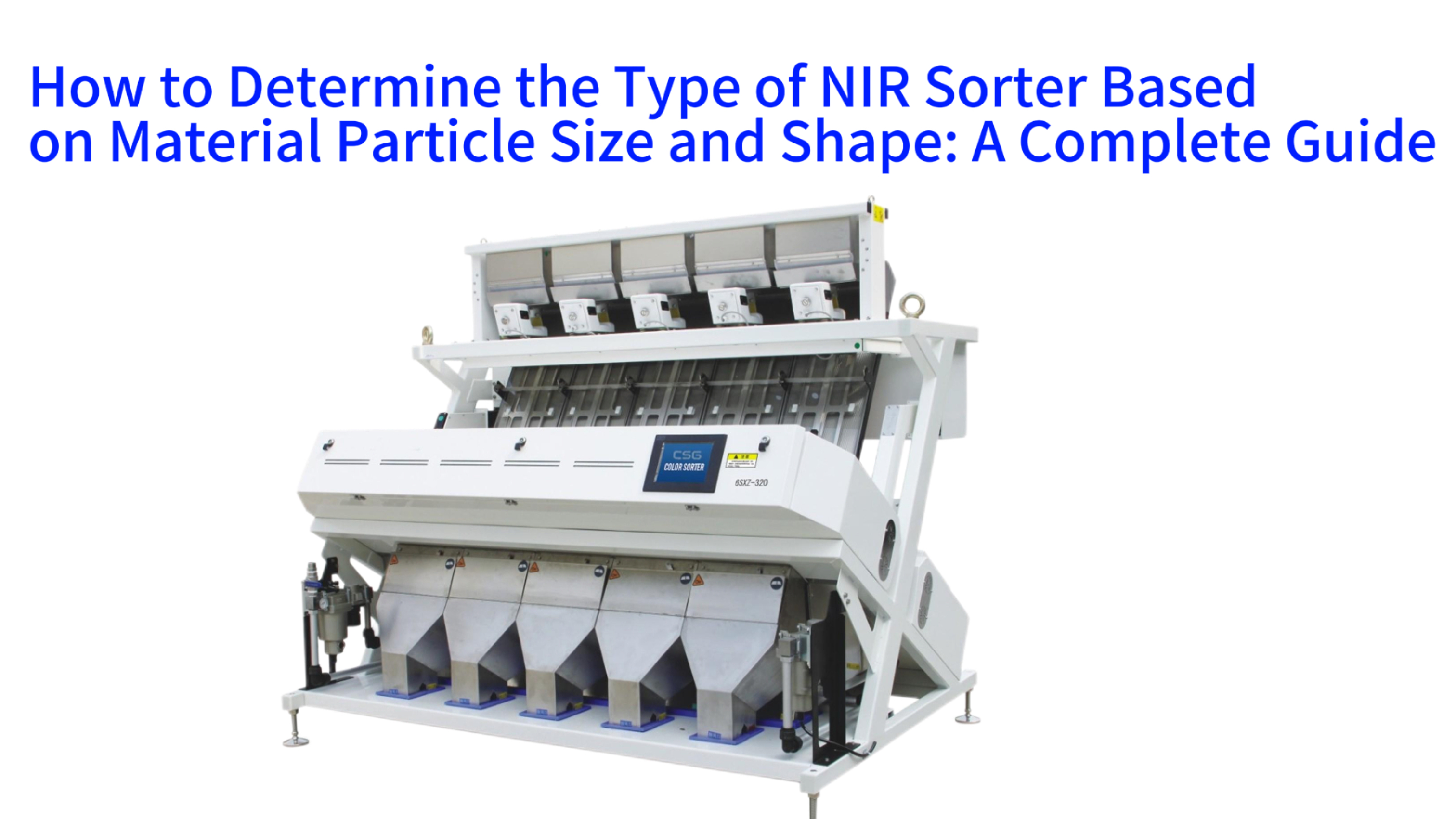
Choosing the right Near-Infrared (NIR) sorting machine is crucial for achieving high purity and efficiency in recycling and material recovery operations. A common point of confusion lies in selecting between the two primary designs: Chute Type and Belt Type NIR sorters. This decision is not arbitrary but is fundamentally guided by the physical characteristics of the material you need to process, specifically its particle size and three-dimensional shape. This guide will demystify the selection process, explaining the core technology, detailing how different material properties dictate machine choice, comparing the two main sorter types, and exploring how advanced features like artificial intelligence can further optimize performance. Understanding this relationship between your feedstock and the machine's design is the first step toward a successful and cost-effective sorting solution, drawing on principles refined over many years in the industry.
Understanding NIR Sorting Technology and Material Interaction
NIR Sorting Core Technology Workflow
Material Feeding
Particles enter detection zone
NIR Light Projection
Light onto individual particles
Spectral Capture
Unique material "fingerprint"
Data Analysis
Compare to material library
Ejection Decision
Trigger air valve timing
Material Separation
Target/Contaminant separation
Near-Infrared (NIR) sorting is a non-contact technology that identifies materials based on their molecular composition. It works by projecting near-infrared light onto individual particles as they pass through a detection zone. Each unique material, such as PET, HDPE, or PP plastic, absorbs and reflects this light in a distinct spectral pattern, like a fingerprint. Sophisticated sensors capture this reflected light, and a computer system instantly compares the signature to a library of known materials. This allows the machine to identify and make a decision on each particle, regardless of its visible color. The effectiveness of this scan, however, is highly dependent on how the material is presented to the sensor, which is where particle size and shape become critical factors. A consistent and stable presentation ensures the sensor gets a clear, unobstructed view for accurate identification, which is the cornerstone of all effective sensor-based sorting systems.
The interaction between the material and the light source is a precise science. For the NIR spectrometer to obtain a reliable reading, the particle must be in the optimal focal plane and correctly oriented for a sufficient duration. Irregular shapes or widely varying sizes can cause particles to tumble, overlap, or present an uneven surface to the sensor, leading to misreads or missed detections. Therefore, the mechanical system that feeds and transports the material through this detection zone—whether a free-fall chute or a moving belt—is engineered to create the ideal presentation conditions for specific material types. This foundational understanding of material-sensor interaction informs the entire design philosophy behind the two main machine configurations, ensuring that the advanced advanced detection capabilities are not compromised by poor material handling.
The Critical Role of Particle Size in Sorter Selection
Particle size is perhaps the most straightforward factor in determining sorter type. It directly influences the method of material transport and the required precision of the ejection system. Chute Type NIR sorters are exceptionally well-suited for materials within a specific, relatively small size range, typically from about 2mm to 60mm. In this design, material flows down a steep, multi-channel chute in a monolayer, creating a consistent curtain of free-falling particles. This method provides a very stable and predictable trajectory, allowing high-resolution line-scan cameras and sensors to capture a clean image and spectral data of each item. The machine can then track each particle accurately and trigger the appropriate high-speed air valve for ejection at the exact right moment, a process reliant on high-speed ejection technology.
Conversely, Belt Type NIR sorters are designed to handle a much broader and often larger range of particle sizes, from fine flakes of 10mm up to large pieces measuring 300mm or more. The flat, moving belt stabilizes items that would be impossible to control in free-fall. Larger plastic fragments, whole plastic bottles, or irregularly shaped electronic waste components can be conveyed smoothly under the sensor array. The belt’s speed and the field of view of the sensors are calibrated to ensure each item, regardless of its size relative to its neighbors, is scanned thoroughly. For processing mixed plastic streams that include anything from small flakes to large rigid parts, the belt type’s flexibility with size variance is often the only viable choice, especially when integrated with effective smart material feeding systems upstream.
How Material Shape Dictates the Conveyance Method
Beyond size, the two-dimensional and three-dimensional shape of material dictates whether it will flow or rest predictably. Chute Type sorters excel with granular, pelletized, or small flake materials that have relatively uniform shapes and good flow characteristics. These materials behave like a fluid, ensuring an even distribution across the chute's channels and a consistent drop speed. This predictability is key to achieving sorting accuracies that can exceed 99.9% for applications like purifying plastic flakes or sorting grains and seeds. The design assumes a largely two-dimensional presentation where the primary surface is visible to the sensor during the fall.
Belt Type sorters are the definitive solution for materials with complex, three-dimensional, or irregular shapes. Items like crushed automotive parts, tangled wires, whole containers, or bulky plastic pieces cannot form a consistent curtain in a chute. They may catch, bridge, or tumble uncontrollably. A belt provides a stable, supportive platform that carries these challenging shapes through the detection zone. The sensor system, often mounted above, can be complemented with additional sensors on the side to build a more complete profile of a non-uniform item. This capability is essential in fields like e-waste sorting or recycling of mixed rigid plastics, where shape is highly inconsistent.
The Importance of Material Throughput and Layer Profile
Throughput, or the volume of material processed per hour, is linked to particle size and shape. Chute Type systems achieve high throughput for small, uniform materials by spreading them into a wide, thin, single-layer curtain. This maximizes the use of the detection area without sacrificing scan quality, as no particle hides behind another. For example, a system can process several tons per hour of plastic flakes by distributing them across dozens of channels. The capacity is achieved through width and speed, not by piling material deep.
Belt Type sorters manage throughput differently. While they can also spread material in a monolayer for optimal scanning, they have a greater tolerance for occasional slight overlapping or for processing a mix that includes both small and large items on the same belt. Their throughput is often determined by belt width and speed. A wider belt, such as a 1800mm belt width NIR sorting machine, can accommodate a broader stream of material, increasing total capacity when handling larger items. The choice between maximizing single-layer precision on a chute versus the flexible capacity of a belt is a direct consequence of the feedstock's physical properties.
Surface Presentation and Scan Quality for Accurate Identification
The ultimate goal of any NIR sorter is to collect a high-quality spectral signature from each particle. For small flakes and granules in a chute system, the free-fall often presents a consistent face to the sensor, and the short, controlled fall distance minimizes vibration or rotation that could blur the scan. This results in exceptionally clear data for the computer to analyze, allowing it to make very precise distinctions between similarly colored plastics, such as natural HDPE and PP.
On a belt, the presentation is different. While stable, the item may rest in any orientation. Advanced NIR systems for belt applications use powerful lighting and high-sensitivity spectrometers to ensure a good signal regardless of orientation. For some complex materials, a single top-down scan may not be enough. This is where the robustness of the belt system allows for integration of multiple sensor angles or even hybrid technologies to guarantee that every piece, regardless of how it lays, is correctly identified, ensuring the final sorted product meets stringent purity standards for applications like PET sorting.
Deep Dive into Chute Type NIR Sorting Machines
Chute Type NIR Sorter Key Specifications
| Parameter | Value | Notes |
|---|---|---|
| Size Range | 2mm – 60mm | Optimal for uniform small particles |
| Accuracy | Up to 99.9% | For plastic flakes/grains |
| Ideal Materials | Flakes/Pellets/Grains | Dry, free-flowing only |
| Throughput | Multiple tons/hour | Via multi-channel monolayer flow |
Size Range Comparison (Chute Type)
2mm (Min)
60mm (Max)
Optimal Size Range
Chute Type NIR Sorting Machines are precision instruments designed for high-volume sorting of free-flowing, granular materials. Their operation is based on gravity: pre-screened material is fed into the top of the machine and distributed across multiple narrow channels, forming several thin curtains of free-falling particles. As the material drops past the scanning zone, it is illuminated by a stable NIR light source and monitored by high-speed sensors. The computer processes the spectral data in real-time, and if a contaminant or unwanted material is detected, a precisely timed burst of compressed air from an ejector valve deflects it out of the product stream. This method is renowned for its incredible accuracy and speed, making it the industry standard for refining materials where purity is paramount.
The architecture of a chute sorter is optimized for consistency and repetition. The multi-chute design ensures an even distribution of the material load, preventing sensor overload and maintaining a high-resolution scan of every single particle. This is why they are predominantly used in the final "precision" stage of a recycling line, where the goal is to take a 95% pure stream of, say, plastic flakes and elevate it to a 99.9% food-grade or fiber-grade product. The effectiveness of this stage often depends on the performance of upstream chute type color sorting machine or other pre-sorting stages. Companies with extensive operational experience, such as MSW Technology with its 15 years in the field, have refined these systems to handle specific materials like plastic pellets or flakes with exceptional efficiency, directly impacting the profitability of recycling operations.
Ideal Materials for Chute Type Systems
Chute Type NIR sorters are the unmatched choice for a specific class of materials. This includes plastic flakes and pellets after a grinding and washing process, where the particle size is typically between 4mm and 20mm. They are also extensively used in the food industry for sorting grains, nuts, beans, and seeds, where the natural product is largely uniform in size and shape. The free-fall design is perfect for these dry, granular substances that flow easily and do not clump. In plastic recycling, achieving a monolayer of flakes is critical for removing the last remnants of different polymer types or for separating colored flakes from natural ones to create a clear recycled resin.
The success with these materials hinges on excellent pre-processing. For instance, in a plastic recycling plant, film plastics or rigid containers must first be shredded and washed into clean, dry flakes of a somewhat uniform size before they are suitable for a chute sorter. This machine acts as the quality gatekeeper. Its ability to process several tons per hour of such material with minimal operational oversight makes it a cornerstone of modern recycling facilities focused on high-value output, such as producing feedstock for plastic flake sorting destined for bottle-to-bottle recycling.
Limitations and Considerations for Chute Designs
While highly effective for their intended purpose, Chute Type sorters have clear limitations dictated by physics. They perform poorly with materials that are sticky, moist, or have a tendency to clump, as these will not flow evenly down the chutes and will cause blockages. Very light or fibrous materials, like some film plastics or shredded foams, may flutter or drift in the air during free-fall, making their trajectory unpredictable and scanning unreliable. Furthermore, materials with a wide mix of particle sizes will naturally segregate, with larger pieces moving faster down the chute than smaller ones, complicating the timing for the ejection system.
Another key consideration is the need for stringent pre-screening. Feeding a chute sorter with material containing oversized items or long, stringy contaminants can lead to jams and significant downtime. Therefore, an effective screening or air classification system must be in place upstream. Understanding these limitations is not a drawback of the technology but a guideline for proper application. Selecting a machine that aligns with your material's true characteristics is a principle that MSW Technology emphasizes, ensuring clients invest in a system that will deliver reliable, long-term performance rather than facing constant operational challenges.
Deep Dive into Belt Type NIR Sorting Machines
Belt Type NIR Sorter Key Specifications
| Parameter | Value | Notes |
|---|---|---|
| Size Range | 10mm – 300mm+ | Handles large/irregular particles |
| Belt Width Range | 600mm – 3000mm | Scalable for throughput |
| Ideal Materials | 3D/Irregular/Bulky | E-waste/Rigid plastics/Containers |
| Flexibility | High | Tolerates mixed size/moisture |
Material Size Range
10mm (Min)
300mm+ (Max)
Belt Width Scalability
600mm (Min)
3000mm (Max)
Belt Type NIR Sorting Machines are the versatile workhorses of the sorting world, designed to handle materials that defy the constraints of free-fall systems. In this design, material is fed onto a high-speed, flat conveyor belt that carries it in a steady stream beneath or past an overhead NIR sensor array. As the material passes under the scanner, its molecular signature is captured. A sophisticated processing unit analyzes this data and, upon identifying a target material, sends a signal to a bank of precisely aligned air jets that fire to eject the selected item off the belt and into a separate collection chute. This method provides controlled, stable transport, making it indispensable for complex, non-free-flowing, or valuable feedstocks.
The belt system's core strength is its forgiveness and adaptability. It can accommodate a much wider variety of physical forms without requiring perfect pre-processing. This is crucial in applications like municipal recycling facilities or electronic waste processing plants, where the incoming waste stream is highly heterogeneous. The belt can carry everything from a shredded plastic bottle to a circuit board or a piece of automotive plastic. This capability for handling diversity makes the Belt Type sorter a key component in the initial bulk sorting or recovery stages of a plant, often working in tandem with other technologies like an AI sorter to tackle complex streams. The engineering behind these robust systems is backed by deep industry experience, allowing companies like MSW Technology to configure them for challenging but high-reward applications in material recovery.
Ideal Materials for Belt Type Systems
Belt Type NIR sorters excel with materials that are three-dimensional, irregular, or simply too large for chutes. This includes whole or crushed plastic containers, rigid plastic parts from electronics or appliances, shredded automotive plastics, and bulkier pieces of electronic waste. They are also perfectly suited for sorting materials that come in a wide range of sizes within the same batch, such as the output from a coarse shredder. In mining, they are used to sort larger pieces of ore based on mineral content. Essentially, if the material can be placed on a conveyor belt without falling through or flying away, a belt sorter can likely be configured to sort it.
A prime example is in sorting mixed plastic packaging from household waste. This stream contains bottles, tubs, trays, and films of various shapes, sizes, and polymers. A Belt Type NIR sorter can effectively scan this diverse mix and accurately eject, for instance, all the HDPE items (like milk jugs and detergent bottles) into one bin and the PET items (like beverage bottles) into another. This mechanical stability is also critical for ensuring the sensor gets a viable scan of non-uniform items, which is the first step in achieving a clean sort for mixed plastic sorting operations aiming to increase recycling rates.
Flexibility and Scalability of Belt Sorters
The belt platform offers inherent flexibility. The width of the belt can be scaled significantly to match throughput requirements, from compact 600mm units for pilot plants or lower-volume specialties to massive 3000mm wide systems for high-capacity municipal facilities. The speed of the belt is also adjustable, allowing operators to fine-tune the balance between processing volume and sorting accuracy for a given material. Furthermore, the modular nature of belt systems allows for the integration of additional sensor types, such as visible light cameras for color sorting or even X-ray sensors for density-based sorting, creating a multi-technology, hybrid sorting station on a single frame.
This scalability and adaptability make Belt Type NIR sorters a future-proof investment. As waste streams evolve or a business expands into processing new materials, the same core machine can often be reconfigured or its software updated to meet the new challenge. This long-term operational perspective aligns with the approach of established providers. For instance, the engineering team at MSW Technology leverages 15 years of application data to help clients not only select the right belt width and speed but also plan for potential future upgrades, ensuring the sorting solution grows alongside the business.
The Role of AI in Adapting to Material Variations
Traditional vs AI-Enhanced NIR Sorting
Traditional NIR Sorter
Fixed material library (pre-programmed)
Static thresholds for spectral analysis
Basic chemical-only identification
Manual recalibration required
AI-Enhanced NIR Sorter
Dynamic learning material library
Adaptive thresholds (size/shape/chemistry)
Multi-modal analysis (chem + physical)
Continuous self-optimization
Artificial Intelligence represents a revolutionary leap in NIR sorting technology, directly addressing the challenges posed by material variations in size, shape, and even surface contamination. Traditional sorters rely on fixed, pre-programmed material libraries and thresholds. AI-enhanced sorters, such as an AI NIR sorting machine, employ machine learning algorithms that continuously analyze the incoming data stream. They learn the natural spectral variations within a "good" material and can more intelligently distinguish it from "bad" materials, even when the differences are subtle or when particles are poorly presented due to their shape. This results in higher accuracy and lower yield loss, especially with complex or inconsistent feedstocks.
The power of AI lies in its ability to adapt and improve over time without constant manual recalibration. For example, in plastic recycling, the color and additive content of post-consumer plastics can vary widely. An AI system can learn that a slightly off-spec blue HDPE flake is still HDPE, while a traditional system might reject it. This intelligence is invaluable when processing real-world waste streams that are never perfectly homogeneous. It effectively makes the sorter more robust against the natural imperfections in particle size distribution and shape that occur after shredding, turning a potential weakness into a managed variable. Implementing such smart technology is a testament to an industry moving from basic automation to cognitive processing, a trend supported by providers with long-term R&D commitments.
AI-Enhanced Feature Recognition Beyond Chemistry
While the core NIR sensor identifies material chemistry, AI can fuse this data with information from high-resolution optical cameras. This allows the system to make decisions based on a combination of chemical composition and physical attributes. For instance, it can be trained to eject only clear PET flakes that also have a specific size or shape, or to accept colored HDPE but reject colored PP, even if they look similar. This multi-modal analysis is particularly powerful for belt-type systems where items have distinct shapes. The AI can learn that a specific chemical signature combined with a long, thin shape corresponds to a wire contaminant in a plastic stream.
This capability significantly reduces false positives and negatives. A non-AI sorter might struggle with a black plastic piece, as carbon black absorbs much of the NIR signal. An AI system, trained on thousands of examples, can learn to use the subtle spectral nuances that remain, combined with shape data, to correctly identify black PET versus black HDPE with much greater reliability. This advancement directly increases the value of the output stream, enabling the recovery of materials that were previously considered too difficult or uneconomical to sort, thereby expanding the scope of profitable recycling operations.
Continuous Learning and Process Optimization
A key advantage of AI sorters is their capacity for continuous learning. As the machine operates, it gathers more data on the material stream. The AI algorithms can use this data to refine their models, automatically adjusting sensitivity and decision boundaries to optimize for purity, yield, or a custom balance of both. This means the sorter's performance can actually improve over the first weeks and months of operation as it becomes finely attuned to the specific nuances of a client's feedstock. It reduces the dependency on highly skilled technicians for constant fine-tuning.
This self-optimization leads to more stable and efficient operations. For plant managers, it translates to more consistent product quality and higher overall equipment effectiveness (OEE). The system can also generate valuable data reports on stream composition, purity rates, and ejection efficiency, providing insights that can be used to improve upstream processes. This data-driven approach to sorting represents the culmination of years of industry evolution, where experience in thousands of installations informs the development of smarter, more autonomous machines that deliver tangible economic benefits.
Making the Final Decision: A Practical Selection Framework
NIR Sorter Selection Decision Framework
Step 1
Characterize Feedstock
(Size/Shape/Moisture)
Step 2
Map to Machine Design
(Chute vs Belt)
Step 3
Material Testing
(Pilot-Scale Trials)
Step 4
Evaluate TCO/ROI
(Pre-processing + Operation)
Step 5
Future-Proof Investment
(Scalability/AI Upgrades)
Final Selection
Chute/Belt + AI (if needed)
Selecting between a Chute Type and Belt Type NIR sorter is a systematic decision that should be based on a clear analysis of your material and operational goals. Start by thoroughly characterizing your feedstock. Collect a representative sample and analyze its key physical properties: What is the size range (minimum, maximum, and average)? What are the dominant shapes (flakes, granules, whole items, irregular fragments)? What is the moisture content and flowability? This empirical data is the most critical input for the decision matrix. Beyond the machine itself, consider the entire system context, including the available space, required throughput (in tons per hour), and the desired final purity of the sorted product.
The next step is to map these characteristics to the machine designs. As a general rule, if your material is dry, free-flowing, and falls within a 2-60mm size range with relatively uniform shape, a Chute Type sorter will likely offer the best combination of high accuracy, high speed, and lower energy consumption per ton. If your material is larger, wet, sticky, irregularly shaped, or encompasses a very wide size distribution, a Belt Type sorter is the necessary choice to ensure reliable operation and effective scanning. Providers with extensive application history, such as MSW Technology, often offer material testing services, using pilot-scale versions of both chute type NIR sorting machine and belt type machines to generate definitive performance data with your actual material, removing all guesswork from the investment decision.
Evaluating Total Cost of Ownership and ROI
The purchase price is only one component of the total cost of ownership. For Chute Type sorters, often the higher-precision tool, the cost per ton processed for suitable materials can be very low due to their high speed and efficiency. However, they may require more investment in pre-processing (screening, drying) to ensure the feedstock is perfectly prepared. Belt Type sorters might have a different cost structure; they can handle less-prepared material, potentially saving on pre-processing costs, but their operational footprint and energy use for moving the belt might be different. The key is to calculate the return on investment based on the value added by the sort.
This value is measured by the increased purity and yield of your target material. A sorter that enables you to sell a 99.5% pure PET flake at a premium price, compared to a 90% pure batch, pays for itself quickly. The ability to reliably sort a previously unsortable mixed stream opens up new revenue streams. A detailed financial analysis, projecting increased revenue from higher-quality output and reduced costs from lower landfill fees or manual labor, will clearly show which machine type delivers the superior ROI for your specific business case. This practical, value-focused analysis is where engineering expertise meets business acumen, ensuring the technology delivers a clear competitive advantage.
Future-Proofing Your Investment with Scalable Design
Consider not just your current needs, but also where your business might be in 5 years. Will you be processing a higher volume? Might you diversify into new material types? Belt Type systems often offer easier scalability in throughput through wider belt options. Both chute and belt systems can be upgraded with AI software to handle more complex tasks. When discussing options with a supplier, inquire about upgrade paths and modularity. Can a basic NIR sorter be later upgraded with AI capabilities? Can additional sensor modules be added?
Choosing a technology partner with a long track record and a broad portfolio is advantageous for future-proofing. A partner like MSW Technology, with 15 years of navigating the evolving recycling landscape, can provide insights into industry trends and help you select a platform that can adapt. Whether it's starting with a core NIR sorter and later integrating it with an precision acceleration sorting machine for specific tasks, or planning for a multi-stage sorting line from the outset, a strategic view ensures your capital investment continues to deliver value as market demands and material streams change.
The MSW Technology Advantage: Expertise Applied to Your Challenge
MSW Technology - End-to-End Support Flow
1. Consultation
Understand material/capacity/purity goals
2. Material Testing
Pilot-scale trials for accuracy/yield data
3. Solution Design
Custom chute/belt + AI configuration
4. Installation & Training
On-site setup + operator/maintenance training
5. Ongoing Support
Maintenance + technical support + upgrades
With over 15 years of dedicated experience in the design, manufacturing, and application of automated sorting solutions, MSW Technology has developed a deep understanding of the intricate relationship between material properties and machine performance. This experience translates into more than just equipment supply; it provides a foundation for trusted partnership. Our team has witnessed and contributed to the evolution of NIR sorting, from early adoption to the current AI-enhanced era, applying these lessons to solve real-world sorting challenges across plastics recycling, mining, and waste management globally. This historical perspective ensures that our recommendations are not based on theory alone, but on proven results from thousands of operational hours.
This accumulated knowledge is directly applied to the selection process. We understand that a specification sheet only tells part of the story. By emphasizing hands-on material testing and a thorough analysis of your entire process flow, we ensure the recommended solution—whether a high-speed chute system for plastic flakes or a rugged belt sorter for municipal waste—is precisely aligned with your operational reality and financial objectives. Our goal is to deliver a sorting system that becomes a reliable, high-performing asset in your facility, maximizing your recovery rates and profitability from day one.
From Consultation to Ongoing Support
Our engagement begins with a detailed consultation to understand your unique material stream, capacity requirements, and purity goals. We often facilitate material trials to generate concrete data on sorting accuracy and potential yield for your specific feedstock. This data-driven approach eliminates uncertainty. Following the selection and installation, our support continues with comprehensive training for your operators and maintenance staff, ensuring you can achieve and sustain peak machine performance. We provide clear maintenance schedules and responsive technical support to minimize downtime.
This end-to-end partnership model is built on the principle that our success is tied to yours. By providing not just a machine but a complete sorting solution backed by extensive experience, we help our clients navigate the complexities of modern material recovery. Whether you are establishing a new recycling line or optimizing an existing one, partnering with a seasoned expert like MSW Technology provides the confidence that your investment in NIR sorting technology is sound, strategic, and capable of delivering a strong return for years to come.