X-RAY SORTING PROCESS FLOW
inspection zone
20,000 lines/sec
<50ms decision
99%+ accuracy
stream separated
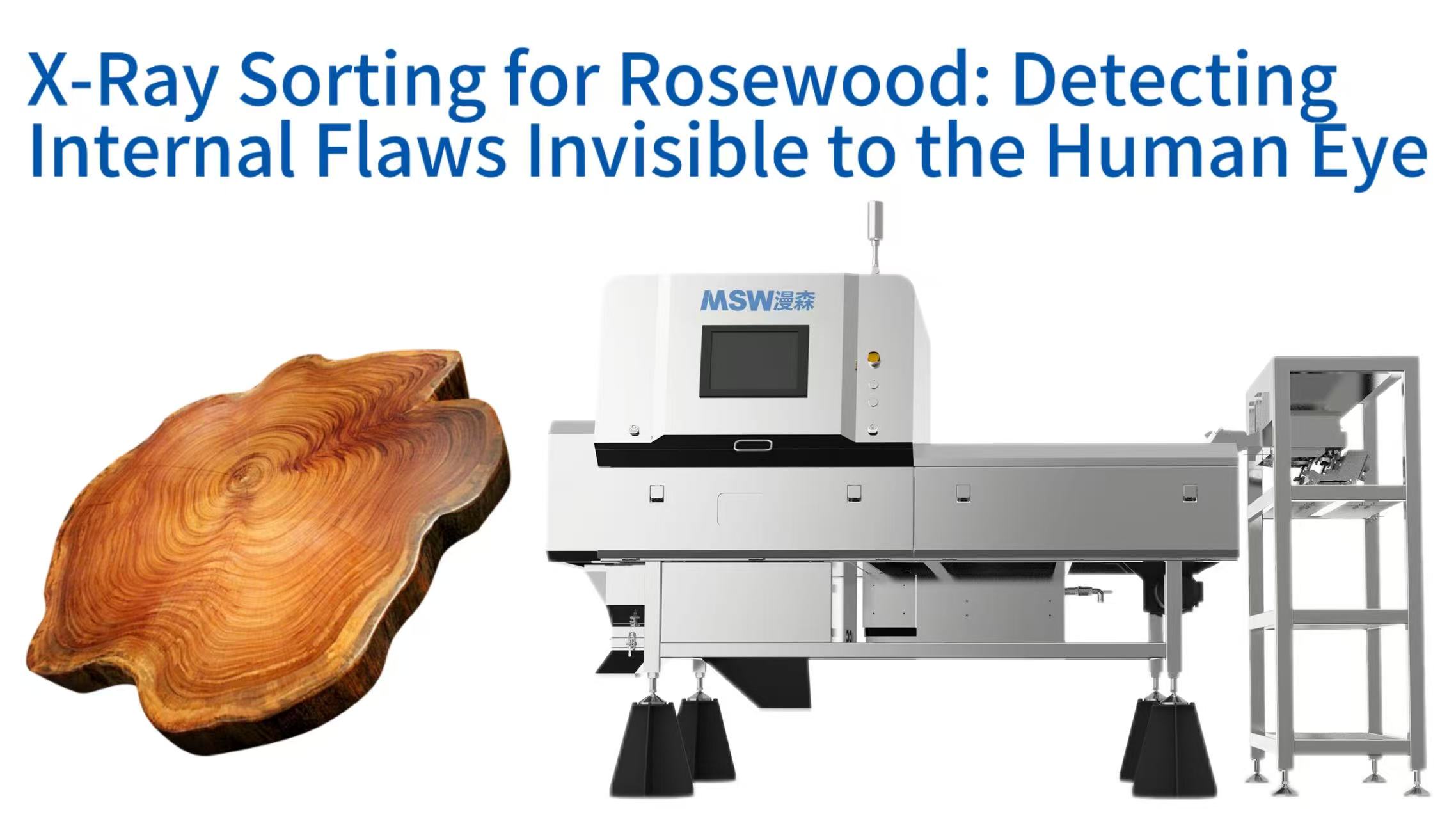
Modern wood processing, particularly for high-value timber species, faces a critical challenge: internal defects such as cracks, voids, decay, and mineral deposits remain completely invisible to human inspectors. Traditional optical sorting systems only analyze surface color and texture, leaving hidden imperfections undetected until costly downstream processing occurs. This article explores how advanced X-ray transmission technology combined with artificial intelligence revolutionizes the inspection of dense tropical hardwoods. Readers will learn how X-ray sorters penetrate material surfaces, how deep learning algorithms identify subtle density variations, and how this technology delivers unprecedented sorting accuracy. The discussion covers the fundamental physics of X-ray detection, the specific challenges of sorting precious timber species, the economic benefits of early-stage defect removal, and practical considerations for integrating this technology into existing production lines.
Why Traditional Visual Inspection Fails for High-Value Timber Species
📊 HUMAN VS AI INSPECTION: DEFECT DETECTION RATES
Human visual inspection remains the most common method for quality control in timber processing facilities worldwide. However, this approach suffers from fundamental physiological limitations that directly impact profitability and product quality. The human eye can only perceive surface characteristics such as color variations, surface cracks, and visible grain patterns. When processing dense hardwoods, internal structural defects like heartwood decay, internal fractures from felling stress, or mineral inclusions remain completely hidden from even the most experienced quality control personnel. Studies have demonstrated that human inspectors typically achieve detection rates below 60% for internal defects, with fatigue reducing accuracy significantly during extended shifts.
The economic consequences of relying on visual inspection for high-value timber processing are substantial. When boards containing internal defects proceed through sawing, planing, and finishing operations, manufacturers waste significant labor, energy, and material costs on products that will ultimately be rejected. For premium applications such as veneer production for musical instruments or high-end furniture, a single undetected internal flaw can render an entire finished piece unsalable. Modern AI sorter technology addresses this gap by introducing non-destructive internal inspection capabilities that fundamentally transform quality control paradigms for valuable timber species.
Understanding Density Variations in Tropical Hardwoods
Tropical hardwood species exhibit complex internal density patterns that directly correlate with wood quality and structural integrity. Healthy heartwood typically maintains consistent density throughout the cross-section, while decayed regions show reduced density due to fungal degradation of cellular structures. Mineral deposits, often appearing as dark streaks or patches, create localized high-density zones that can damage cutting tools and weaken finished products. Internal stress cracks from natural growth patterns or harvesting operations appear as low-density voids that propagate unpredictably during processing. X-ray transmission systems excel at detecting these density variations because different material densities attenuate X-ray beams to different degrees.
The relationship between X-ray attenuation and material density follows predictable physical principles that enable quantitative quality assessment. When a collimated X-ray beam passes through a timber board, the reduction in beam intensity correlates directly with the integrated density along the beam path. High-density features like mineral deposits or embedded foreign objects absorb more radiation, appearing darker in transmission images. Low-density features like decay pockets, voids, or cracks allow more radiation to pass through, appearing brighter. Advanced AI X-ray sorting machine systems analyze these transmission variations at resolutions below one millimeter, creating detailed density maps that reveal internal conditions invisible to any surface inspection method.
The Physics of X-Ray Transmission Through Organic Materials
X-ray imaging technology operates on the principle of differential absorption, where different materials attenuate electromagnetic radiation to varying degrees based on their atomic number, density, and thickness. For organic materials like wood, which consists primarily of carbon, hydrogen, and oxygen, the primary attenuation mechanism is Compton scattering rather than photoelectric absorption. This physical characteristic means that wood density variations produce subtle but detectable differences in transmitted X-ray intensity. Modern industrial X-ray sorters employ carefully calibrated source energies between 30 and 150 kiloelectron volts, optimized specifically for penetrating organic materials while maintaining sensitivity to small density differences.
The practical implementation of X-ray transmission for timber inspection requires sophisticated sensor technology capable of detecting minute intensity variations across wide material streams. Linear detector arrays with pixel pitches below 0.8 millimeters capture transmission data at rates exceeding 10,000 lines per second, enabling inspection of boards moving at industrial processing speeds. Each pixel generates a 16-bit digital value representing the transmitted X-ray intensity, creating a grayscale image where each level corresponds to a specific material density. This rich data stream feeds directly into advanced detection algorithms that classify every millimeter of material with precision impossible for human operators or conventional optical systems.
Why Internal Defects Matter More Than Surface Imperfections
Surface imperfections in timber products, while visible, typically affect only cosmetic appearance and can often be removed through planing or sanding operations. Internal defects, conversely, pose fundamentally more serious risks to product integrity and manufacturing economics. A hidden void or crack can cause catastrophic failure during structural loading, creating safety hazards and liability exposure for finished product manufacturers. Mineral deposits embedded within boards can destroy expensive cutting tools during secondary processing, causing unplanned downtime and significant replacement costs. Decayed internal regions that appear healthy on the surface may fail prematurely in service, damaging brand reputation and customer confidence.
The financial impact of processing boards containing internal defects extends far beyond the value of the individual boards themselves. When a board with internal defects proceeds through primary breakdown, resawing, and finishing operations, each step adds labor, energy, and machine time that becomes completely wasted when the defect is ultimately discovered. For high-value applications like musical instrument components or architectural veneers, processing costs can exceed material costs by a factor of five or more. Implementing ore sorting-inspired inspection technology adapted for timber applications enables manufacturers to identify and reject defective boards immediately after initial breakdown, dramatically reducing downstream processing waste and improving overall plant profitability.
How X-Ray AI Sorting Systems Detect Hidden Timber Flaws
⚙️ SYSTEM PERFORMANCE METRICS
X-ray AI sorting systems represent the convergence of three advanced technologies: high-resolution X-ray imaging, real-time image processing hardware, and deep learning classification algorithms. When a timber board passes through the inspection zone, an X-ray source illuminates the material while a linear detector array captures transmission data at rates exceeding 20,000 line scans per second. This continuous data stream reconstructs into a two-dimensional density map where each pixel represents the integrated attenuation along a specific beam path. The system processes this density map through convolutional neural networks trained on thousands of annotated examples to classify every region of the board as acceptable or defective based on internal condition.
The classification performance of modern AI-powered sorting systems significantly exceeds both human inspection and conventional machine vision approaches. Field data from timber processing installations demonstrates defect detection rates exceeding 98% for internal voids, decay, and mineral deposits, compared to approximately 60% for human inspectors under optimal conditions. The false rejection rate, where acceptable material is incorrectly classified as defective, typically remains below 3% for properly calibrated systems. This performance level enables processors to confidently eliminate downstream quality risks while maintaining high material utilization rates. The self-optimizing nature of deep learning systems means that detection accuracy improves continuously as the system processes additional material and receives feedback on classification correctness.
Dual-Energy X-Ray Technology for Material Discrimination
Single-energy X-ray systems measure only total material density along the beam path, which can create ambiguity between thick sections of low-density material and thin sections of high-density material. Dual-energy X-ray technology overcomes this limitation by acquiring transmission measurements at two distinct X-ray energy levels simultaneously. By analyzing the ratio of attenuation between high and low energies, dual-energy systems can estimate both material thickness and effective atomic number independently. This capability is particularly valuable for timber inspection, where the system must distinguish between localized mineral deposits (high atomic number) and overall board thickness variations (density changes without composition change).
The implementation of dual-energy X-ray sorting for timber applications requires specialized detector technology capable of discriminating photon energies with high precision. Layer-stack scintillator detectors, where two different phosphor materials are arranged vertically, absorb low-energy photons preferentially in the top layer while high-energy photons penetrate to the bottom layer. This arrangement generates separate signals for low and high energy components, enabling material-specific analysis. For processing facilities handling rare earth sorting machine applications, this technology proves similarly valuable for distinguishing between valuable minerals and waste rock with similar densities but different atomic compositions.
Convolutional Neural Networks for Defect Pattern Recognition
Convolutional neural networks applied to X-ray transmission images learn to recognize defect patterns through exposure to thousands of labeled examples. Each training image contains annotations indicating the precise location and type of each internal defect, as verified through destructive testing. The network architecture typically includes multiple convolutional layers that extract increasingly abstract features, from simple edge and texture detectors in early layers to complex pattern recognition for specific defect types in deeper layers. After training, the network processes new images in milliseconds, generating probability maps indicating the likelihood that each region contains defective material requiring rejection.
The specific network architectures optimized for timber X-ray inspection typically employ between eight and twenty convolutional layers, depending on the complexity of defect types present in the target species. Training requires carefully curated datasets containing at least ten thousand annotated defect examples to achieve robust performance across natural variation in wood anatomy and defect presentation. Data augmentation techniques, including rotation, scaling, and intensity variation, artificially expand the effective training set size by factors of ten to one hundred. The resulting AI optical sorting machine systems achieve defect recognition performance that rivals or exceeds human experts while operating at speeds impossible for manual inspection.
Real-Time Processing Architecture for High-Speed Production
Industrial X-ray sorting systems must process imaging data and make rejection decisions within milliseconds to keep pace with high-speed production lines. This real-time requirement drives specialized computing architectures combining field-programmable gate arrays for low-level image preprocessing with graphics processing units for neural network inference. The FPGA stage performs dark current correction, gain calibration, and defect pixel replacement at line rates exceeding 10,000 scans per second. This preprocessed data streams directly to GPU memory, where the trained neural network executes inference on overlapping image windows covering the entire board surface.
The computational demands of real-time X-ray image analysis for timber inspection are substantial but well within the capabilities of modern industrial computing hardware. A typical system processing 100 boards per minute at 2 meters per second requires approximately 5 tera-operations per second of neural network processing power, deliverable by a single high-end GPU. The complete processing pipeline, from X-ray detection to ejection valve activation, typically completes in under 50 milliseconds. This speed enables integration into existing smart material feeding systems without creating production bottlenecks, allowing processors to add internal defect inspection capability without sacrificing throughput.
Comparing Chute-Type and Belt-Type Configurations for Timber Sorting
🔧 CHUTE-TYPE VS BELT-TYPE COMPARISON
Timber sorting applications require careful consideration of material handling configuration because board geometry, surface condition, and fragility significantly impact transport behavior through the inspection zone. Chute-type AI sorting machine systems utilize gravity to accelerate boards down a polished stainless steel surface, achieving high speeds without powered components. This configuration works well for dried, dimensionally stable boards with consistent surface properties. The absence of belts or rollers eliminates potential contamination sources and reduces maintenance requirements, while the compact footprint allows integration into space-constrained facilities. Chute systems typically achieve processing speeds of 2 to 3 meters per second with board lengths up to 2 meters.
Belt-type AI sorting machine configurations employ powered conveyor belts to transport boards through the X-ray inspection zone, offering several advantages for challenging timber applications. The belt provides gentle acceleration and deceleration, making this configuration appropriate for fragile boards or those with rough surfaces that could jam in chute systems. Belt systems can handle significantly larger board sizes, with widths up to 2.8 meters and lengths exceeding 3 meters. The controlled transport eliminates orientation variability that can affect X-ray inspection consistency, while the ability to vary belt speed independently of board properties provides operational flexibility. The primary disadvantages include higher initial cost, increased maintenance for belt tracking and tensioning, and potential contamination from belt wear particles.
Channel Configuration Options for Different Production Scales
X-ray sorting systems for timber applications are available in channel configurations ranging from 64 to 768 channels, referring to the number of parallel detection and ejection zones across the machine width. Smaller configurations with 64 to 128 channels suit specialty processors handling limited volumes of high-value species, offering capital cost optimization while maintaining full detection capability. These systems typically process 2 to 5 tons per hour, appropriate for facilities producing musical instrument components or premium architectural elements. The lower channel count simplifies installation and calibration while providing adequate throughput for these applications.
High-volume timber processing operations benefit from larger channel configurations ranging from 256 to 768 channels. These systems process 20 to 50 tons per hour, matching the output of primary breakdown equipment in medium to large sawmills. The increased channel count provides finer spatial resolution across wide boards, enabling detection of small defects near board edges that could be missed with coarser channel spacing. Multi-channel systems also offer redundancy, where individual channel failures cause minimal impact on overall system performance. For processors handling multiple species or variable board dimensions, modular channel architectures allow reconfiguration between production runs without hardware changes, providing flexibility traditional sorting equipment cannot match.
Selecting Appropriate Belt Widths for Board Dimensions
Belt width selection critically impacts both detection performance and system cost for timber X-ray sorting applications. Narrow belts from 300 to 600 millimeters suit dedicated lines processing specific board dimensions, such as component manufacturers producing consistent width material for flooring or furniture parts. These compact systems offer lower capital cost and reduced floor space requirements while maintaining full detection capability. The narrower inspection zone simplifies X-ray source and detector alignment, potentially improving image quality compared to wider systems. However, these systems cannot accommodate board width variations without manual adjustment or multiple passes.
Wide belt systems from 1,000 to 2,800 millimeters provide maximum flexibility for facilities processing variable board dimensions or multiple product lines simultaneously. A 1,800-millimeter belt, for example, can accommodate boards up to 1.6 meters wide with margins for edge clearance, or simultaneously process three 500-millimeter boards in separate lanes. The 2,800-millimeter maximum width supports the widest timber products, including veneer sheets and specialty architectural panels. While wider systems cost more due to larger X-ray sources and longer detector arrays, the increased flexibility and throughput potential often justify the investment for mid-sized to large operations. Installation requires adequate ceiling height for X-ray shielding and service access around the larger machine footprint.
Throughput Capabilities Across Machine Configurations
Throughput in X-ray timber sorting systems depends on multiple factors including belt width, conveyor speed, board dimensions, and defect density in the incoming material. A typical 600-millimeter belt system operating at 2 meters per second processes approximately 10 cubic meters per hour of 25-millimeter thick boards, assuming 80% belt utilization and 75% material density. Increasing belt width to 1,200 millimeters doubles theoretical throughput to 20 cubic meters per hour at the same speed, while the maximum 2,800-millimeter width achieves approximately 45 cubic meters per hour under similar conditions. These throughput figures assume continuous operation with automated infeed and outfeed systems; manual loading reduces effective rates significantly.
Actual production throughput also depends on defect rejection rates and downstream material handling capacity. When the sorting system rejects defective boards, the ejector mechanism requires finite time to remove material from the product stream, creating theoretical maximum rejection rates around 30% before throughput degradation occurs. For typical timber applications where defect rates remain below 15%, this limitation does not impact production. Facilities processing material with exceptionally high defect rates should consider high-speed ejection systems with multiple ejector rows to maintain throughput during periods of elevated rejection. The combination of appropriate belt width, conveyor speed, and ejector configuration enables X-ray sorting systems to match or exceed the throughput of upstream and downstream processing equipment.
Economic Benefits of X-Ray Sorting for Premium Timber Processing
The economic justification for X-ray sorting technology in premium timber applications rests on quantifiable improvements in yield, labor productivity, and risk reduction. Processing facilities implementing this technology typically report yield improvements of 8 to 15 percent, representing recovered value from boards that would otherwise be rejected at final inspection or fail in service. For high-value species, this yield improvement alone often generates payback periods under twelve months, with the system continuing to deliver returns for its operational lifetime of ten to fifteen years. Labor savings from reduced manual inspection requirements add secondary benefits, though yield improvement remains the primary economic driver.
🌱 ENVIRONMENTAL IMPACT REDUCTION
Beyond direct yield improvements, X-ray sorting delivers economic benefits through downstream processing cost reduction and quality assurance. When defective boards are removed early in the production sequence, subsequent processing steps including planing, edging, and finishing only operate on acceptable material. This selectivity reduces energy consumption, tool wear, and labor application to defective material by 50 to 80 percent compared to conventional inspection approaches. Quality assurance benefits include elimination of customer claims related to hidden defects, protecting brand reputation and avoiding costly field failures. For manufacturers supplying critical applications such as structural components or transportation products, the risk reduction value alone justifies technology investment regardless of yield improvement calculations.
Energy and Water Consumption Reduction Compared to Traditional Methods
Conventional timber defect detection often relies on destructive testing methods including cross-cutting and visual inspection of cut faces. These approaches require significant energy for cutting equipment operation, material handling, and subsequent re-joining of inspected sections. X-ray sorting eliminates this energy consumption by providing non-destructive inspection that leaves boards intact for further processing. Facilities converting from destructive sampling to full X-ray inspection typically reduce energy consumption for quality control by 60 to 75 percent, with proportional reductions in carbon emissions associated with power generation. The elimination of cut-and-inspect operations also reduces compressed air consumption for pneumatic equipment and hydraulic fluid for cutting machinery.
Water usage in timber processing relates primarily to cleaning operations for optical inspection systems that require dust-free surfaces for accurate color analysis. X-ray systems, operating on density rather than surface appearance, tolerate significantly higher dust levels without performance degradation. This tolerance reduces or eliminates water-based cleaning systems required for optical sorters, conserving both water and the energy required for pumping, heating, and wastewater treatment. For facilities in water-stressed regions, this conservation benefit provides both economic and environmental advantages. The combination of energy and water savings typically reduces the environmental footprint of quality control operations by 40 to 60 percent compared to conventional approaches.
Return on Investment Calculations for Processing Facilities
Return on investment for X-ray timber sorting equipment depends on material value, throughput volume, defect rates, and current inspection effectiveness. A medium-volume facility processing 5,000 board feet per day of premium hardwood with a market value of 5 dollars per board foot and a 10 percent defect rate experiences an annual material loss of approximately 125,000 dollars from undetected internal defects if current inspection captures only half of defective boards. An X-ray system costing 250,000 dollars that captures 90 percent of remaining defects would recover approximately 56,000 dollars annually, generating a 4.5-year payback period. Higher-value species or larger throughput volumes produce proportionally faster returns.
Multiple factors can accelerate payback beyond these baseline calculations. Facilities currently performing destructive sampling reduce or eliminate the associated material and labor costs. Manufacturers with field failure claims related to hidden defects eliminate those costs completely. Premium processors achieving quality certification for defect-free production access higher-margin markets unavailable to competitors without X-ray inspection capability. When these secondary benefits are included, effective payback periods often fall below 18 months for high-value applications. The technology's long operational life of ten to fifteen years means that each system generates substantial cumulative returns, making X-ray sorting one of the highest-ROI investments available to premium timber processors.
Reducing Waste and Improving Sustainability Metrics
Waste reduction from X-ray sorting directly improves environmental sustainability metrics for timber processing operations. When defective boards are identified early and diverted to appropriate lower-value applications rather than proceeding through high-value processing, overall material utilization increases substantially. A facility achieving 10 percent yield improvement through X-ray sorting processes the same output with 10 percent less timber input, reducing pressure on forest resources. The rejected material, properly identified as containing defects, can be directed to pulp, biomass energy, or other applications where internal flaws do not impact value. This optimal allocation of timber resources maximizes value extraction from each harvested tree.
Sustainability certification programs increasingly recognize the environmental benefits of advanced sorting technologies. Facilities implementing X-ray inspection may qualify for reduced chain-of-custody documentation requirements due to lower commingling risk between certified and uncertified material. The technology also supports certification for recycled or reclaimed timber by verifying internal condition of salvaged boards before they enter production streams. For processors targeting carbon-neutral or zero-waste operations, X-ray sorting provides a practical pathway to achieving these environmental goals without sacrificing economic performance. The measurable reductions in energy, water, and material consumption provide verifiable data for sustainability reporting and marketing claims.
Integrating X-Ray Sorters into Existing Production Lines
Successful integration of X-ray sorting technology requires careful planning of material flow, equipment placement, and control system interfaces. The sorter should be positioned immediately after primary breakdown operations and before any significant value-adding processes. This placement ensures that defective boards are rejected before they accumulate substantial processing cost, while still allowing inspection of full-length boards rather than cut pieces. The infeed system must present boards to the sorter in a consistent orientation, typically with leading edges aligned and lateral position controlled within the machine's detection width. Automated infeed systems using servo-driven alignment gates or edge positioners achieve the required consistency for high-speed operation.
Outfeed configuration must accommodate both accepted and rejected material streams with sufficient capacity to prevent backups that would interrupt sorter operation. Accepted boards typically continue to downstream processing on the same conveyor line or transfer to storage or drying systems. Rejected boards divert to a separate collection system, which may include bin accumulation for manual sorting, chipping for lower-value applications, or direct feeding to alternative processing lines. The physical separation between accept and reject streams should be sufficient to prevent cross-contamination while allowing operator access for system monitoring and maintenance. Control system integration enables the sorter to communicate with upstream and downstream equipment for coordinated start-stop operation and production data collection.
Upstream Material Preparation Requirements
Optimal X-ray sorting performance requires consistent material presentation meeting specific size, orientation, and spacing parameters. Boards should be cut to final length before inspection, as end defects near board ends are particularly common and valuable to detect before further processing. Maximum board length is limited by the sorter's infeed and outfeed conveyor lengths, typically 2 to 3 meters for chute systems and 3 to 5 meters for belt configurations. Boards longer than these limits require cutting before inspection or selection of an extended-length sorter design. Minimum board dimensions relate to detection resolution; boards thinner than 6 millimeters may require specialized low-energy X-ray sources for adequate contrast between defect and sound wood.
Material feeding systems must present boards to the sorter as a single layer with gaps between consecutive boards sufficient for ejection without collisions. Typical gap requirements range from 50 to 150 millimeters depending on board length and conveyor speed. Vibratory feeders or singulation belts achieve the required spacing for cut-to-length boards, while random-length material requires more sophisticated infeed systems with speed-matching sections to create consistent gaps. Lateral positioning should maintain boards within the detection zone with maximum deviation less than 10 percent of belt width. Optical sensors at the sorter infeed verify spacing and positioning, triggering rejection if parameters fall outside acceptable ranges.
Downstream Material Handling After Sorting
Accepted material from the X-ray sorter typically continues to subsequent processing operations including drying, planing, grading, or packaging. The transition from sorter outfeed to downstream equipment should maintain board orientation and spacing to prevent jams or misalignment. Accumulation conveyors after the sorter provide buffer capacity to accommodate brief downstream stoppages without stopping the sorter. For facilities with multiple downstream processing lines, a diverter system can route accepted boards to different destinations based on defect classification. A board containing minor mineral deposits that does not require rejection might divert to a less demanding application, while completely sound material proceeds to premium product lines.
Rejected material handling systems must accommodate the volume and characteristics of defective boards. Simple bin accumulation works for low rejection rates below 10 percent, with operators periodically removing and processing rejected material. Higher rejection rates require automated removal systems such as cross-belt conveyors or floor sweepers that clear rejected boards to designated collection points. The ultimate disposition of rejected material depends on defect type and severity; boards with minor defects may be saleable to secondary markets, while severely defective material may require chipping for pulp or biomass applications. Real-time data from the sorter allows automatic routing of rejected boards to appropriate downstream processing based on defect classification, maximizing value recovery from every board.
Control System Integration for Production Data
Modern X-ray sorters generate substantial data about material quality, defect types, and sorting performance that provides value beyond real-time rejection decisions. Integration with facility control systems enables collection and analysis of this data for production optimization. The sorter can report defect rates by board origin, species, or time period, identifying quality issues with specific suppliers or production shifts. Historical data analysis reveals trends in defect occurrence, enabling predictive quality management rather than reactive rejection. Real-time dashboards provide operators with immediate visibility into sorter performance and material quality, facilitating rapid response to process upsets.
Data integration requires appropriate communication protocols and data formatting for compatibility with facility systems. Most industrial sorters support standard industrial protocols such as EtherNet/IP, Profinet, or Modbus TCP for real-time control data exchange. Higher-level quality data typically transmits via OPC UA or REST APIs to manufacturing execution systems or cloud analytics platforms. The data volume from X-ray sorters is substantial, with each board generating a multi-megabyte X-ray image plus classification results and ejection decisions. Edge computing systems on the sorter aggregate and compress this data before transmission, reducing network bandwidth requirements while preserving analytical value. Properly implemented data integration transforms the sorter from a simple rejection device into a comprehensive quality intelligence platform.
Maintenance and Calibration for Consistent X-Ray Sorting Performance
X-ray sorting systems require regular maintenance to sustain the detection performance achieved during initial commissioning. Daily visual inspections should verify that all safety interlocks function correctly and that warning lights and labels remain visible and legible. Weekly cleaning of detector arrays and X-ray source windows prevents signal degradation from dust accumulation, which can reduce contrast and compromise defect detection. The cleaning procedure must follow manufacturer specifications to avoid scratching optical surfaces or disturbing calibration. Monthly verification of ejector performance using test boards with known defect locations confirms that rejection accuracy remains within specifications.
Calibration procedures for X-ray sorters typically include both automated and manual elements. Automated daily calibration using internal reference standards compensates for gradual changes in X-ray source output and detector sensitivity. Weekly manual calibration using certified reference materials verifies system performance across the full range of expected material densities. The calibration process should document any adjustments made and the resulting performance metrics, providing an audit trail for quality certification purposes. Facilities processing multiple timber species should maintain species-specific calibration profiles, as density variations between species affect optimal detection parameters. Operator training on proper calibration procedures ensures consistency across shifts and personnel changes.
Sensor Cleaning and Optical Alignment Procedures
The X-ray detector array requires meticulous cleaning to maintain image quality and detection performance. Dust and debris on the detector surface scatter X-rays, reducing spatial resolution and contrast. Cleaning should use lint-free wipes and manufacturer-approved solvents, applied with gentle pressure to avoid scratching the scintillator surface. The cleaning frequency depends on the facility's dust levels, ranging from daily in high-dust applications to weekly in cleaner environments. Optical alignment verification should accompany each cleaning, using laser alignment tools to confirm that the X-ray beam remains centered on the detector array. Misalignment as small as 0.5 millimeters can significantly reduce image quality at board edges.
The X-ray source window, typically made of beryllium or other low-absorption material, also requires regular cleaning to maintain output consistency. Window contamination absorbs X-rays, reducing beam intensity and requiring higher tube currents that accelerate source aging. Cleaning procedures for source windows vary by manufacturer but generally involve dry cleaning methods to avoid liquid ingress into the X-ray tube assembly. Annual professional service should include thorough cleaning of internal cooling systems that maintain stable X-ray source temperature. Temperature stability affects X-ray output wavelength, with 1 degree Celsius of temperature variation causing approximately 0.1 percent output change that can affect detection thresholds for subtle density differences.
Air Ejector System Maintenance for Reliable Rejection
Pneumatic ejector systems in X-ray sorters require regular maintenance to ensure reliable defect removal. The high-speed solenoid valves that control air pulses typically have rated lifetimes of 100 to 200 million cycles, equivalent to 6 to 12 months of continuous operation at typical processing speeds. Preventive replacement of these valves before end-of-life prevents unexpected failures that would allow defective boards to pass undetected. The valve replacement interval should be tracked in the maintenance management system, with replacement scheduled during planned downtime to avoid production interruption. After replacement, verification testing should confirm that new valves provide consistent pulse characteristics matching the original specifications.
Compressed air quality critically affects ejector system reliability and component life. Air should be filtered to remove particles larger than 5 microns and dried to a pressure dew point below 4 degrees Celsius to prevent condensation in pneumatic lines. Lubricated systems require careful oil selection and application rates to avoid contamination of timber products. Many timber applications prefer oil-free ejector systems to eliminate product contamination risk, though these systems may have shorter component life due to increased friction. Daily inspection of air filters and drains prevents water accumulation that would reduce ejection force and accelerate valve wear. Weekly testing of ejection accuracy using calibration boards verifies system performance and identifies developing issues before they cause product quality problems.
Software Update and Algorithm Retraining Schedule
X-ray sorting systems benefit from regular software updates that incorporate improved detection algorithms, user interface enhancements, and security patches. Major software releases typically occur annually, with minor updates and bug fixes released quarterly. Facilities should establish a formal update management process that evaluates updates in a test environment before production deployment. The test process should verify that update does not degrade detection performance on the facility's specific material types and that all interface connections to upstream and downstream systems remain functional. Update installation during scheduled maintenance periods minimizes production impact while ensuring timely implementation of improvements.
Deep learning algorithms used for defect classification require periodic retraining to maintain optimal performance as material characteristics change. Natural variation in timber properties, including seasonal density changes and evolving defect patterns, gradually reduces the accuracy of fixed algorithms. Annual retraining using boards collected during production provides ongoing performance optimization. The retraining process requires collecting and destructively verifying at least 2,000 boards containing representative defect types, a substantial but manageable sample for most facilities. Alternatively, manufacturers offering retraining-as-a-service can provide algorithm updates based on aggregated data from many installations, benefiting from larger training datasets while maintaining individual facility privacy. The resulting performance improvements typically recover any gradual accuracy degradation that occurred since the previous retraining.