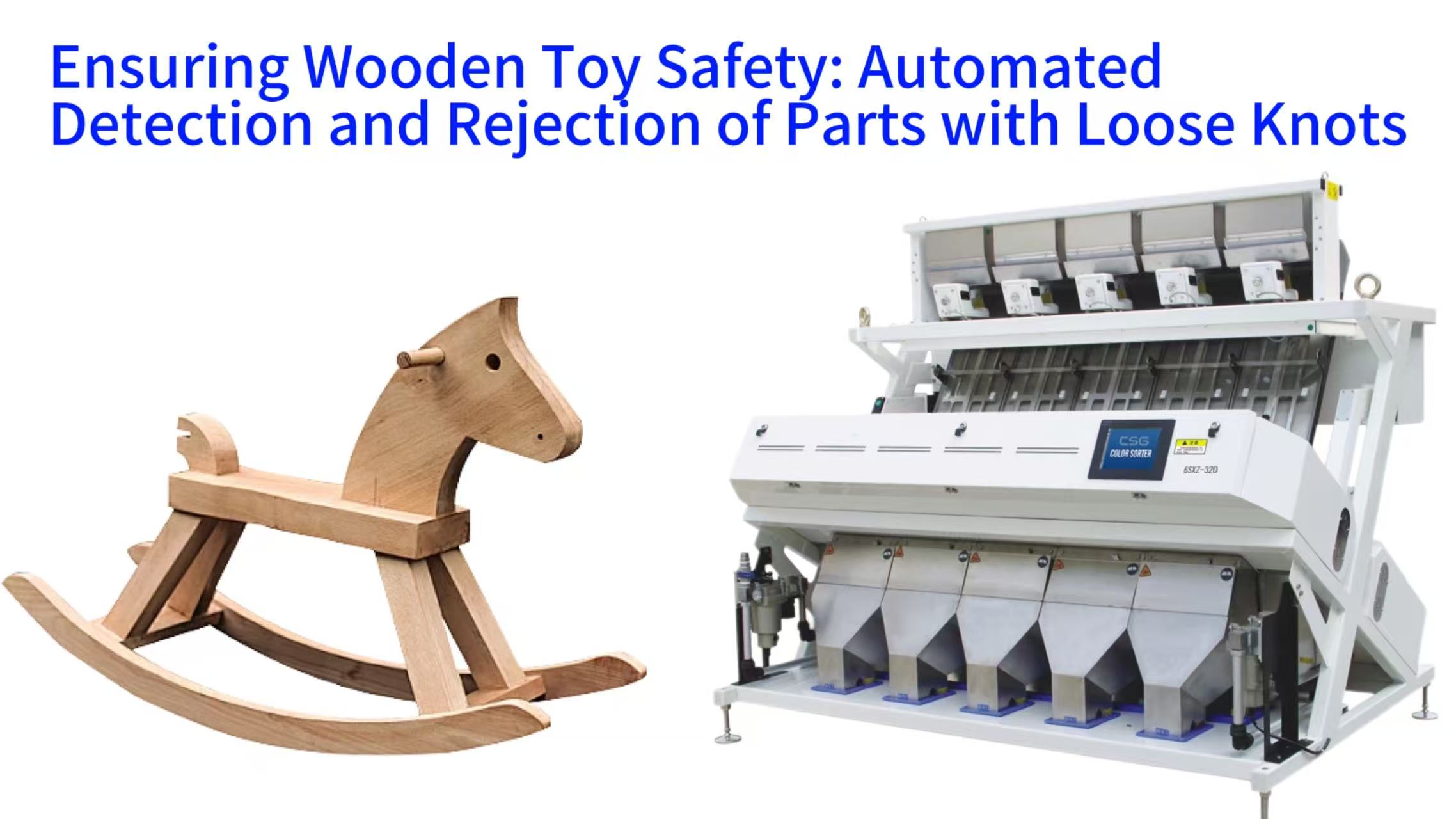
The production of safe wooden toys requires meticulous attention to material integrity, particularly the detection of structural defects like loose knots that pose a significant safety hazard. This article provides a comprehensive overview of how modern industrial sorting technology is deployed for stringent quality control in the wooden toy manufacturing sector. We will examine the specific risks associated with loose knots, the technological limitations of manual inspection, and the operational principles of automated sorters that solve this challenge. The discussion extends to the core sensing and ejection technologies that make this possible, the practical steps for integrating such a system, and the measurable benefits this automation delivers in terms of consumer safety, regulatory compliance, and production economics, establishing a new standard for quality assurance in the industry.
Core Process for Loose Knot Detection & Rejection
The Critical Safety Risk of Loose Knots in Wooden Toys
Safety Risks & Regulatory Compliance Requirements
Loose knots in wooden toy components represent a primary point of structural failure with direct implications for child safety. A knot is a naturally occurring imperfection in wood where a branch grew from the tree trunk. When the wood dries and is machined, the differential shrinkage between the knot and the surrounding wood can create a weak bond. This bond can fail under the stresses of play, causing the knot to detach. A dislodged knot instantly becomes a small, hard choking hazard for young children, while the resulting cavity in the toy can have sharp edges capable of causing cuts or splinters.
Beyond the immediate physical dangers, the presence of such defects exposes manufacturers to substantial liability risks and can lead to costly product recalls that damage brand reputation. Regulatory bodies in major markets enforce strict toy safety standards, such as the ASTM F963 in the United States and EN 71 in the European Union, which explicitly address the security of components and the prevention of small part generation. Therefore, the reliable identification and removal of components containing potential or active loose knots is not merely a quality objective but a fundamental compliance and ethical manufacturing requirement for any producer of wooden toys.
Understanding Knot Structure and Failure Mechanics
The anatomy of a knot involves intergrown wood fibers that are perpendicular to the main grain direction. A "tight" or "intergrown" knot remains solidly fixed within the surrounding wood. A "loose" or "encased" knot, however, is characterized by a visible circular crack or a dark ring around it, indicating separation. This separation is the precursor to failure. The detection challenge lies in identifying not just the presence of a knot, but more critically, assessing its bond integrity to predict if it will remain secure throughout the toy's intended lifespan under typical use conditions.
Consequences of Undetected Loose Knots in Finished Products
When a loose knot goes undetected and the toy reaches the consumer, the risk escalates from a production flaw to a direct safety incident. The consequences range from a near-miss where a parent discovers the loose piece before a child interacts with it, to tragic outcomes involving choking or ingestion. From a business perspective, a single verified incident can trigger a mandatory recall of an entire production batch, resulting in massive financial losses from logistics, replacement costs, and destroyed inventory, not to mention the incalculable damage to consumer trust and brand equity that can take years to rebuild.
Limitations of Manual and Traditional Visual Inspection Methods
Comparison of Inspection Methods for Loose Knot Detection
Manual Visual Inspection
Error rate: 10-30% (studies confirm)
Subjective defect classification
Fatigue-induced performance decline
Unable to detect internal separation
Slow throughput (limited by human speed)
No objective quality data logging
AI-Powered Automated Inspection
Accuracy: >99.9% for defined defects
Consistent, objective decision-making
24/7 performance with no fatigue
Multi-sensor detection of internal flaws
High throughput (thousands of pieces/hour)
Comprehensive quality data collection
For decades, the primary method for ensuring wooden toy quality relied on manual visual inspection by trained workers on the production line. This method involves operators examining each piece of wood for visible defects before or after machining. While this approach can catch obvious flaws, it suffers from significant and well-documented limitations that make it inadequate for guaranteeing safety in high-volume modern manufacturing. Human inspectors are subject to fatigue, distraction, and varying subjective standards, leading to inconsistent judgment calls on borderline defects like partially loose knots.
The physical nature of the inspection further complicates reliability. A loose knot may not be visibly apparent on the surface; it might be tight on one face of a component but separated on the opposite side or internally. Manual inspection typically cannot assess the internal bond integrity without physically probing or stressing the knot, which is impractical in a fast-paced production environment. Furthermore, increasing line speeds to meet demand reduces the time an inspector can spend on each part, directly increasing the probability that a defective piece will pass through undetected, creating a dangerous trade-off between throughput and safety.
Subjectivity, Fatigue, and Human Error in Visual QC
The human element introduces unavoidable variability. One inspector's definition of a "slightly loose" knot may differ from another's, leading to inconsistent product quality. As shift hours progress, visual acuity and concentration decline due to fatigue, causing the defect escape rate to rise steadily. Studies in manufacturing quality control consistently show that repetitive visual inspection tasks have an inherent error rate, often estimated between 10% and 30%, depending on complexity and duration, which is unacceptably high for a critical safety parameter.
Inability to Assess Internal Bond Integrity Non-Destructively
The core flaw of surface-level visual inspection is its inability to see beneath the wood's surface. A knot may appear perfectly sound on the exposed face but be completely detached on the reverse side or within the thickness of the part. Without a non-destructive testing method, inspectors cannot verify the internal adhesion of the knot without potentially damaging the component. This limitation forces a conservative approach where all knots are rejected, leading to excessive material waste, or a risky approach where only obviously loose knots are removed, allowing latent defects into the final product.
Operational Principles of AI Sorting Machines for Knot Detection
AI Sorter System Architecture for Loose Knot Detection
Data Acquisition Layer
High-res cameras, 3D laser profilometers, NIR spectroscopy sensors
Preprocessing Layer
Image enhancement, noise reduction, feature extraction, data fusion
AI Inference Layer
CNN deep learning model, real-time defect classification (ms response time)
Actuation Layer
High-speed air ejection valves, synchronized timing control
Advanced sorting machines overcome the limitations of manual inspection by employing a combination of high-resolution sensing, sophisticated data processing, and precise mechanical action. These systems, often based on AI sorter platforms, operate on an in-line, non-contact principle. Individual wooden components are fed sequentially through a scanning zone where an array of sensors captures comprehensive data about each piece. This data is not limited to surface color but extends to three-dimensional topography and, in some systems, subsurface characteristics.
The critical innovation lies in the software intelligence. The sensor data is processed in real-time by machine learning algorithms trained on vast libraries of images and scans of both acceptable wood and samples with known defects, including various stages of knot looseness. These algorithms learn to identify the subtle visual signatures of a failing knot bond—such as specific shadow patterns, minute cracks, or texture anomalies around the knot periphery—that are often invisible to the human eye. Upon positive detection, the system triggers an ejection mechanism to remove the defective part from the production stream with high reliability and speed, operating consistently 24 hours a day without performance degradation.
Multi-Sensor Data Acquisition for Comprehensive Analysis
Modern sorters utilize a suite of complementary sensors to build a complete digital profile of each wooden part. High-resolution color cameras capture detailed surface color and visible cracks. Laser profilometers or 3D scanners map the exact surface geometry, detecting even slight depressions or raised areas around a knot that indicate separation. Some systems incorporate NIR (Near-Infrared) spectroscopy or structured light to infer density variations that can signal internal voids or poor adhesion. This multi-modal data fusion provides a robust basis for the AI's decision, far surpassing the information available to a human inspector.
Real-Time AI Decision-Making and Defect Classification
The heart of the system is a convolutional neural network (CNN) or similar deep learning model. This AI is not simply following "if-then" rules programmed by an engineer. Instead, it has been trained through a process of supervised learning, where it was shown hundreds of thousands of labeled examples of "good" and "bad" knots. Through this training, it autonomously derives complex, multi-dimensional patterns that correlate with knot integrity. In operation, it analyzes the incoming sensor data stream, classifies each knot with a probability score, and makes a pass/reject decision within milliseconds, all while continuously logging data to further refine its own accuracy over time.
Key Technologies Enabling Automatic Detection and Ejection
Key Technical Parameters & Performance Metrics
Ejection System Performance
Response Time: < 100 milliseconds
Accuracy: >99.9% (defective part capture)
Precision Acceleration: ±0.5mm positioning accuracy
Throughput: Up to 5,000 pieces per hour
Feeding & Sensing Specifications
Smart Feeding: 100% part singulation
Camera Resolution: 12+ megapixels per sensor
Laser Scan Resolution: 0.1mm point spacing
NIR Spectral Range: 780-2500 nm
The effective removal of defective parts requires a seamless integration of detection and action technologies. Once the AI system identifies a component with a loose knot, it must communicate this decision to a physical actuator with extreme timing precision. This is achieved through synchronized high-speed ejection systems. The most common method involves an array of precisely aimed, solenoid-valve-controlled air nozzles. The system calculates the exact trajectory and timing of the defective part as it falls or is conveyed from the scanning zone.
When the part reaches the ejection point, a brief but powerful puff of compressed air is fired from the correct nozzle(s), physically diverting the piece into a reject bin without slowing down the main product flow. This demands not only fast processing but also exceptional mechanical and temporal precision. The entire sequence, from scanning to ejection, typically occurs in under 100 milliseconds, allowing these systems to inspect and sort thousands of pieces per hour, maintaining a throughput that meets or exceeds manual line speeds while providing vastly superior and documentable quality control.
Precision Air Ejection Systems and Timing Synchronization
The ejection mechanism's accuracy is paramount to avoid rejecting good parts or missing defective ones. The system's software tracks the exact position and speed of each piece. It then calculates the millisecond-precise moment to fire the air jet, accounting for the physical delay in valve response and air travel time. Modern sorters use precision acceleration control in their feeding systems to ensure consistent part spacing and velocity, which is critical for reliable ejection timing. The air pressure and duration are adjustable to suit the weight and size of the wooden components being sorted.
Advanced Feeding Systems for Optimal Presentation to Sensors
Consistent and accurate inspection requires that each wooden part be presented to the sensors in a stable, isolated manner without overlapping or tumbling. This is the role of specialized smart material feeding systems. Vibratory feeders, rotating discs, or precisely spaced belts are engineered to singulate the parts—separating them from a bulk load and delivering them one by one into the scanning chute or onto the inspection belt. This controlled presentation ensures every surface is exposed to the sensors, eliminating blind spots and providing the uniform data quality necessary for the AI to perform at its highest potential accuracy, which can exceed 99.9% for well-defined defects like loose knots.
Implementing an AI Sorter for Wooden Toy Safety QC
Implementation Workflow for AI Sorter Integration
The integration of an automated sorting system into an existing wooden toy production line is a strategic project that requires careful planning. The first phase involves a detailed analysis of the current process to identify the optimal integration point, typically after initial cutting and shaping but before final sanding, painting, or assembly. A critical step is the collection of a representative sample of production materials, including a wide variety of both good parts and parts with known loose knots of different severities. This sample library is used to train and validate the sorter's AI model before live deployment.
Following the planning and sampling stage, the physical installation takes place. This includes integrating the sorter's feeding mechanism with the upstream process, connecting the reject and accept material streams to the correct downstream paths, and installing necessary utilities like electrical power and compressed air. The most crucial phase is the system calibration and training, where the AI model is exposed to the sample parts. Operators work with the software to define the acceptable thresholds for knot integrity, essentially teaching the machine the factory's specific quality standards. This creates a digital, repeatable, and auditable definition of a "loose knot" that will be applied uniformly to every single piece thereafter.
Defining Quality Thresholds and Training the AI Model
Successful implementation hinges on translating human quality standards into machine-learnable parameters. Quality managers and engineers work together to categorize the sample parts: "Accept," "Reject," and sometimes "Marginal." These labeled samples are fed into the sorter's software during the training mode. The AI analyzes the sensor data from each category and learns the distinguishing features. The operators can then test the model on a separate validation set and adjust sensitivity settings—how "strict" the machine should be—until the rejection accuracy meets the required safety and quality benchmarks without causing excessive waste of good material.
Integration with Production Line Data and Quality Management Systems
A modern sorter is not an isolated machine but a node in the factory's digital ecosystem. It generates valuable production data in real-time, such as total pieces processed, rejection rates, and images of rejected defects. This data can be fed into a central advanced detection and quality management system (QMS) for analysis. Trends can be monitored; for instance, a sudden spike in loose knot rejections might indicate an issue with a specific wood batch or a machining tool that needs adjustment. This data-driven insight allows for proactive process improvement, turning the sorter from a simple filter into a strategic tool for enhancing overall manufacturing quality and efficiency.
Measurable Benefits of Automated Loose Knot Detection for Toy Manufacturers
Quantifiable Benefits of Automated Inspection
Safety & Brand Benefits
Elimination of safety-related product recalls
100% compliance with ASTM F963/EN 71 standards
Zero loose knot-related safety incidents
Enhanced brand reputation for safety
Reduced liability insurance costs
Operational Benefits
30-50% increase in inspection throughput
15-20% reduction in material waste
Elimination of manual inspection labor costs
Data-driven process optimization
Consistent quality across production shifts
ROI & Business Impact
Typical payback period: 6-12 months
Improved raw material utilization
Reduced scrap/rework costs
Competitive advantage in safety compliance
Enhanced customer confidence (retailers/consumers)
Scalable quality control for production growth
The adoption of automated sorting technology delivers a compelling return on investment across multiple dimensions, starting with an absolute guarantee of improved product safety. By eliminating human error and inconsistency, the system ensures that no component with a detectable loose knot enters the assembly process. This dramatically reduces the risk of safety-related incidents and recalls, providing robust protection for children and solid legal defensibility for the manufacturer. This assurance is increasingly becoming a competitive advantage and a baseline expectation from retailers and consumers who prioritize safety.
From an operational standpoint, automation delivers substantial economic benefits. While it replaces manual inspection labor, it often does so while increasing line speed and throughput. The reduction in liability risk and potential recall costs represents significant financial savings. Furthermore, by providing consistent, data-backed sorting, manufacturers can optimize their material usage. They can confidently use wood with tight, secure knots that were previously discarded due to conservative manual policies, reducing raw material waste and cost. The cumulative effect is a stronger, more resilient, and more profitable manufacturing operation built on a foundation of guaranteed quality.
Enhanced Consumer Safety, Brand Protection, and Regulatory Compliance
The primary benefit is the quantifiable enhancement of end-product safety. Automated sorters provide a level of consistency and vigilance impossible for human teams to maintain, creating a virtually impermeable barrier against loose knots. This safeguards the brand from the catastrophic reputational damage of a safety recall and demonstrates due diligence to regulators. Compliance with international toy safety standards becomes a documented, automated process rather than a hopeful outcome of human vigilance, simplifying audits and certifications.
Increased Production Efficiency, Reduced Waste, and Data-Driven Optimization
Beyond safety, the technology drives tangible process improvements. Production lines can run faster without sacrificing quality. The detailed rejection data pinpoints the root causes of defects, enabling proactive fixes in upstream processes like wood sourcing or drying. Material yield improves as the system makes more nuanced decisions than a blanket "all-knot" rejection policy. The operational data generated allows for true continuous improvement, optimizing the entire value chain from raw material to finished toy, ensuring that manufacturers not only meet safety standards but do so in the most efficient and sustainable manner possible.