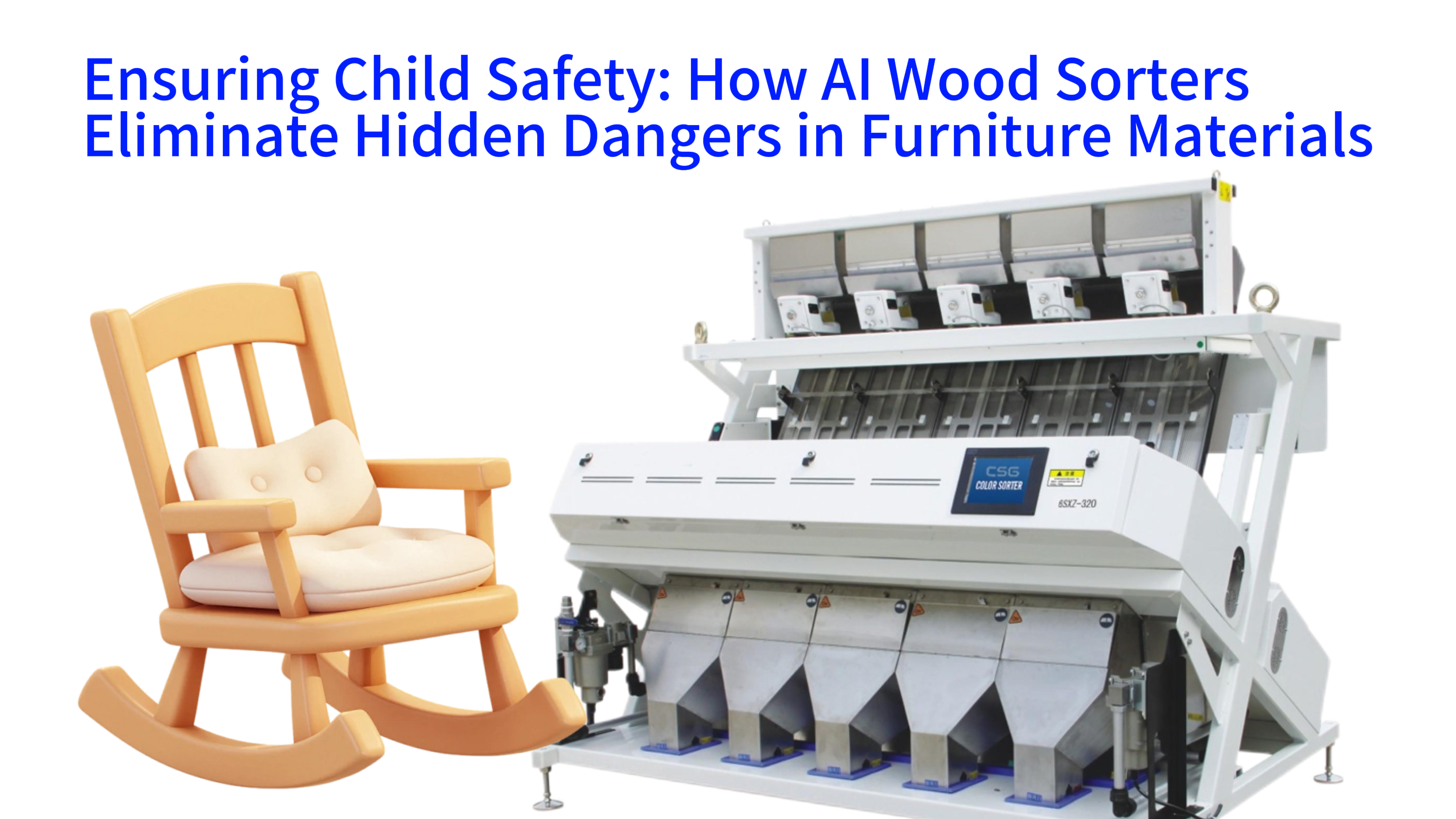
Creating safe children's furniture goes beyond rounded edges and non-toxic paints. It starts with the fundamental material: the wood itself. Hidden internal cracks, splits, and minuscule metal contaminants like broken saw blade fragments or old nails from recycled wood pose significant, invisible risks. This article explores how modern AI-powered wood sorting machines act as a critical first line of defense. We will delve into the sophisticated sensor technologies, such as X-ray and laser scanning, that these systems employ to see what the human eye cannot. The discussion will cover the step-by-step inspection process, how artificial intelligence algorithms make precise reject decisions, and the direct impact this has on complying with rigorous international safety standards for juvenile products. By integrating this technology, manufacturers can ensure that every piece of wood entering the production line is verified for internal integrity and purity, contributing to safer furniture and greater consumer confidence.
The Critical Importance of Material Purity in Juvenile Furniture
Key Risks of Wood Materials for Juvenile Furniture
| Hazard Type | Source | Potential Consequence | Detection Difficulty (1-5) |
|---|---|---|---|
| Internal Cracks/Checks | Growth stress, improper drying | Structural failure, breakage during use | 5 (Invisible to human eye) |
| Metal Contaminants (Nails, Saw Blades) | Recycled wood, logging, mill processing | Sharp protrusions, choking hazard, tool damage | 5 (Fully embedded in wood) |
| Internal Decay/Insect Damage | Moisture exposure, pest infestation | Reduced load-bearing capacity, sudden failure | 4 (Partial visibility, hidden pockets) |
Children's furniture is subject to some of the most stringent safety regulations in the manufacturing world. Standards set by organizations like ASTM International or the European Committee for Standardization (CEN) explicitly address material integrity, requiring that wood components be free from defects that could lead to sudden failure. A hidden crack inside a crib rail or a bed slat can propagate under stress, leading to catastrophic breakage. Similarly, metal residues, often remnants from earlier processing stages or embedded in recycled lumber, pose multiple hazards including sharp protrusions, choking risks if loose, and potential toxicity.
Traditional quality control methods, relying on manual visual inspection and random sampling, are fundamentally inadequate for this task. The human eye cannot peer inside a solid piece of wood, and sampling only a fraction of production leaves room for dangerous defects to slip through. This gap in quality assurance is where AI wood sorting technology provides a transformative solution. By inspecting one hundred percent of the material at high speed, it shifts the paradigm from defect detection to defect prevention at the raw material stage. This proactive approach is essential for manufacturers aiming to mitigate liability, protect their brand reputation, and, most importantly, safeguard their youngest end-users.
Understanding the Risks of Internal Wood Defects
Internal defects in wood, such as checks, shakes, and heart cracks, develop due to growth stresses or improper drying. These flaws severely compromise the structural strength of a board. In a high-stress application like a bunk bed ladder or a chair leg, such a hidden weakness can result in unexpected failure during normal use. The consequences of such failures in children's products are particularly severe, making the detection and removal of these components non-negotiable. Traditional grading rules often allow certain defects, but the specifications for juvenile furniture are far stricter, demanding a higher grade of material that conventional sorting methods are not designed to identify.
Furthermore, internal decay or insect damage, even in small pockets, can drastically reduce load-bearing capacity. AI sorters equipped with advanced sensor suites are trained to recognize the density variations associated with these forms of deterioration. By rejecting any wood piece containing these hidden flaws, the sorter ensures that only structurally sound material proceeds to the cutting and assembly stages. This level of assurance is critical for meeting the duty of care expected in the children's furniture market and is a key application of sensor-based sorting machine technology.
The Hidden Menace of Metal Contaminants
Metal contamination in wood can originate from various sources. During harvesting and logging, bullets from hunting or old fencing wire can become embedded in trees. At the mill, saw blades can chip, leaving tiny fragments of tungsten carbide or steel in the lumber. When using recycled wood, the risk includes old nails, screws, and staples. These metal pieces are not merely impurities; they are serious safety hazards. They can damage expensive cutting tools during manufacturing, cause sparks that pose a fire risk, and most alarmingly, they can work their way to the surface over time, creating sharp edges or becoming a choking hazard for a child.
Detecting these contaminants, especially when fully embedded and invisible, requires technology that can differentiate material densities. This is a task perfectly suited for certain scanning modalities. Ensuring the complete absence of such metals is a fundamental requirement for premium children's furniture producers who utilize reclaimed or recycled wood, turning a potential liability into a trusted selling point through rigorous inspection protocols that leverage advanced waste sorting principles.
Beyond Visual Inspection: The Need for Technological Intervention
For decades, the lumber industry has relied on the trained eyes of graders to sort wood. However, this method is subjective, inconsistent, and limited to surface features. It is physically impossible for a person to assess the internal condition of hundreds of boards per minute. As production speeds and safety expectations have increased, this manual bottleneck has become a significant vulnerability. Technological intervention is no longer a luxury but a necessity for any manufacturer committed to producing consistently safe children's products.
Automated sorting systems provide the objectivity, speed, and comprehensive inspection that manual methods lack. By deploying a combination of sensors that mimic and exceed human senses, these systems create a complete digital profile of each piece of wood. This data-driven approach eliminates human error and fatigue, establishing a new, reliable benchmark for material quality that forms the foundation of a modern safety-first production line, often integrated with a belt-type AI sorting machine for seamless workflow.
The Core Technology: Sensors That See the Unseeable
Core Sensor Technologies for AI Wood Sorters
| Sensor Type | Core Principle | Detectable Hazards/Features | Industry Application Reference |
|---|---|---|---|
| X-Ray Sensor | Differential absorption (dense materials absorb more X-rays) | Embedded metal, internal cracks, voids, density anomalies | X-ray sorter |
| 3D Laser Scanner | Laser line distortion + 3D contour mapping (sub-millimeter accuracy) | Surface cracks, warp, cup, bow, geometric imperfections | advanced detection |
| Near-Infrared (NIR) Sensor | Molecular composition analysis via infrared light reflection | Surface treatments, coatings, glues, chemical contaminants | NIR sorter |
| High-Resolution Vision Camera | Color imaging + surface texture recognition | Wood species, surface stains, blue fungus, bark remnants | Visual quality control |
At the heart of an AI wood sorter's capability is its suite of advanced sensors, each chosen to gather specific data about the wood passing through it. Unlike a simple camera that only sees color and surface texture, these machines combine multiple sensing technologies to build a three-dimensional, internal, and compositional map of every board. This multi-sensor fusion approach is critical because no single sensor can detect all types of defects. A crack might be visible to a high-resolution camera if it's on the surface, but an internal metal shard requires a different physical principle to detect.
The integration of these diverse data streams happens in real-time, allowing the system's artificial intelligence to make a holistic assessment. For children's furniture safety, two sensor technologies are particularly paramount: X-ray-based systems for density analysis and high-resolution laser scanners for precise geometry and surface mapping. These technologies, often also found in X-ray sorter configurations for other industries, are fine-tuned for the specific task of identifying the subtle signatures of hidden dangers in wood.
X-Ray Inspection for Density Anomalies
X-ray technology in wood sorting operates on the principle of differential absorption. Dense materials, like metal, absorb more X-rays than wood. Internal cracks or voids, which contain air, absorb far fewer X-rays. As wood passes through an X-ray beam, sensors on the opposite side measure the amount of radiation that passes through. The system then creates a detailed grayscale image where variations in brightness correspond to variations in density within the wood. A bright white spot indicates a very dense object like a metal fragment, while a dark line or blob can reveal a crack or knot.
Modern high-resolution X-ray systems used in sorters can detect density differences as small as 0.1 grams per cubic centimeter, enabling them to find tiny metal slivers or hairline cracks. The AI software is trained to recognize the specific patterns and thresholds that signify a rejectable defect according to safety standards. This non-destructive testing method is unparalleled for finding inclusions and internal flaws without damaging the wood, making it an indispensable tool for pre-screening material destined for sensitive applications like food-grade processing or children's products.
Laser 3D Scanning for Surface and Structural Mapping
While X-rays see inside the wood, laser 3D scanners provide an exquisitely detailed map of its exterior geometry. A array of laser lines is projected onto the surface of the moving wood. Cameras set at an angle capture the distortion of these lines, and sophisticated software uses this data to calculate the precise height and contour of every point on the board. This creates a full three-dimensional profile, revealing surface cracks, warp, cup, bow, and other geometric imperfections that affect structural integrity.
For safety, a deep surface check (a crack that runs with the grain) is as critical as an internal one, as it drastically weakens the board. The 3D scanner measures the depth, length, and position of such flaws with sub-millimeter accuracy. This information is combined with the X-ray data; a piece might be rejected for a deep surface crack detected by the laser, a large internal void seen by the X-ray, or a combination of smaller defects that collectively fail the safety grade. This multi-layered inspection is a hallmark of advanced detection systems.
High-Resolution Vision and Spectral Analysis
Complementing the internal and geometric scans are high-resolution color cameras and near-infrared (NIR) sensors. The color cameras perform tasks like identifying wood species—critical as different species have different strength properties—and detecting surface stains, blue fungus, or bark remnants. While these may not always be a structural safety issue, they are important for quality and aesthetics. More importantly, they contribute to the complete data picture.
Near-infrared spectroscopy analyzes the molecular composition of the wood surface. It can reliably identify surface treatments, coatings, or glues that might be present on recycled wood, which could be a source of chemical contamination or indicate prior non-wood material attachment. By identifying such pieces, the sorter ensures that only pure, untreated wood raw material enters the children's furniture production line. This spectral analysis capability is shared with specialized NIR sorter units used in other sectors.
The AI Brain: From Data to Decision
AI Core Capabilities for Wood Defect Recognition
| AI Function | Technical Foundation | Key Performance Metrics | Benefit for Child Furniture Safety |
|---|---|---|---|
| Defect Recognition | Convolutional Neural Networks (CNNs), Deep Learning | Near 100% detection rate for critical hazards; low false positive rate | No missed hidden cracks or metal contaminants |
| Real-Time Data Fusion | Industrial GPUs, Multi-modal data correlation | ≤1ms processing time per board; ≥150 pieces/min throughput | High-speed inspection without production bottlenecks |
| Adaptive Learning | Operator feedback integration, Model fine-tuning | Continuous accuracy improvement over time | Adapts to new wood species and defect types |
The raw data from the sensors is a flood of numbers and images. The true magic lies in the artificial intelligence algorithms that interpret this data. These are not simple rule-based programs but complex deep learning models, often based on convolutional neural networks (CNNs). Before operation, these AI models are "trained" using thousands of labeled images and scans of wood—examples of "good" boards and boards with various known defects like cracks, knots, and metal inclusions. The model learns to recognize the subtle patterns associated with each flaw.
During operation, the real-time sensor data for each piece of wood is fed into this trained model. The AI analyzes the combined dataset—the X-ray image, the 3D profile, the color image—simultaneously. It doesn't just look for a single issue; it evaluates the overall integrity of the piece against the learned safety criteria. In milliseconds, it makes a judgment: accept or reject. This decision is then sent to the ejection system. The system's ability to learn and adapt is continuous; as it processes more wood, it can refine its detection capabilities, constantly improving accuracy which is a core feature of any AI sorter platform.
Deep Learning for Defect Recognition
The deep learning approach is particularly effective for defect recognition because it can handle the natural variability of wood. No two cracks are identical, and metal fragments come in endless shapes and sizes. Traditional computer vision with hard-coded parameters would struggle with this variation. A deep learning model, however, generalizes from its training. It learns the underlying "essence" of a crack—a continuous line of low density or a specific discontinuity in the surface geometry—rather than just matching a specific pixel pattern.
This allows the system to reliably detect even faint, partial, or unusually shaped defects that a rules-based system might miss. The model's confidence level for each detection is also calculated. For critical safety applications, the threshold for rejection can be set very high, ensuring a conservative approach where any suspicious piece is removed. This high sensitivity is crucial for achieving the near-100% detection rates required for children's product safety compliance.
Real-Time Data Fusion and Analysis
The speed of analysis is a critical engineering feat. A typical industrial wood sorter might process over 150 pieces per minute. For each piece, the system has a mere fraction of a second to capture data from all sensors, synchronize it, run the AI analysis, and make a decision before the board reaches the ejection zone. This requires powerful industrial computing hardware, often with specialized Graphics Processing Units (GPUs) to accelerate the neural network calculations.
The data fusion process is key. For instance, a dark line on an X-ray image might be a crack, or it might be a natural density variation in the grain. By fusing this with the 3D laser data, the AI can check if there is a corresponding surface indentation. If the laser shows a perfectly smooth surface, the X-ray feature is less likely to be a critical crack. This correlative analysis across different data modalities dramatically reduces false positives and false negatives, leading to highly reliable sorting that maximizes both safety and yield.
Adaptive Learning and System Calibration
A significant advantage of AI-powered systems is their capacity for adaptive learning. While the core model is pre-trained, it can be fine-tuned on the specific wood species and defect types prevalent in a particular factory. As the machine operates, operators can provide feedback on its decisions, confirming correct rejects or correcting mistakes. The system uses this feedback to adjust its internal parameters, becoming more accurate for that specific production environment over time.
Regular calibration is also part of the maintenance routine to ensure sustained accuracy. This involves running test pieces with known defects through the sorter to verify that all sensors are aligned and the AI is performing as expected. This commitment to ongoing accuracy maintenance is what separates a reliable safety system from a simple inspection tool, and it is supported by robust software features often managed from a central dashboard similar to those used in color sorter management systems.
The Ejection Process: Removing Danger with Precision
High-Speed Ejection System Technical Specifications
| Ejection Component | Technical Parameters | Performance Benefit | Related Technology |
|---|---|---|---|
| Pneumatic Nozzles | Array alignment; adjustable air pressure (5-10 bar) | Clean, balanced deflection of wood boards of varying sizes/weights | high-speed ejection |
| Solenoid Valves | Ultra-fast response (≤5ms open/close) | Precise timing to match high-speed conveyor flow | High-speed automation |
| Position Tracking System | Real-time board position/speed monitoring | Eject defective boards without disturbing adjacent safe material | smart material feeding |
Once the AI brain has made its decision, the physical action of separating the defective wood from the good material must be executed with extreme speed and precision. The accepted and rejected boards are traveling at high speed on a conveyor, closely spaced. The ejection system, typically a bank of high-speed pneumatic (air) nozzles, has only milliseconds to activate and accurately target the defective piece without disturbing the adjacent good boards.
The coordination between the scanning zone and the ejection zone is meticulously timed. As a board is scanned, its position and speed are tracked. By the time it reaches the ejection array, the system knows its exact location and whether it needs to be rejected. A precisely timed burst of compressed air from one or several nozzles then pushes the defective board off the main conveyor and onto a reject lane. The timing and air pressure are adjustable to handle different wood sizes and weights, ensuring clean ejection every time, a process reliant on high-speed ejection technology.
High-Speed Pneumatic Ejection Mechanics
The pneumatic ejection system is an engineering marvel of speed and control. The nozzles are arranged in a row across the width of the conveyor. They are controlled by ultra-fast solenoid valves that can open and close in just a few milliseconds. When the AI signals a reject, the controller calculates which nozzles align with the defective board and fires them in a sequence that applies a balanced force, cleanly deflecting the board sideways.
The air pressure is carefully calibrated. Too little pressure, and a heavy board won't be fully rejected; too much, and it might cause a good board to jump or create excessive noise. In systems designed for children's furniture wood, where board sizes might be smaller or more variable, this calibration is particularly important to maintain a smooth, efficient flow and prevent mis-sorting that could let a defective piece through.
Integration with Material Handling Systems
The sorting machine does not operate in isolation. It is integrated into a larger material handling system that feeds it raw wood and transports the accepted and rejected streams to their next destinations. The infeed system, often involving vibrating conveyors or rollers, must present the wood in a consistent, singulated manner to ensure each piece is scanned individually. This smart material feeding is crucial for scan accuracy.
On the output side, the accepted wood is conveyed directly to the next stage of production, such as a planer or cutting station. The rejected wood, containing pieces with hidden cracks and metal, is typically directed to a separate bin for alternative, non-safety-critical uses, recycling, or disposal. This automated, closed-loop system ensures a complete physical separation, guaranteeing that no wood deemed unsafe by the AI ever enters the children's furniture manufacturing line.
Meeting and Exceeding Safety Standards
International Safety Standards for Juvenile Furniture Materials
| Standard Organization | Key Standard | Material Requirements | Compliance Verification Method |
|---|---|---|---|
| ASTM International (U.S.) | ASTM F1169 (Cribs), ASTM F1216 (Children's Chairs) | No structural defects; no hazardous inclusions; load-bearing capacity verification | Material inspection + structural testing; documented quality control |
| CEN (European Union) | EN 71 (Toy Safety), EN 12520 (Children's Furniture) | No sharp edges; no small parts (choking hazard); non-toxic materials; structural integrity | Full product testing; traceability of raw materials |
For manufacturers, compliance with safety standards is both a legal requirement and a moral imperative. Regulations such as the U.S. Consumer Product Safety Commission (CPSC) standards for cribs or the European EN 71 series for toy safety include clauses related to material soundness and the absence of hazardous sharp points or small parts. AI wood sorting provides a demonstrable, data-backed method of compliance. It offers an objective, repeatable, and documented process for verifying material quality.
Manufacturers can use the data logs from the sorter as part of their technical documentation, showing auditors and customers that every component has been inspected for critical defects. This shifts compliance from a paperwork exercise based on spot checks to an engineered, process-embedded guarantee. It represents a proactive quality culture that not only meets the letter of the law but significantly exceeds the spirit of it by aiming for zero defective parts, a goal supported by the precision of precision acceleration in scanning and ejection.
Documentation and Traceability for Compliance
Modern AI sorters are data hubs. They don't just sort; they record. For every piece of wood processed, the system can log its scan data, the AI's decision, and a timestamp. This creates a full digital traceability trail. If a question ever arises about a specific batch of furniture, a manufacturer can theoretically trace back to the sorting logs for the wood used in that batch, demonstrating the inspection results.
This level of documentation is invaluable for quality assurance and recall management. It provides tangible proof of due diligence, showing that state-of-the-art technology was employed to screen for safety hazards. This can be a powerful tool in risk management and in building trust with retailers and consumers who are increasingly concerned about product origins and safety.
Building Consumer Trust Through Technology
In today's market, safety is a powerful brand differentiator. Parents actively seek out products they believe are the safest for their children. Manufacturers who can credibly communicate their use of AI-powered material inspection technology have a compelling story to tell. This isn't just marketing; it's a transparent sharing of the concrete steps taken to ensure safety.
By investing in this technology, a company sends a clear message about its priorities. It demonstrates a commitment to safety that goes beyond minimum requirements, leveraging innovation to deliver superior protection. This builds long-term brand loyalty and trust, turning a production floor machine into a cornerstone of customer confidence and brand reputation in the competitive juvenile products industry.
The Future of Safe Wood Material Supply
The application of AI sorting in children's furniture wood preparation is a clear example of Industry 4.0—the integration of smart technology into industrial processes. The future will see even tighter integration, where data from the sorter directly informs downstream processes like cutting optimization software, ensuring not only safety but also maximum material efficiency from each certified-safe board. As sensor technology improves, detection capabilities will become even more sensitive and comprehensive.
Furthermore, the principles and technologies used here—multi-sensor fusion, deep learning AI, and high-speed precision automation—are applicable across many industries concerned with material purity and safety. From inspecting plastic pellets for toys to sorting food ingredients, the core mission is the same: to use technology to create a safer, more reliable supply of materials. The ongoing development in this field, including more compact and affordable systems, promises to make this level of safety assurance accessible to an even wider range of manufacturers, ultimately leading to safer products for all consumers.