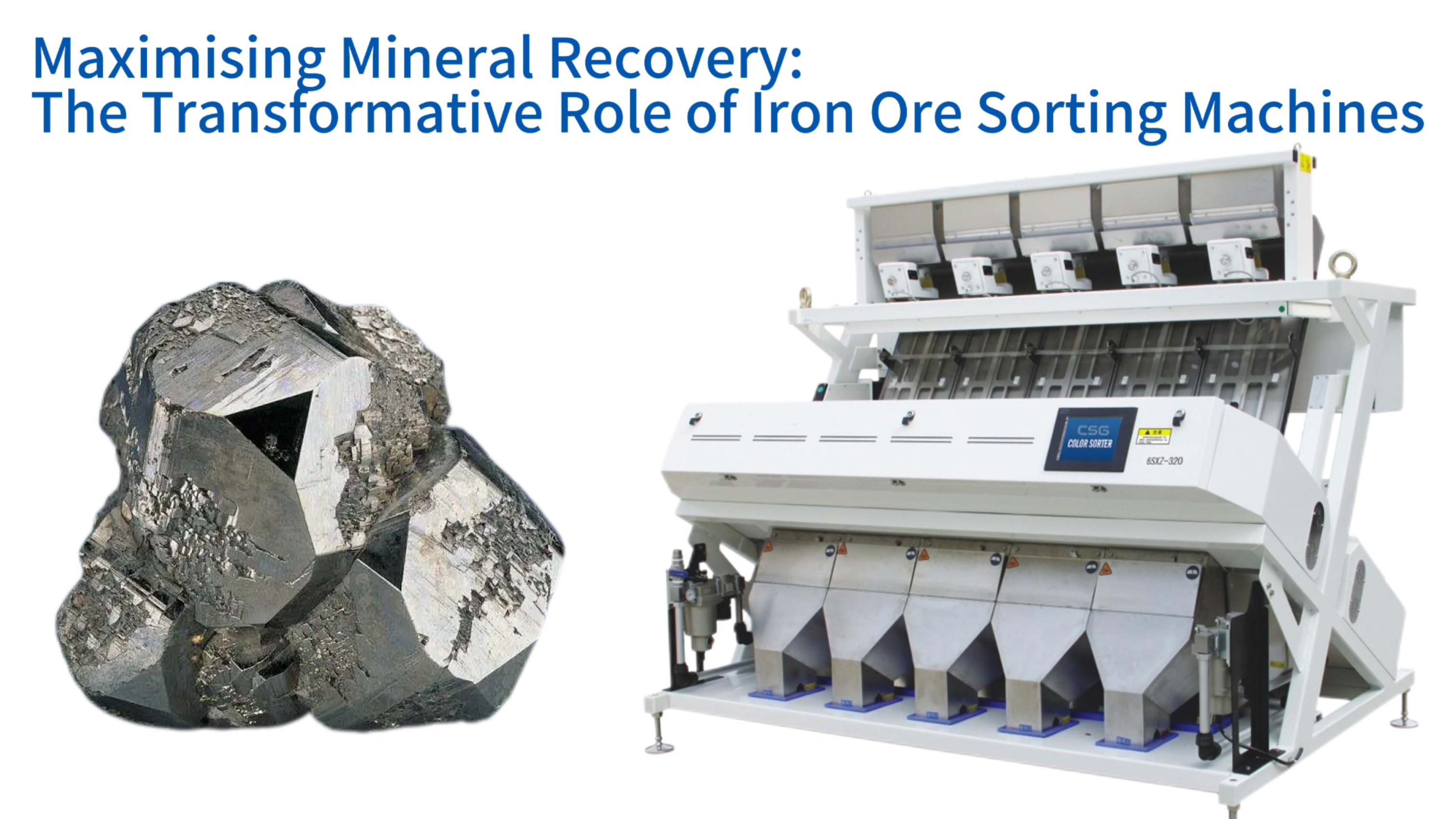
In the journey from rough rock to refined metal, the efficiency of separating valuable iron minerals from worthless waste rock—known as gangue—determines the profitability and sustainability of a mine. Traditional methods often sent all extracted material to energy-intensive mills, wasting power and water on rocks that contained little to no iron. Today, a new generation of intelligent sorting machines, driven by artificial intelligence and advanced sensors, is rewriting this story. By precisely identifying and ejecting individual particles of iron ore at the very beginning of the processing stream, these systems dramatically increase the overall mineral recovery rate. This article explores the inner workings, benefits, and future of iron ore sorting technology, explaining how it turns marginal deposits into economic assets while conserving resources.
1. Fundamentals of Iron Ore Sorting: From Simple Vision to Intelligent Perception
Evolution of Iron Ore Sorting Technologies
Manual Picking & Simple Screening
Slow, Inaccurate (60-70% Recovery)
Color Cameras & Lasers
Basic Optical Sorting
Sensor-Based Technologies
XRT + NIR (Up to 40% Waste Rejection)
AI-Driven Multi-Sensor Sorting
>95% Ejection Accuracy
Iron ore sorting is no longer just about colour. Modern machines perceive the invisible—atomic density, molecular composition, and even crystalline structure. This leap from simple optical sorting to multi-dimensional sensing forms the bedrock of recovery improvement. By understanding exactly what constitutes an iron-rich particle, the sorter can make split-second decisions that were previously impossible for human sorters or basic cameras.
The evolution began with manual pickers and simple screening, but those methods were slow and inaccurate. The integration of sensor-based technologies, such as X-ray transmission and near-infrared spectroscopy, allows for the detection of iron minerals even when they are locked within composite rocks. This foundational capability ensures that fewer valuable fragments end up in the waste pile, directly lifting the recovery rate.
Historical Methods and Their Inherent Losses
Before the advent of automated sorters, mines relied on dense media separation or jigs that processed bulk streams, often misplacing fine or complex iron ore particles. These older techniques could not differentiate between a piece of high-grade hematite and a similar-looking piece of chert, leading to significant losses of valuable material to tailings. Recovery rates often stagnated around 60-70%, leaving a considerable portion of the resource behind.
Furthermore, these methods consumed vast amounts of water and energy, making them both economically and environmentally costly. The inability to adapt to varying ore characteristics meant that as the mine face changed, recovery would fluctuate unpredictably. This historical context highlights the urgent need for smarter, more precise separation technologies that could see beyond the surface.
Transition to Sensor-Based Technologies
The shift began with the introduction of colour cameras and simple lasers, but the real breakthrough came with XRT (X-Ray Transmission) sorting machines, which could measure the atomic density of each particle. For iron ore, where iron atoms are much denser than silicon or oxygen in gangue, this was a game-changer. Soon after, near-infrared sensors added the ability to identify specific iron oxide minerals like goethite and limonite, which appear similar to the naked eye.
This transition enabled mines to pre-concentrate ore before milling, rejecting up to 40% of the feed as waste rock with minimal loss of iron units. The technology proved particularly effective for complex ores where visual cues are absent. Today, sensor-based sorting is considered the standard for new projects aiming for high recovery and low operating costs.
Core Components of a Modern Sorting Machine
Core Components of Modern Iron Ore Sorting Machine
Feeder System
Monolayer Particle Presentation
Sensor Array
Physical/Chemical Data Capture
AI Processing Unit
Real-time Decision Making
Ejection Mechanisms
Precision Air Jets
At its heart, an iron ore sorting machine consists of four main elements: a feeder system that presents a monolayer of particles, a sensor array that captures physical and chemical data, a real-time processing unit running deep learning algorithms, and high-speed ejection mechanisms usually comprising precision air jets. Each component must work in perfect harmony to achieve the desired recovery rate. The feeder ensures particles are spaced apart, allowing sensors to analyse each one individually without overlap.
The processing unit, often an industrial computer with graphics cards, interprets the sensor data in milliseconds. It compares the signature of each rock against a constantly evolving digital model of what constitutes 'ore'. This self-improving capability means that the machine becomes more accurate as it processes more material, learning to recognise even the most subtle indicators of valuable iron minerals.
Particle Size Ranges and Throughput Capabilities
Iron Ore Sorter Particle Size & Throughput Capabilities
| Machine Type | Particle Size Range (mm) | Typical Throughput (tonnes/hour) | Ejection Accuracy |
|---|---|---|---|
| Belt-type AI Sorter | 30 - 300 | 100 - 300+ | >98% |
| Chute-type AI Sorter | 6 - 30 | 50 - 200 | >98% |
| General Range | 6 - 300 | 50 - 300+ | >98% |
Iron ore sorters are designed to handle a wide spectrum of particle sizes, typically from as small as 6 millimetres up to 300 millimetres. This flexibility allows mines to sort material from different crushing stages. For instance, belt-type AI sorting machines excel with larger particles, providing a stable platform for detailed scanning, while chute-type machines are optimised for smaller, faster-moving grains. Throughput can range from 50 to over 300 tonnes per hour depending on the machine width and particle size, ensuring that even high-capacity operations can benefit from sorting without creating a bottleneck.
Processing such volumes while maintaining accuracy requires robust engineering. The air ejection systems, with hundreds of valves firing in precise sequence, must be capable of removing targeted particles without disturbing adjacent ones. Modern machines achieve ejection accuracy above 98%, meaning that almost every identified ore particle is successfully recovered, while waste is reliably rejected.
2. The Workflow of Recovery: How an Iron Ore Sorter Operates
Iron Ore Sorting Workflow Process
Step 1
Controlled Feeding
Particle Singularisation
Step 2
Multi-Sensor Data
XRT + NIR + Laser
Step 3
AI Decision Making
< 2ms Response Time
Step 4
Precision Ejection
Material Separation
The path a rock takes through a sorting machine is a story of rapid sensing, intelligent analysis, and decisive action. This sequence is where the theoretical promise of high recovery becomes a practical reality. Understanding this workflow reveals why AI-driven sorters are so effective at capturing every possible gram of iron.
From the moment material enters the vibrating feeder to the final split into product and reject bins, each step is optimised for precision. The elimination of human error and the consistency of machine-based decision-making ensure that recovery rates remain stable even as ore characteristics change throughout the day.
Controlled Feeding and Particle Singularisation
The process begins with a vibrating feeder that spreads the crushed ore into a thin, uniform layer. For chute-type AI sorting machines, particles slide down an inclined plane, accelerated by gravity to create separation. In belt-type systems, a conveyor belt carries the material under the sensors at a controlled speed. This step is crucial: if particles touch or stack, the sensors cannot accurately analyse each one, leading to misclassification and loss of recovery. Advanced feeders use tailored trough designs and frequency modulation to handle sticky or damp iron ore without clumping.
The goal is to present each rock individually to the sensor array. This singularisation allows the machine to assign a unique 'value' to every particle. Modern systems can process millions of particles per hour, each one evaluated on its own merit. This granular approach is far superior to bulk sorting, where good ore can be diluted by waste, or waste can carry away valuable minerals.
Multi-Sensor Data Acquisition
As the particles pass through the inspection zone, they are bombarded by various energy sources. X-rays reveal density differences, allowing the system to distinguish between pure hematite (density ~5 t/m³) and quartz (density ~2.6 t/m³). Near-infrared (NIR) sorters identify hydrated iron minerals and differentiate iron oxides from clays. Laser profilers measure the three-dimensional shape and size, which can indicate the liberation of iron minerals. This multi-sensor fusion creates a comprehensive 'fingerprint' for each rock, providing the data needed for high-confidence decisions.
The data streams are synchronised and sent to the processing unit at incredible speeds. A single machine may generate gigabytes of data per hour. The ability to handle this data flow in real time is what separates modern AI sorters from earlier, simpler devices. The richer the data, the more nuanced the sorting decisions, and the higher the potential recovery rate.
Real-Time AI Decision Making and Machine Learning
At the core of the sorter is a neural network trained on thousands of examples of ore and waste. This AI model does not simply apply a fixed colour threshold; it learns to recognise patterns. For instance, it might learn that a certain mottled texture on the surface of a rock correlates with internal iron content, based on feedback from downstream processes. This advanced detection capability means the machine continuously refines its sorting criteria. When a new vein of ore with slightly different appearance is encountered, the AI adapts, preventing a drop in recovery that would require manual recalibration in older systems.
The decision time is typically under two milliseconds. In that blink of an eye, the AI calculates the probability that a particle is valuable ore. If the probability exceeds a user-defined threshold, it triggers the ejection mechanism. This speed ensures that even fast-moving small particles are correctly sorted, maximising the recovery of every fragment.
Precision Ejection and Material Separation
Once the AI makes a decision, an array of solenoid valves fires a precisely aimed blast of compressed air. The air stream is powerful enough to deflect the chosen particle from its natural trajectory into the 'accept' bin, while waste particles continue on their path to the 'reject' chute. The timing and pressure must be perfect; if the air fires too early or late, the wrong particle is ejected, leading to either loss of ore or contamination of product. Modern machines use precision acceleration models to calculate the exact delay based on particle speed and size.
The physical separation is the final step in the recovery loop. After ejection, the sorted products can be sampled to verify recovery performance. This closed-loop feedback allows operators to fine-tune the AI models further, creating a virtuous cycle of continuous improvement. The result is a consistently high recovery rate that often exceeds 95% for well-liberated ores.
3. Direct Impact on Mineral Recovery: The Numbers Behind the Technology
Iron Ore Recovery Rate Improvements with Sensor-Based Sorting
| Ore Type / Scenario | Traditional Recovery Rate | Post-Sorting Recovery Rate | Improvement (Percentage Points) |
|---|---|---|---|
| General Iron Ore (Average) | ~75% | ~83% | 8% |
| Magnetite Ores | ~78% | ~83-85% | 5-7% |
| Hematite/Goethite Ores | ~70% | ~82-85% | 12-15% |
| Banded Iron Formations (BIF) | ~70% | ~80%+ | >10% |
| Hematite Operation (Case Study) | 72% | 84% | 12% |
Recovery rate—the percentage of valuable mineral extracted from the mined ore—is the ultimate metric of success. Iron ore sorting machines have demonstrated the ability to lift this figure by significant margins, often turning uneconomic projects into profitable ventures. This section quantifies those gains and explains the mechanisms behind them.
The improvements are not just incremental; in many cases, sorting enables the recovery of material that would otherwise be sent directly to the waste dump. By capturing these previously lost values, mines can extend their life and reduce their environmental footprint per tonne of product.
Pre-Concentration: Upgrading Ore Before Milling
Pre-Concentration: Ore Upgrading Before Milling (Example)
| Parameter | Before Sorting | After Sorting (Mill Feed) | Change |
|---|---|---|---|
| Feed Quantity (tonnes) | 100 | 70 | -30 tonnes (waste rejected) |
| Iron Grade | 40% | 52% | +12 percentage points |
| Total Iron Units | 40 tonnes | 36.4 tonnes | Minimal loss (~91% retention) |
| Mill Energy Consumption | 100% | 70% | -30% reduction |
One of the most powerful ways sorting boosts recovery is through pre-concentration. By removing barren or low-grade rock immediately after primary crushing, the mill only processes material that already has a high iron content. This means that for every tonne fed to the mill, a larger proportion is converted into final product. For example, a mine might feed 100 tonnes of ore grading 40% iron to the sorter. After removing 30 tonnes of waste, the 70 tonnes sent to the mill might now grade 52% iron. The recovery of iron units into the final concentrate often increases because the mill is not wasting energy on grinding waste rock that would dilute the feed.
Data from operating mines show that pre-concentration can increase the overall plant recovery by 5 to 15 percentage points. In one case, a hematite operation saw recovery jump from 72% to 84% after installing a belt-type sorter. This gain translated directly into more tonnes of iron ore product from the same mining rate, with no increase in mining cost.
Minimising Losses in Fine and Complex Fractions
Fine particles, typically below 10 millimetres, are notoriously difficult to process using conventional gravity or magnetic methods. They often report to tailings because they are too small for efficient separation. However, modern iron ore sorting machines equipped with high-resolution sensors can effectively sort particles down to 6 millimetres. By recovering iron from this fine fraction, which was previously lost, the overall recovery rate receives another boost.
Similarly, complex ores where iron minerals are intergrown with silicates present a challenge. Liberation might require fine grinding, which is energy-intensive. Sorting can often reject a portion of the composite particles that are mostly gangue, even if they contain some iron. This prevents those iron units from being sent to the tailings dam with the gangue after grinding. The net effect is a higher recovery of the iron that is truly recoverable at reasonable cost.
Case Example: Recovery Improvements in Banded Iron Formations
Banded iron formations (BIF) are a major source of iron ore but often contain alternating layers of hematite and chert. When crushed, these layers can produce particles that are partly ore and partly waste. Without sorting, such middlings particles might be discarded or diluted. AI sorters, using XRT and texture analysis, can often identify and recover particles where the iron-rich layer dominates. This selective recovery can increase the yield from BIF deposits by over 10% compared to simple density separation.
In practice, mines processing BIF have reported that sorting allows them to economically extract iron from material previously stockpiled as low-grade waste. This not only improves the current recovery rate but also unlocks value from historical waste dumps, contributing to circular mining practices.
Statistical Validation of Recovery Gains
Industry studies indicate that sensor-based sorting can increase the recovery of iron units by 8% on average across different ore types. For magnetite ores, where magnetic separation is the primary method, pre-sorting can remove silica-rich waste before the energy-intensive grinding stage, leading to recovery improvements of 5-7%. For hematite and goethite ores, the gains are often larger, sometimes reaching 12-15%, because these ores are harder to separate by traditional methods. These statistics are backed by extensive pilot plant trials and full-scale operational data.
Furthermore, the consistency of recovery improves. Manual or basic sorting methods often suffer from operator fatigue or changing light conditions, but AI-driven machines maintain the same high standard 24 hours a day. This stability ensures that the recovery rate remains at its peak, maximising the return on investment.
4. Core Technologies Enabling Superior Iron Ore Recovery
Core Sensing Technologies for Iron Ore Recovery
| Technology | Key Measurement | Precision/Capability | Primary Application |
|---|---|---|---|
| X-Ray Transmission (XRT) | Density / Atomic Number | 0.1 g/cm³ density resolution | Identify iron-rich particles (hematite/magnetite) regardless of surface color |
| Near-Infrared (NIR) Spectroscopy | Molecular Bonds / Mineral Type | Distinguish iron oxide minerals | Identify goethite/limonite, detect clay contaminants |
| 3D Laser Scanning | Shape / Liberation / Volume | 3D particle modeling | Assess mineral liberation, optimize ejection force |
| Hyperspectral Imaging | Surface Chemistry / Trace Elements | Hundreds of spectral bands | Detect trace iron minerals in tailings/stockpiles |
Behind the impressive recovery figures lies a suite of advanced sensor and computing technologies. Each plays a specific role in identifying and separating iron minerals from gangue. The synergy between these technologies creates a system far more capable than the sum of its parts.
Understanding these core technologies helps explain why AI sorters can achieve recovery rates that were once thought impossible. They are not just seeing colour; they are effectively 'seeing' chemistry and physics at the particle level.
X-Ray Transmission (XRT) for Density and Atomic Number
XRT technology measures how X-rays are absorbed by a material. Elements with higher atomic numbers, like iron (atomic number 26), absorb more X-rays than lighter elements like silicon (14) or oxygen (8). This allows the X-ray sorter to create an image where iron-rich areas appear darker. By analysing the average absorption of each particle, the system can accurately estimate its iron content, even if the particle is covered in dust or moisture. This is particularly valuable for dense iron ores like magnetite and hematite, where the density contrast with gangue is stark.
The precision of modern XRT sensors can detect density differences as small as 0.1 grams per cubic centimetre. This sensitivity means that even particles with only slightly elevated iron content can be identified and recovered, pulling value from what would otherwise be considered waste. XRT is also unaffected by surface colour, making it ideal for oxidised or stained ores.
Near-Infrared (NIR) Spectroscopy for Mineral Identification
While XRT sees density, NIR sees molecular bonds. Different minerals absorb and reflect infrared light at characteristic wavelengths. For iron ore, NIR can distinguish between hematite, magnetite, goethite, and limonite. This is crucial because these minerals have different economic values and require different downstream processing. For instance, goethite contains water molecules, which can affect pelletising and sintering. By identifying goethite-rich particles, the sorter can either reject them or route them to a specific process stream, optimising both recovery and product quality.
NIR sensors can also detect clay minerals that are often associated with iron ore. Removing these clays early improves the handling characteristics of the ore and reduces the load on downstream dewatering systems. The combination of XRT and NIR in a single machine provides a powerful toolkit for maximising recovery while maintaining product grade.
3D Laser Scanning for Shape and Liberation Analysis
The shape of a particle can indicate how well the iron minerals are liberated. Flat, elongated particles might be composite materials where iron and gangue are still attached. Laser profilers build a three-dimensional model of each particle as it passes through the sorter. The AI can then correlate shape with mineral composition from other sensors. For example, it might learn that particles with a certain aspect ratio are more likely to be middlings, and adjust the ejection threshold accordingly, potentially recovering some that would otherwise be rejected.
Furthermore, 3D data helps in calculating the exact volume of each particle, which, when combined with XRT density data, allows for a precise estimation of mass. This mass information can be used to control the air ejection force, ensuring that heavier ore particles receive a stronger blast, improving ejection accuracy and recovery.
Hyperspectral Imaging for Detailed Surface Chemistry
Taking NIR a step further, hyperspectral cameras capture data across hundreds of spectral bands, creating a detailed chemical map of the particle's surface. This can reveal trace elements or subtle variations in mineralogy that might indicate the presence of valuable iron minerals. While still an emerging technology in commercial sorting, hyperspectral imaging promises to push recovery rates even higher by identifying mineral phases that are invisible to other sensors.
In pilot studies, hyperspectral-based sorting has successfully recovered iron from stockpiled tailings that were previously considered barren. The technology's ability to detect even minute quantities of iron minerals means that the threshold for what is considered 'ore' can be lowered, effectively increasing the resource base and overall recovery.
5. Operational and Economic Ripple Effects of Higher Recovery
Operational & Economic Benefits of Higher Recovery
| Benefit Category | Reduction/Improvement | Key Impact |
|---|---|---|
| Grinding Energy Consumption | 20-40% Reduction | Lower electricity costs (40-50% of total site energy), reduced carbon emissions |
| Water Consumption | 20-50% Reduction | Less pressure on water resources, smaller tailings dams, lower environmental risk |
| Tailings Volume | 20-40% Reduction | Lower construction/closure costs for tailings facilities |
| Mine Life | Extended (Years) | Economic recovery of low-grade ore (20-25% Fe) that was previously uneconomic |
Improved mineral recovery is not an isolated benefit. It triggers a cascade of positive effects throughout the mining operation, from reduced energy bills to a smaller environmental footprint. These secondary gains often add up to more value than the direct increase in product tonnes.
By rejecting waste early, every downstream process becomes more efficient. This holistic improvement transforms the economics of iron ore production and makes operations more sustainable.
Reduced Grinding Energy Consumption
Grinding is the most energy-intensive step in mineral processing, often accounting for 40-50% of the total site energy cost. When a sorter removes 20-30% of the feed as waste, the mill only has to grind the remaining ore. This directly cuts electricity consumption by a similar percentage. For a large mine, this can mean millions of dollars in annual savings and a significant reduction in carbon emissions. The energy saved per tonne of final product can be as high as 30-40%.
This energy efficiency also allows mines to process lower-grade ores that were previously uneconomic due to high grinding costs. By pre-concentrating, the effective feed grade to the mill is raised, maintaining throughput and recovery even as the mine depletes its high-grade reserves.
Lower Water Consumption and Tailings Volume
Water is a scarce resource in many mining regions. Traditional processing, especially for fine iron ore, can consume large volumes of water in spirals, flotation cells, and tailings thickening. By discarding dry waste rock early, the sorter reduces the amount of material that needs wet processing. This can cut water consumption by 20-50%, easing pressure on local water supplies and reducing the size of tailings dams. Smaller tailings facilities mean lower construction and closure costs, as well as reduced environmental risk.
The waste rock rejected by the sorter is dry and can often be used for mine backfill or construction, further reducing the environmental footprint. This dry stacking of waste is far more sustainable than sending all material to a wet tailings dam.
Extended Mine Life Through Economic Recovery of Low-Grade Ore
One of the most profound impacts of high-recovery sorting is its ability to turn previously uneconomic low-grade resources into reserves. Mines can now profitably process material that was once considered waste, effectively increasing the mine's life without additional exploration. For example, a mine with an average grade of 35% iron might have significant tonnages of 20-25% iron material that was scheduled to be left in situ or stockpiled. With an efficient sorter, this low-grade material can be upgraded to a saleable product, adding years to the mine's operational life.
This capability also reduces the pressure to explore new, often more environmentally sensitive areas. By getting more value from existing mines, the industry can meet demand with a smaller surface footprint.
Improved Product Quality and Market Flexibility
Higher recovery does not mean sacrificing quality. On the contrary, sorting often improves the consistency of the final product. By removing specific contaminants like silica, alumina, or phosphorus, the sorter ensures that the iron concentrate meets stringent market specifications. This quality consistency allows mines to command premium prices and reduces penalties. It also provides flexibility; the sorter can be quickly reconfigured to produce different product grades in response to market demand, without major process changes.
For instance, if a customer requires a low-silica product, the AI can tighten its sorting parameters to reject particles with even small amounts of quartz. This ability to tailor the product mix on the fly, while maintaining high recovery of the target grade, gives mines a competitive edge.
6. Adapting Sorting Systems to Diverse Iron Ore Types and Conditions
Belt-Type vs Chute-Type AI Sorting Machines
| Characteristic | Belt-Type AI Sorter | Chute-Type AI Sorter |
|---|---|---|
| Optimal Particle Size | >30 mm (coarse/heavy) | 6-30 mm (fine/small) |
| Key Advantage | Stable surface, longer sensor exposure, gentle handling | High speed, compact design, cost-effective for fines |
| Best For | Friable ores, primary crushing stage | Hard ores, secondary crushing stage |
| Typical Throughput | 100-300+ tonnes/hour | 50-200 tonnes/hour |
Not all iron ores are the same. They vary in mineralogy, hardness, moisture content, and particle size distribution. A successful sorting installation must be tailored to these specific conditions to achieve maximum recovery. Machine configuration, sensor selection, and operational parameters all play a role.
The flexibility of modern AI sorters allows them to be optimised for everything from dry, dusty hematite ores to wet, sticky goethite-rich ores. This adaptability ensures that the promise of high recovery can be realised across the entire spectrum of iron ore deposits.
Belt-Type Versus Chute-Type Configurations
For coarse, heavy particles above 30 millimetres, belt-type machines are often preferred. They provide a stable surface, reducing bouncing and allowing for longer exposure to sensors. The belt also enables gentler handling, which is important for friable ores that might break apart if dropped. On the other hand, chute-type AI sorting machines are ideal for smaller particles (6-30 mm) where high speed and compact design are advantageous. The choice between the two directly affects recovery: using the wrong configuration can lead to misalignment, poor sensor readings, and lost ore.
Many modern plants use a combination: a belt sorter for the coarse fraction after primary crushing, and a chute sorter for the finer fraction after secondary crushing. This tiered approach ensures that particles of all sizes are processed in an optimal environment, maximising overall recovery.
Customisation for Particle Size Distribution
The feed to a sorter is rarely uniform. To maintain high recovery, the machine must handle a range of sizes simultaneously. Advanced sorters use multi-stage air valve banks with different nozzle sizes and pressures to effectively eject both small and large particles. Some systems also incorporate adjustable splitter positions to account for the different trajectories of particles based on size and density. This level of customisation is developed through extensive testing of ore samples in the manufacturer's test centres, where the exact parameters for maximum recovery are determined.
Furthermore, the AI algorithms can be trained on specific size fractions. They learn that a particle of 50 millimetres requires a different ejection delay than a 20-millimetre particle of the same composition. This dynamic adjustment ensures that every particle, regardless of size, has the best chance of being recovered.
Handling Moisture and Dust in Iron Ore
Iron ore can be damp, especially if mined in tropical regions or during rainy seasons. Moisture can cause particles to stick together, disrupting feeding and blinding sensors. Specialised feeder liners, vibration patterns, and air knives are used to keep the material flowing. Sensors are housed in pressurised enclosures with air curtains to prevent dust from settling on lenses. These engineering details are critical; if the sensors cannot 'see' clearly, recovery will plummet.
For extremely sticky ores, some sorters incorporate heating elements or de-dusting systems. The AI can also be programmed to recognise when dust is affecting readings and flag the need for maintenance. By ensuring consistent sensor performance, the machine maintains its high recovery rate even under challenging conditions.
Integration with Existing Crushing and Conveying Circuits
A sorter is not a standalone device; it must fit seamlessly into the existing plant layout. This often means installing it between crushing stages, with feed and product conveyors that match the plant's capacity. The control system of the sorter needs to communicate with the plant's distributed control system (DCS) to adjust feed rates and provide real-time data on recovery and grade. Successful integration ensures that the benefits of sorting—higher recovery, lower energy use—are realised without disrupting upstream or downstream operations.
Mines often start with a pilot installation to validate performance before scaling up. This phased approach allows for fine-tuning of the integration and builds confidence in the technology. The data gathered during this phase is used to optimise the sorting parameters, ensuring that when the full-scale system is commissioned, the recovery targets are met from day one.
7. Future Horizons: AI, Automation, and Sustainable Iron Ore Recovery
Future Development of Iron Ore Sorting Technology
Current State
AI Multi-Sensor Sorting
95%+ Ejection Accuracy
Short-Term (1-3 Years)
Edge AI & Real-Time Learning
Autonomous Calibration
Mid-Term (3-5 Years)
Predictive Maintenance
99%+ Uptime
Long-Term (5+ Years)
Digital Twin Integration
Full Process Optimisation
The future of iron ore sorting lies in the convergence of artificial intelligence, automation, and sustainability. As the mining industry faces increasing pressure to reduce its environmental footprint while maintaining productivity, sorting technology will continue to evolve to meet these dual demands. The next generation of sorting systems will not only recover more iron but will do so with even greater efficiency and autonomy.
This evolution is driven by advances in computing power, sensor technology, and machine learning algorithms. The result will be a fully integrated, self-optimising system that adapts to changing ore conditions in real time, minimises human intervention, and maximises both economic and environmental performance.
Advanced AI and Machine Learning: From Reactive to Predictive Sorting
Current AI sorters use reactive learning—they adjust their parameters based on feedback from recently processed material. Future systems will move to predictive AI sorting, where the machine uses historical data, geological models, and real-time mine data to anticipate changes in ore characteristics before they reach the sorter. For example, if a mine is advancing into a new ore zone with different mineralogy, the AI can pre-adjust its sorting criteria, ensuring no drop in recovery during the transition.
These advanced models will also incorporate reinforcement learning, where the sorter 'explores' different sorting parameters in a controlled way to find the optimal balance between recovery and grade. This self-exploration capability will allow the machine to continuously improve its performance, even in highly variable ore bodies where manual optimisation would be time-consuming and inefficient.
Autonomous Operation and Predictive Maintenance
The goal of full autonomy in sorting is no longer distant. Future systems will integrate with autonomous mining fleets and conveyor systems, creating a seamless flow from pit to processing plant with minimal human intervention. Sensors on the sorter will monitor not just ore particles but also the machine's own health—tracking wear on air valves, sensor calibration, and feeder performance. Predictive maintenance algorithms will analyse this data to schedule maintenance before failures occur, reducing unplanned downtime from typical industry averages of 5-10% to less than 1%.
This level of autonomy will also include remote operation centres, where a single technician can monitor multiple sorters across different mine sites. The reduction in on-site personnel not only lowers operational costs but also improves safety by removing workers from potentially hazardous areas.
Digital Twin Integration for Full Process Optimisation
Digital twins—virtual replicas of physical sorting systems—will become standard in future operations. The digital twin will simulate the performance of the sorter under different feed conditions, allowing operators to test new parameters or scenarios without disrupting production. By integrating the sorter's digital twin with the mine's overall digital twin, the entire value chain can be optimised holistically. For example, the model can determine the optimal crushing size to maximise both sorter throughput and recovery, balancing upstream and downstream processes for maximum overall efficiency.
These digital twins will also enable what-if analysis for sustainability goals. Operators can simulate the impact of different recovery targets on energy consumption and water use, allowing them to make data-driven decisions that balance economic and environmental objectives.
Miniaturisation and Mobility: Portable Sorting for Remote and Small-Scale Mines
Current sorting systems are large, fixed installations suitable for high-capacity operations. Future developments will include portable iron ore sorters—compact, modular units that can be transported to remote mine sites or used for small-scale operations. These mobile units will use the same advanced sensor technology as large systems but in a more energy-efficient package, making sorting accessible to mines that previously could not justify the capital cost of a fixed installation.
Portable sorters will also play a role in mine rehabilitation, allowing operators to process waste rock or stockpiles on-site, reducing the need for transportation and lowering the carbon footprint of mine closure activities.
Sustainability: Maximising Recovery While Minimising Environmental Impact
The future of sorting is intrinsically linked to sustainability. New sensor technologies will require less energy, and air ejection systems will be optimised to use compressed air more efficiently, reducing the energy required for sorting by a further 10-15%. Additionally, sorters will be designed to recover not just iron but also other valuable minerals present in the ore, such as rare earth elements or phosphorus, turning waste into revenue streams and reducing the need for dedicated mining of these minerals.
By maximising the recovery of iron from existing resources, sorting technology will extend the life of mines and reduce the need for new greenfield developments. This, combined with lower energy and water use, will make iron ore production significantly more sustainable, aligning with global climate goals and community expectations.
Conclusion: The Enduring Impact of Sorting on Iron Ore Recovery
Iron ore sorting machines have already transformed the economics and sustainability of iron ore production, lifting recovery rates by 8-15 percentage points across different ore types. From simple optical sorters to today's AI-driven multi-sensor systems, the technology has consistently delivered on its promise to recover more value from every tonne of mined rock.
Looking forward, the integration of predictive AI, autonomy, and digital twins will push recovery rates even higher, while simultaneously reducing the environmental footprint of mining. For the iron ore industry, sorting is no longer just a processing step—it is a strategic technology that underpins the industry's ability to meet growing global demand for steel in a sustainable way. As ore grades continue to decline worldwide, the role of intelligent sorting in maximising mineral recovery will only become more critical.