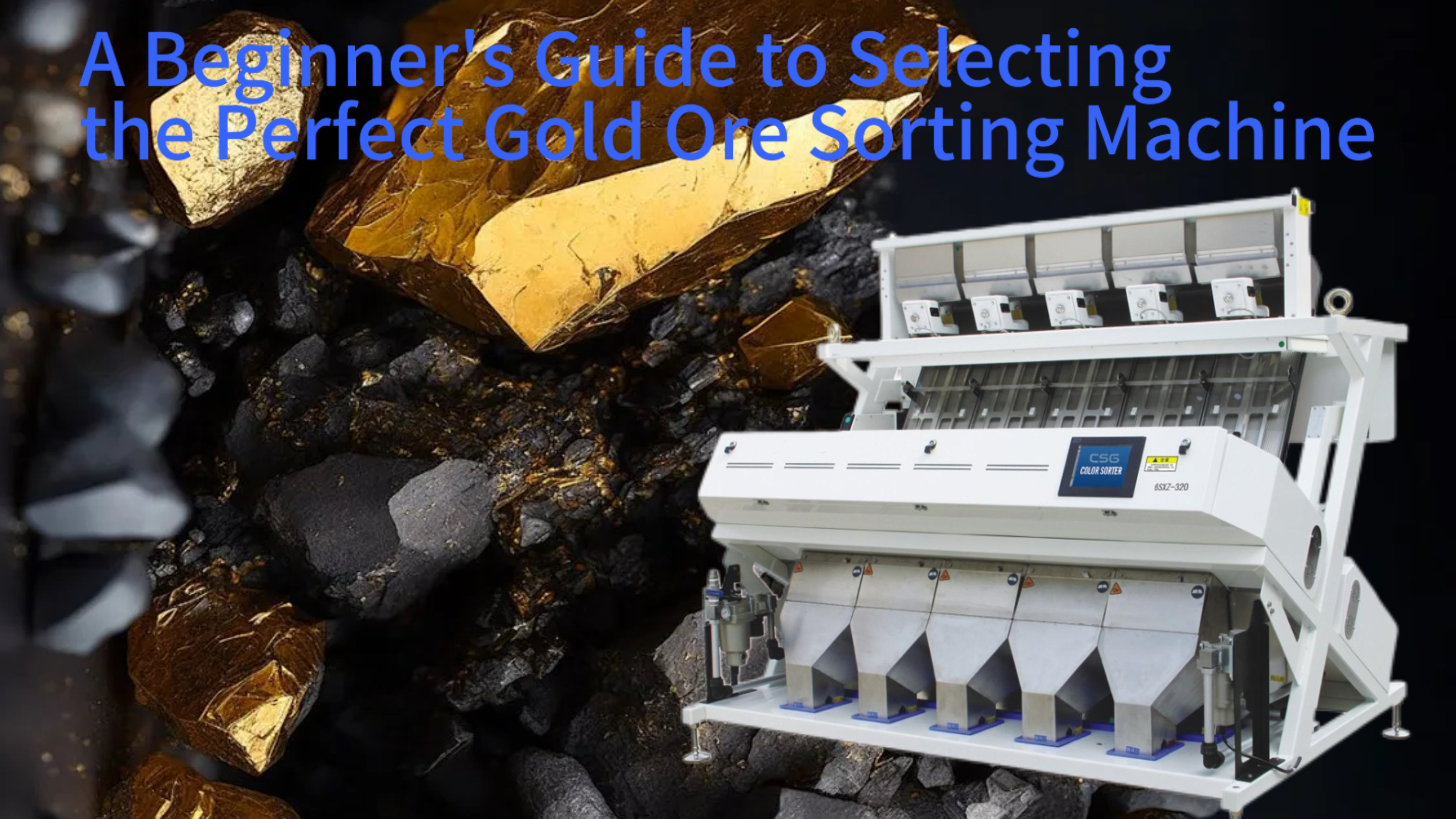
Core Steps for Selecting a Gold Ore Sorting Machine
Analyze mineralogy, liberation size & gangue composition
Choose XRT/NIR/Dual-Energy X-ray based on ore properties
Check throughput, accuracy & site compatibility
ROI analysis, vendor selection & scaling planning
Choosing your first gold ore sorting machine is a significant decision that can dramatically impact the efficiency and profitability of your mining operation. This guide is designed for newcomers to the field, providing a clear, step-by-step framework for navigating the various technologies and considerations. We will explore how different gold deposit types influence machine selection, compare core sensor technologies like X-ray and Near-Infrared, and examine critical operational factors from throughput to site conditions. By understanding these fundamental principles, beginners can make an informed investment that aligns with their specific ore body and operational goals, transforming raw material into a more concentrated and valuable product right at the mine face.
Understanding Your Gold Ore: The First Critical Step
Ore Type vs. Sorting Strategy
| Ore Type | Key Characteristics | Optimal Sorting Approach | Critical Considerations |
|---|---|---|---|
| Free-Milling Ore | Coarse, liberated gold; gravity/cyanidation recoverable | XRT (density-based detection) | Crush size 10-100mm; density contrast with gangue |
| Refractory Ore | Gold locked in sulfides (pyrite/arsenopyrite) | NIR (mineralogy-based detection) | Detect host sulfide minerals; spectral signature contrast |
| Low-Grade Ore | Low gold concentration; high waste content | High-rejection XRT/Dual-Energy X-ray | Maximize waste rejection (50%+); upgrade head grade |
Key Data: Proper ore characterization improves sorting efficiency predictions by over 70%.
The journey to selecting the right sorter begins not with the machine, but with a deep understanding of the material you need to process. Gold ore is notoriously diverse, and its physical and chemical characteristics directly dictate which sorting technology will be effective. The form in which the gold occurs—whether as coarse, free-milling particles or as fine grains locked within other minerals like pyrite or arsenopyrite—is the primary determining factor. A machine that excels at detecting liberated gold may be completely blind to gold that is microscopically dispersed within sulfide host rocks, making ore characterization through mineralogical studies an essential pre-purchase activity.
The Importance of Ore Characterization and Mineralogy
Before considering any machinery, conducting a detailed ore characterization study is non-negotiable. This involves assessing the particle size distribution of your crushed ore, as sorters typically operate within specific size ranges, often between 10mm and 100mm. More importantly, it requires understanding the gold's liberation size. If the gold is largely free and visible at a coarse crush size, a sorter can be used early in the process to reject waste. However, if the gold is finely disseminated, the ore may require finer grinding before sorting becomes viable, or it may necessitate a sensor technology that can detect the host mineral rather than the gold itself. Industry reports suggest that proper characterization can improve sorting efficiency predictions by over 70%, preventing costly mismatches between machine capability and ore reality.
Differentiating Between Free-Milling and Refractory Ores
Free-milling gold ores, where gold is readily liberated through crushing and can be recovered by gravity or cyanidation, often present excellent opportunities for sensor-based sorting. In these cases, the gold itself can be the detection target if it presents a distinct density or conductivity signature compared to the gangue. Refractory ores, where gold is locked inside sulfide minerals, require a different approach. Here, the sorter must be chosen to identify the gold-bearing sulfide particles (e.g., arsenopyrite or pyrite) based on their atomic density or mineralogical spectrum, effectively pre-concentrating the material that will later undergo more intensive processing like roasting or pressure oxidation. Selecting a machine without this distinction can lead to the valuable material being erroneously ejected as waste.
Analyzing Waste Rock and Gangue Composition
The success of sorting relies as much on identifying waste as it does on finding value. A thorough analysis of your waste rock or gangue mineralogy is crucial. The sensor technology you choose must be able to consistently and reliably differentiate between the valuable signal and the background. For instance, if the waste rock contains minerals with densities similar to gold-bearing particles, a density-based sorter like an X-ray Transmission (XRT) system may struggle. Conversely, if the waste rock has a distinct color or mineralogical signature from the gold-bearing material, as is often explored with color sorting or Near-Infrared (NIR) technology, the separation can be highly effective. Understanding the contrast between ore and waste is the foundation of a successful sorting application.
Core Sorting Technologies for Gold Exploration
Comparison of Gold Sorting Sensor Technologies
X-ray Transmission (XRT)
Principle: Differential X-ray absorption (density detection)
Best For: Coarse liberated gold, dense sulfide-hosted gold
Strengths: Detects internal material (not just surface)
Typical Recovery: >90% for high-contrast ores
Near-Infrared (NIR)
Principle: Molecular composition/spectral fingerprinting
Best For: Refractory ores (arsenopyrite/pyrite host)
Strengths: Mineralogy-based discrimination
Limitations: Surface-only detection
Dual-Energy X-ray/Conductivity
Principle: Density + atomic number/electrical conductivity
Best For: Similar-density ore/waste differentiation
Strengths: Enhanced discrimination power
Use Case: Conductive sulfide mineral detection
With a firm grasp of your ore's characteristics, you can now explore the sensor technologies that power modern sorters. Each technology interacts with material in a unique way, detecting different physical properties. There is no universally "best" technology; the optimal choice is entirely dependent on the specific signature your gold or gold-bearing mineral presents against its waste background. The most common technologies employed in gold sorting are X-ray Transmission, Dual-Energy X-ray, and Near-Infrared spectroscopy, each with its own strengths and ideal use cases for a beginner to evaluate.
X-ray Transmission (XRT) Sorting Technology
XRT sorting is one of the most prominent technologies in the gold sector, particularly for ores where gold is associated with high-density minerals. It works by measuring the differential absorption of X-rays as they pass through a material. Particles with higher atomic density, such as those containing gold or dense sulfide minerals, absorb more X-rays and appear darker on the sensor. This allows the system's computer to identify and eject them. XRT is exceptionally effective for coarse, liberated gold or for gold hosted in dense sulfides where there is a clear density contrast with the surrounding waste rock. Its main advantage is the ability to detect valuable material inside a particle, not just on the surface, making it a powerful tool for many gold deposit types.
Near-Infrared (NIR) and Laser Sorting Technology
Near-Infrared technology operates on a different principle, identifying materials based on their molecular composition. When NIR light is shone on a particle, specific chemical bonds within the minerals vibrate and absorb characteristic wavelengths of the light. The reflected spectrum acts like a fingerprint, allowing the system to identify mineral types. This is exceptionally useful for gold ores where the valuable component is a specific gold-bearing mineral like arsenopyrite, which has a distinct spectral signature. NIR can differentiate between different types of alteration or sulfide minerals, enabling the sorting of ore based on mineralogy rather than density. For certain complex ore bodies, this sensor-based approach can provide a selectivity that density-based methods cannot.
Dual-Energy X-ray and Conductivity-Based Sorting
Beyond standard XRT, more advanced X-ray techniques like Dual-Energy X-ray systems can provide additional discrimination power. By using two different X-ray energy levels, these systems can gather data on both density and atomic number, offering better differentiation between materials with similar densities but different elemental compositions. Additionally, some sorting systems utilize electromagnetic or conductivity sensors. These are particularly relevant for gold ores where the valuable particles are associated with conductive sulfide minerals. The machine can detect the conductivity difference between a sulfide particle and non-conductive silicate waste, providing another pathway for effective pre-concentration. Understanding these nuanced technological options is key for beginners assessing which system offers the clearest "detection window" for their specific ore.
Evaluating Machine Performance and Operational Needs
Key Performance Metrics & Site Requirements
Critical Performance Metrics
| Site Environment | Machine Requirements | Key Modifications |
|---|---|---|
| Dry/Dusty Desert | High dust resistance | Enhanced dust-proofing; sealed sensor cabinets |
| Humid/Tropical | Corrosion resistance | Corrosion-resistant materials; dehumidified enclosures |
| High Altitude | Temperature stability | Climate-controlled electronics; adjusted pneumatic systems |
After identifying the suitable sensor technology, the next phase involves matching the machine's performance specifications to your operational reality. A gold ore sorter is not an isolated unit; it must integrate seamlessly into your existing or planned processing plant. Key considerations include the required throughput tonnage, the particle size range you need to process, and the often-overlooked environmental conditions of your mine site. A machine with excellent laboratory results but inadequate capacity or poor environmental resilience will not deliver the promised value in a real-world mining setting.
Assessing Throughput Capacity and Particle Size Range
Machine throughput, measured in tons per hour, must align with your mine's production schedule. Beginners should carefully calculate the volume of material they intend to feed to the sorter, considering both current needs and future expansion. It is often wiser to select a machine with some spare capacity. Equally critical is the particle size range. The sorter must be engineered to handle the specific size fraction you've identified as optimal after your ore characterization. Feeding material that is too fine or too coarse for the machine's design will lead to poor accuracy, material blockage, and reduced efficiency. The design of the material feeding system is paramount to ensuring a consistent, single-layer flow of particles past the sensors, which is a prerequisite for high accuracy.
Understanding Ejection Accuracy and System Reliability
The core promise of a sorter is its ability to make correct "keep or reject" decisions for thousands of particles every second. This is quantified by metrics like recovery (percentage of target gold recovered to the concentrate) and rejection (percentage of waste rock correctly sent to tailings). A high-performance sorter for gold can achieve recovery rates above 90% while rejecting 50% or more of the waste. Beginners should request data from tests conducted on their own ore samples. Equally important is overall system reliability and Mean Time Between Failures (MTBF). Mining environments are harsh, and the sorter must be robustly built with accessible components for maintenance. Downtime directly translates to lost revenue, so reliability is as crucial as initial accuracy.
Factoring in Site-Specific Environmental Conditions
The physical environment of your operation plays a major role in machine selection. Is the sorter intended for a dry, dusty desert environment or a humid, tropical location? Will it operate in an area with wide temperature fluctuations or at high altitude? These conditions affect sensor performance, pneumatic systems, and electronic cooling. Machines destined for rugged environments require enhanced dust-proofing, climate-controlled cabinets for sensitive electronics, and corrosion-resistant materials. Furthermore, access to stable electrical power and compressed air must be confirmed. A full understanding of these site-specific factors ensures the chosen sorter will operate reliably day in and day out, as explored in strategies for advanced detection systems in challenging conditions.
Calculating Financial Viability and Return on Investment
Financial Impact of Gold Ore Sorting
Operational Cost Savings
| Cost Category | Typical Savings | Notes |
|---|---|---|
| Grinding Energy | 20-50% | Less tonnage to mill; reduced power consumption |
| Reagent Consumption (Cyanide) | 15-40% | Lower volume of processed material |
| Transportation | Up to 50% | Waste rejected at mine face; less haulage |
| Tailings Management | 20-40% | Reduced volume of tailings to handle/store |
Key ROI Drivers
Low-grade ore upgrade: Turns marginal deposits into viable projects (improves NPV)
Waste rejection value: Shortens payback period (often < 2 years for high-waste ores)
Operational flexibility: Modular designs preserve resale value (30-50% of original cost)
Mine life extension: Lower cut-off grade enables processing of additional reserves
For any beginner, the ultimate question is whether the investment in a gold ore sorting machine makes financial sense. This involves looking beyond the initial purchase price to understand the total cost of ownership and the potential for revenue generation. The economic argument for sorting is compelling: by removing a significant portion of waste rock early in the process, you drastically reduce the costs associated with transporting, crushing, grinding, and processing that worthless material. This calculation, known as the "value of waste rejection," forms the bedrock of the return on investment analysis and must be carefully modeled for your specific operation.
Analyzing Upfront Costs Versus Long-Term Operational Savings
The capital expenditure for a sorter is significant and includes the machine itself, installation, commissioning, and any required building modifications. However, this must be weighed against the substantial operational savings. Industry case studies frequently demonstrate reductions of 20-50% in downstream energy consumption for grinding, as less tonnage of material reaches the mill. Water usage in subsequent processes is similarly reduced. There are also savings in reagent consumption (like cyanide) and tailings management costs, as the overall volume of processed material decreases. For operations with high transportation costs from the mine to a central mill, the value of rejecting waste at the source can be exceptionally high, paying back the investment in a surprisingly short timeframe.
Modeling the Economic Impact on Low-Grade and Marginal Ores
One of the most powerful economic impacts of ore sorting is its ability to transform resource economics. It can make previously uneconomic, low-grade deposits viable by upgrading the feed to the processing plant. By rejecting a large fraction of waste, the head grade of material sent for further processing is increased. This can extend the life of a mine by allowing it to process lower-grade stockpiles or by lowering the operational cut-off grade. For beginners evaluating a new project, incorporating a sorter into the flow sheet can fundamentally improve the project's Net Present Value (NPV) by increasing recoverable reserves and reducing unit processing costs, turning a marginal prospect into a profitable venture.
Considering Operational Flexibility and Resale Value
Financial viability also encompasses flexibility. If your operation processes different ore types from multiple pits or veins, a sorter with easily reconfigurable software and settings may provide more value than a highly specialized unit. Furthermore, the potential future resale value of the equipment is a consideration. Robust, well-maintained sorting machines from reputable manufacturers retain value in the secondary market. This can partially de-risk the initial investment. Beginners should view the purchase not just as an expense but as a strategic capital asset that can enhance project economics, improve sustainability metrics by reducing energy and water intensity, and provide operational optionality for years to come.
Navigating the Vendor Selection and Support Process
Vendor Selection & Support Evaluation
Vendor Evaluation Process
Step 1: Request ore testing (300+ kg sample required)
Step 2: Review test data (recovery/rejection/throughput)
Step 3: Evaluate support (installation/training/parts)
Step 4: Review warranty/service agreements
Support Response Time: Target < 24hrs for regional support
Warranty: Sensor arrays (1-2yrs), main frame (3-5yrs)
Software Updates: Annual algorithm improvements
Choosing a reputable and supportive vendor is arguably as important as choosing the right technology. For a beginner, the relationship with the supplier will extend far beyond the sale, encompassing critical stages like ore testing, installation, training, and long-term maintenance. A vendor with deep application expertise in gold ores can provide invaluable guidance, helping you avoid pitfalls and maximize the performance of your investment. Their commitment to support can mean the difference between a machine that runs smoothly and one that becomes a source of constant operational headaches.
The Critical Role of Comprehensive Ore Testing
Any reputable supplier will insist on conducting representative ore tests before offering a final recommendation or quotation. This typically involves sending several hundred kilograms of your sample material to the vendor's test center. The material is run through a pilot-scale sorter to gather real data on recovery, rejection, and throughput. This test report is your most important piece of evidence for making a buying decision. It provides a realistic projection of the machine's performance with your specific ore. Beginners should never skip this step or rely solely on generic performance claims. A thorough test, potentially involving different sensor types like X-ray sorters or NIR sorters, de-risks the purchase and sets clear expectations.
Evaluating Installation, Training, and After-Sales Support
The vendor's proposal should include a detailed plan for installation, commissioning, and operator training. Proper installation by qualified engineers is essential for achieving design performance. Comprehensive training for your maintenance and operational staff ensures they understand how to run the machine optimally, perform basic troubleshooting, and conduct routine maintenance. Crucially, you must evaluate the vendor's after-sales support structure. What is the guaranteed response time for technical support? Do they have service engineers located in your region? What is the availability and cost of spare parts? A machine backed by a strong, responsive support network provides long-term peace of mind and protects your operational continuity.
Reviewing Warranties, Service Agreements, and Software Updates
Carefully review the warranty terms for different components, such as the sensor array, the high-speed pneumatic ejection system, and the central computer. Some critical components may have shorter warranties than the main frame. Many operators opt for a comprehensive service agreement, which for a predictable annual fee covers preventive maintenance, software updates, and priority support. In the rapidly evolving field of sensor-based sorting, regular software updates that improve the detection algorithms or system efficiency can deliver ongoing value. Ensuring you have access to these updates is an important part of the vendor selection process, keeping your investment at the forefront of technology throughout its lifespan.
Planning for Successful Implementation and Future Scaling
Implementation & Scaling Planning
Processing Flow Integration
Primary/Secondary
10-100mm Sizing
Concentrate/Waste
Upgraded Feed
Scalability Considerations
Modular Design: Parallel machine addition (2x capacity with 2 machines)
Reserve Capacity: Select machines with 20-30% spare throughput
Upgradeable Sensors: Support for future sensor suite upgrades (XRT → Dual-Energy)
Data Integration: Compatibility with mine management software for process optimization
The final stage for a beginner is to plan for the successful integration of the sorter into the mining workflow and to consider future needs. Implementation is more than just installing a machine; it involves preparing the site, integrating the sorter with upstream crushing and downstream conveying systems, and establishing new operating procedures. Furthermore, a well-considered purchase should account for potential future growth. Planning for scalability from the beginning, whether through selecting a modular design or a machine with reserve capacity, can save considerable expense and disruption when production needs increase.
Integrating the Sorter into the Existing Processing Flow Sheet
The sorter must be correctly positioned within your material flow. Typically, it is placed after primary or secondary crushing and screening, where ore is sized into the optimal range. You need to plan for feed conveyors, product (concentrate) conveyors, and waste (tails) conveyors. Dust extraction and control systems are often required. The electrical and compressed air supply must be reliably connected. This integration work requires careful engineering to ensure a smooth, continuous flow of material without bottlenecks or spillage. Close collaboration between your team and the vendor's engineers during this planning phase is essential to avoid costly rework or operational inefficiencies post-installation.
Developing Standard Operating Procedures and Data Monitoring
Once installed, developing clear Standard Operating Procedures (SOPs) is vital for consistent performance. These SOPs should cover startup, shutdown, routine operation, daily checks, and basic cleaning and maintenance tasks. Modern sorters are data-rich devices, continuously generating information on throughput, ejection counts, and system health. Establishing a routine for monitoring this data allows operators to spot trends, such as a gradual decline in sensor performance or an increase in air consumption, enabling proactive maintenance. Learning to leverage this operational data turns the sorter from a simple separator into a process optimization tool, providing insights that can inform mining and blending decisions upstream.
Considering Modularity and Expansion for Future Growth
For beginners, especially those in developing projects, it is prudent to consider future scalability. Some sorting system designs are inherently modular, allowing you to add a second machine in parallel to double capacity as your mine ramps up. Others may have the ability to upgrade sensor suites or processing computers. Discussing these possibilities with the vendor during the initial selection can inform your choice. Investing in a slightly more capable control system or a sturdier frame initially might facilitate a simpler and cheaper expansion later. Forward-thinking planning ensures that your first sorter is not a dead-end purchase but the first building block in a scalable, modern, and highly efficient mineral processing circuit designed to maximize gold recovery for years to come.
**Meta Description:** A beginner's step-by-step guide to selecting a gold ore sorting machine. Learn how ore type, sensor technology (XRT/NIR), throughput, and ROI analysis determine the right choice for your mining operation.