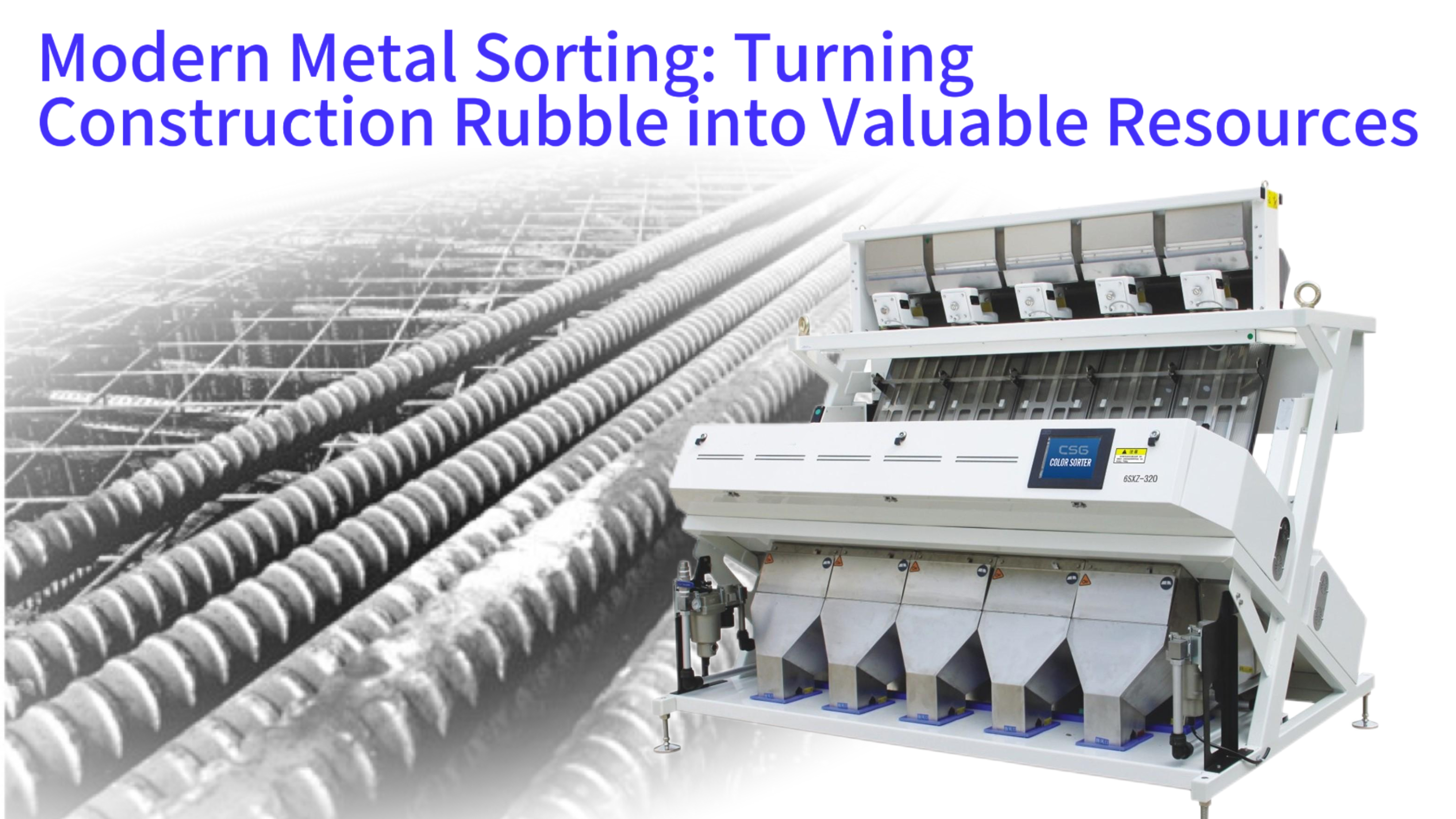
Core Process of Metal Sorting from C&D Waste
Every year, the construction and demolition (CD) industry generates a colossal amount of waste, much of which contains valuable metals like steel, copper, and aluminum. For decades, recycling this material was a slow, labor-intensive, and often imprecise process. Today, advanced metal sorting machines have revolutionized this field, offering a high-tech solution for the fine classification and recovery of metals from C&D scrap. These intelligent systems can accurately identify and separate different metal types at remarkable speeds, ensuring that more material is recovered at a higher purity, ready to re-enter the manufacturing cycle. This page will explore the critical role these machines play, detailing how they work, the specific metals they target, and the substantial economic and environmental benefits they deliver to the recycling industry and our planet.
The Challenge of Metal Recovery in Construction and Demolition Waste
Comparison of Conventional vs Advanced Sorting Technologies
Construction and demolition sites produce a uniquely complex waste stream. Unlike homogeneous industrial scrap, C&D debris is a tangled mix of concrete, wood, plastics, insulation, and various metals. These metals are not presented in clean, sorted bundles but are often embedded in concrete, painted, coated, or physically attached to other materials. Traditional methods like manual picking or basic magnetic separation are insufficient for this task. Magnets only recover ferrous metals, leaving valuable non-ferrous metals like copper wiring, aluminum window frames, and brass fittings behind in landfills. Furthermore, manual sorting is unsafe, inefficient, and cannot achieve the purity levels required by modern smelters, who impose strict penalties on contaminated loads. This complexity creates a significant barrier to achieving high recycling rates from C&D waste, despite the clear value locked within the metal component.
The Composition of C&D Metal Scrap
The metal fraction within construction debris is diverse. It primarily includes structural steel beams and rebar, which are ferrous and magnetic. However, the non-ferrous portion holds significant value and includes electrical wiring and pipes made of copper, lightweight framing and window components made from aluminum alloys, and various fixtures, valves, or door handles that may be made from brass or stainless steel. These materials are often comingled and coated, making visual identification nearly impossible after demolition. An advanced sensor-based sorting machine is essential to distinguish between these different metal types based on their inherent physical properties rather than their outward appearance, which is often obscured by dirt, paint, or corrosion.
Limitations of Conventional Sorting Methods
Conventional recycling for C&D scrap has historically relied on a series of crushing, screening, and basic separation steps. While effective for bulk volume reduction, these methods are crude for metal recovery. Electromagnets and eddy current separators are commonly used; the former captures iron and steel, while the latter repels non-ferrous metals like aluminum. However, eddy current systems cannot differentiate between different non-ferrous metals. This means a mix of copper, aluminum, and zinc all end up together in a lower-value "mixed non-ferrous" pile. This lack of precision results in financial loss and limits the recyclability of the materials, as copper contaminated with aluminum, for instance, cannot be used for high-conductivity applications.
The Economic and Regulatory Drivers for Better Sorting
Powerful economic and regulatory forces are pushing the industry toward advanced sorting solutions. Landfill costs and taxes are rising globally, making waste diversion a financial imperative. Simultaneously, governments are setting ambitious circular economy targets and implementing stricter rules for C&D waste management, requiring higher recovery rates. On the market side, the demand for high-quality secondary raw materials is soaring. Manufacturers seeking sustainable supply chains are willing to pay premium prices for sorted, clean metal fractions. This creates a direct economic incentive to invest in technology that can upgrade mixed, low-value demolition scrap into high-purity, commodity-grade copper, aluminum, and steel.
How Metal Sorters See and Separate What Humans Cannot
Working Flow of Advanced Metal Sorting Sensors
The core innovation of modern metal sorters lies in their ability to act as hyper-sensitive, high-speed identification systems. These machines go far beyond simply detecting if something is metallic. They can determine the exact type of metal by analyzing its fundamental material signature. The process begins with a consistent feed of pre-processed scrap. This material, typically sized and liberated from bulk concrete, travels at high speed past an array of sophisticated sensors. These sensors, which can include high-resolution optical cameras, advanced near-infrared (NIR) detectors, and powerful X-ray systems, collect vast amounts of data from each individual particle. This data forms a unique "fingerprint" for that particle, which is instantly analyzed.
This real-time analysis is powered by complex software algorithms that compare the scanned fingerprint against a pre-loaded library of material signatures. For example, the system knows the specific spectral response of 304 stainless steel versus 316 stainless steel, or the exact density and atomic signature of copper versus brass. When a match is found for a targeted metal type, the computer sends a split-second signal to the high-speed ejection system. This is typically a bank of precisely controlled air nozzles that fire a focused blast of air, physically diverting the selected particle into the correct collection chute. This all happens in milliseconds, allowing the machine to process several tons of material per hour with accuracy rates exceeding 95%.
The Role of X-ray Technology in Density Separation
One of the most powerful tools for sorting metals from dense C&D waste streams is X-ray transmission (XRT) technology. Unlike medical X-rays that create an image of shapes, industrial XRT sorters measure the material density and effective atomic number of each particle. This is crucial because metals have distinctly higher densities than plastics, wood, or rubber that may be mixed in. An X-ray sorter can easily distinguish a piece of copper wiring from a piece of PVC-coated cable or a stone. It can also separate different metals from each other; lead is much denser than aluminum, for instance. This makes XRT exceptionally effective for ensuring final purity, as it can eject last traces of non-metallic contaminants or wrongly classified metal pieces that other sensors might have missed.
Identifying Alloys and Coated Materials
A major challenge with C&D scrap is that metals are rarely in their pure, elemental form. Steel is an alloy of iron and carbon, often with other elements. Aluminum window frames are a specific alloy, different from aluminum cans. Furthermore, these materials are almost always painted, anodized, or otherwise coated. Advanced sorters overcome this. While a simple color sensor might be fooled by paint, technologies like Laser-Induced Breakdown Spectroscopy (LIBS) or sophisticated multi-sensor NIR can see through surface coatings to analyze the underlying metal's composition. This allows for precise alloy sorting, such as separating different grades of stainless steel or sorting cast aluminum from extruded aluminum, which maximizes the value of the output because each specific alloy commands a different price in the recycling market.
Integration with AI for Continuous Learning
The latest generation of sorters incorporates artificial intelligence (AI) to become smarter over time. An AI-powered sorter does not just rely on a fixed library of material signatures. As it processes material, it can learn from its ejections and outcomes. The system can be trained to recognize new or unusual material combinations specific to a certain type of demolition waste. For example, if a particular batch of scrap contains a unique brass fixture, the AI can learn its signature and ensure it is correctly sorted in future runs. This adaptive intelligence is key for handling the unpredictable and variable nature of C&D waste, leading to progressively higher purity levels, less material loss, and increased operational efficiency without constant manual reprogramming by an operator.
Targeting Specific Valuable Metals in the Debris Stream
Key Valuable Metals in C&D Waste & Sorting Details
Modern sorting systems are configurable to target specific high-value materials within the complex C&D stream. This targeted approach allows recyclers to tailor their operations to maximize revenue based on current market prices. The process is not about simply removing all metal from waste; it is about strategically extracting defined, clean fractions that can be sold directly to specific consumers. For instance, a recycler might first use a powerful magnet to remove all ferrous scrap, which is a straightforward process. The remaining non-ferrous mix, however, is where the advanced sorter creates its most significant value. By programming the machine to look for specific elemental or density signatures, it can pick out individual commodities from the mixed flow.
This precision recovery has a direct impact on profitability. Sending a mixed load of metals to a smelter results in a low, blended price. However, delivering a dedicated load of clean, shredded copper #1 commands the highest possible price. Similarly, a pure stream of extruded aluminum alloy is worth significantly more than a mix containing cast aluminum. By deploying sorters that can make these fine distinctions at high speed, recyclers transform from being waste processors into sophisticated raw material producers. This capability is central to the economics of modern C&D waste sorting facilities, allowing them to justify the investment in advanced technology through superior product output and higher margins.
Recovering Copper from Electrical and Plumbing Systems
Copper is one of the most valuable metals found in buildings, used extensively in electrical wiring, plumbing pipes, and HVAC systems. Recovering it efficiently is a top priority. After demolition, this copper is often tangled, insulated, or soldered to other metals. Post-shredding, advanced sorters, particularly those using XRT or high-sensitivity conductivity sensors, excel at identifying copper particles regardless of surface oxide (tarnish) or residual insulation flakes. They can separate pure copper from brass (a copper-zinc alloy) and from heavier metals like lead, ensuring the output meets the strict quality specs of copper mills. This recovered copper can then be melted and drawn into new wire, completing the circular loop with minimal quality loss.
Separating Different Aluminum Alloys
Aluminum is ubiquitous in construction in the form of window frames, siding, roofing, and structural components. These applications use different aluminum alloys with varying silicon, magnesium, or manganese content. Mixing these alloys during recycling downgrades the material. An advanced aluminum sorting machine using LIBS or advanced spectroscopic technology can perform real-time chemical analysis. It can distinguish between a 6063 alloy (common for extrusions) and a 380 alloy (common for die-casting). By keeping these streams separate, the recycled aluminum retains more of its inherent value and properties, making it suitable for demanding new applications like automotive parts or new building components, rather than being downcycled into lower-value products.
Isolating Stainless Steel and Other Specialty Metals
Stainless steel, often used in kitchens, bathrooms, and structural applications for its corrosion resistance, is another high-value target. It must be kept separate from regular carbon steel. Since both are magnetic, a simple magnet cannot tell them apart. However, their chemical composition is different. Sorters equipped with the right sensors can detect the presence of nickel and chromium, the key alloying elements in stainless steel. This allows the machine to eject stainless steel particles into a separate bin, creating a clean product stream. The same principle applies to other specialty metals like brass (from fixtures) or lead (from old roofing or radiation shielding), allowing for their dedicated recovery and preventing contamination of the more common metal streams.
From Demolition Site to New Product: The Sorting Process Flow
Complete C&D Metal Sorting Process Breakdown
Remove large metal items first
Transport mixed debris to facility
Crushing & screening
Magnetic ferrous separation
Monolayer feed preparation
Sensor scanning & ejection
Cleaning & quality control
Compacting & shipping
Implementing metal sorting is not about dropping a single machine at a demolition site. It is an integrated process that begins with demolition practices and ends with bagged or baled pure metal commodities. The first step is selective demolition, where efforts are made to remove large, easily separable metal items like beams or appliances beforehand. The remaining mixed debris is then transported to a dedicated recycling facility. Here, it undergoes primary processing: large pieces are broken down by hydraulic crushers, and the material is screened to remove fine dirt and sand. It may also pass under an overhead magnet to pull out the majority of ferrous scrap.
The remaining mixed non-ferrous and residual waste stream is then prepared for the advanced sorter. This often involves shredding or crushing the material to a consistent size and ensuring it is presented to the machine as a monolayer of particles via a smart material feeding system. This even spread is critical for the sensors to get a clear "view" of every piece. After being scanned and sorted, the ejected metal fractions are conveyed to their respective collection points. The sorted metals are then often cleaned further (e.g., delacquered) and compacted into dense bales for efficient transportation to smelters or foundries. The non-metallic residue, now largely free of valuable metal, is either used for alternative purposes like road base or sent to landfill, but its volume and environmental impact are drastically reduced.
Pre-processing and Feed Preparation
The success of the high-tech sorting stage is entirely dependent on proper pre-processing. The goal is to "liberate" the metals—that is, break apart composite materials so sensors can analyze individual pieces. This involves shredders, crushers, and hammer mills that reduce large chunks of concrete with rebar inside into smaller fragments where the metal is exposed. Screening decks then separate material by size, sending only the optimally sized fraction (e.g., 10mm to 100mm) to the sorter. A consistent and controlled feed rate is also vital. Vibratory feeders or conveyor belts with precise speed control ensure the material flows evenly into the sorter's scanning chamber, preventing piles of material that would block the sensors' view and lead to missed or incorrect ejections.
The High-Speed Scanning and Ejection Core
This is the heart of the operation. As prepared material flows through the scanning chamber, it is bombarded with various forms of energy—light, infrared, X-rays—depending on the sensor suite. High-speed computers process this data, making millions of decisions per second. When a target particle is identified, its position is tracked as it flies off the end of the conveyor belt. At the exact millisecond it passes the ejection array, a tiny, precise jet of compressed air is fired to knock it off its trajectory into the correct chute. The timing must be incredibly accurate, as particles are moving at several meters per second. This stage transforms data into physical action, creating the separation that adds value.
Post-Sorting Handling and Quality Control
Once sorted, the metal fractions are not necessarily finished products. They may undergo additional processing to enhance their value. For instance, aluminum fragments might go through a dry or wet cleaning process to remove any remaining paint, lacquer, or plastic labels. Copper wire may be chopped and granulated to separate any final bits of insulation. The final step is quality control. Samples from each sorted pile are often analyzed using handheld XRF guns to verify their chemical composition and purity. Once confirmed, the clean, homogeneous metal is densely packed. Aluminum might be baled, copper chopped wire is bagged, and stainless steel is shredded and piled. This packaging prepares the materials for efficient shipping to their next life in a manufacturing plant, where they will be melted and reborn as new products.
The Tangible Benefits: Environmental and Economic Impact
Resource & Energy Savings from Metal Recycling
The deployment of metal sorters in C&D recycling delivers a powerful dual benefit: it is both an environmental imperative and an economic opportunity. From an ecological standpoint, recycling metals from scrap uses only a fraction of the energy required to mine and process virgin ores. For example, recycling aluminum saves up to 95% of the energy needed for primary production. By efficiently capturing more metal from waste, these machines directly reduce greenhouse gas emissions, conserve natural resources, and minimize the landscape destruction associated with mining. They also drastically cut the volume of waste destined for landfills, reducing soil and water pollution from leachate and extending the lifespan of landfill sites.
Economically, the impact is equally transformative. For recycling facility operators, advanced sorting turns a cost center (waste processing) into a significant profit center (commodity production). The ability to produce high-purity, specification-grade metals commands premium market prices. This improves the business case for recycling, attracting investment and creating jobs in the green technology sector. For the broader economy, it creates a more secure and sustainable domestic supply of critical raw materials, reducing reliance on volatile international commodity markets and imported virgin materials. It fosters a true circular economy where buildings, at the end of their life, become the raw material for the next generation of infrastructure.
Quantifying Resource Conservation and Energy Savings
The numbers behind metal recycling are staggering and provide clear justification for advanced sorting. Recycling one ton of steel conserves approximately 1,100 kilograms of iron ore, 630 kilograms of coal, and 55 kilograms of limestone. For copper, recycling uses about 85% less energy than primary production. When a modern sorter increases the recovery rate of copper from C&D waste from, say, 70% to over 95%, the cumulative energy and resource savings at scale become monumental. These are not just theoretical benefits; they are quantifiable reductions in the environmental footprint of our built environment, contributing directly to corporate sustainability goals and national climate action plans.
Improving Operational Safety and Efficiency
Beyond pure economics and ecology, metal sorters profoundly improve working conditions. Manual sorting of demolition waste is hazardous, exposing workers to sharp objects, heavy lifting, dust, and potential exposure to hazardous materials like asbestos. Automating the most dangerous and tedious part of the job with an optical sorter or similar machine removes humans from harm's way. Furthermore, machines work tirelessly 24/7 with consistent accuracy, unaffected by fatigue. This leads to vastly higher and more predictable throughput. A single automated sorting line can process material that would require dozens of manual workers, and it does so with a level of purity and consistency that is impossible to achieve manually, leading to more stable and reliable output for customers.
Creating High-Quality Feedstock for Manufacturers
The final, crucial benefit is the creation of a superior secondary raw material. Manufacturers of metal products are increasingly demanding clean, reliable recycled content to meet their own sustainability pledges and reduce production costs. Contaminated scrap can cause defects in final products and damage expensive smelting equipment. By providing highly sorted, pure metal fractions, advanced sorting machines close the quality gap between scrap and virgin material. This builds trust and enables long-term supply contracts between recyclers and manufacturers. It allows a demolished office building to reliably provide the aluminum for new car parts or the copper for new wind turbines, creating a robust and efficient circular supply chain that benefits all participants.
The Future of Metal Sorting in a Circular Construction Economy
Future Development Roadmap of Metal Sorting Technology
• Faster processing speed
• AI self-optimization
• Sensor fusion technology
• Modular on-site sorters
• Design for Disassembly integration
• Full circular material loop
The future of construction is inherently linked to the principles of the circular economy, where waste is designed out, and materials are kept in use for as long as possible. Advanced metal sorting technology is the enabling tool that makes this vision practical for the legacy of existing buildings. Looking ahead, we can expect further integration and intelligence. Sorters will become even more connected, with data from the recycling facility feeding back to designers and demolition planners, informing material choices for future buildings to make them easier to disassemble and recycle—a concept known as Design for Disassembly (DfD).
Technologically, sorters will continue to become faster, more accurate, and more capable of handling finer material sizes. The integration of advanced detection technologies like hyperspectral imaging and more powerful AI will allow for the recognition of increasingly complex material combinations. We may also see the rise of smaller, more modular sorting units that could be deployed at larger demolition sites themselves, decentralizing the recycling process. The ultimate goal is a near-zero waste construction cycle, where every beam, wire, and pipe is accounted for and has a predetermined next use, with automated sorting machines acting as the indispensable sorting hub in this sustainable material loop.
Integration with Building Information Modeling (BIM)
A futuristic but plausible development is the direct link between Building Information Modeling (BIM) data and sorting machines. BIM is a digital 3D model of a building containing information about every component, including material types. When a building marked for demolition has a BIM model, this data could be used to pre-program the sorting machine. The system would "know" that a particular building contains specific types of aluminum alloy in its windows and a certain grade of copper in its wiring. This would allow for hyper-efficient, pre-planned sorting strategies, further optimizing recovery rates and purity from the very first batch of processed material from that site, moving from generic sorting to building-specific material recovery.
Advancements in Sensor Fusion and Machine Learning
The next leap in performance will come from sensor fusion—combining data from X-ray, NIR, LIBS, and visual cameras simultaneously for a single particle analysis. This multi-layered data approach will allow machines to overcome the limitations of any single sensor. Coupled with deeper machine learning algorithms, the sorter will not just identify materials but also predict and compensate for sensor "blind spots" caused by extreme dirt or unusual shapes. These self-optimizing systems will require less calibration, handle more variable input, and continuously refine their sorting logic without human intervention, pushing recovery rates and purity ever closer to 100% and further driving down the cost and environmental impact of securing vital metal resources.