Size Grade Sorting Machine
Color Grade Sorting Machine
Material Texture Grade Sorting Machine
Appearance Grade Sorting Machine
Foreign Matter Grade Sorting Machine
Application Grade Sorting Machine
Shape Grade Sorting Machine
Moisture Grade Sorting Machine
Maturity Grade Sorting Machine
Flatness Grade Sorting Machine
What is Material Grade Sorting
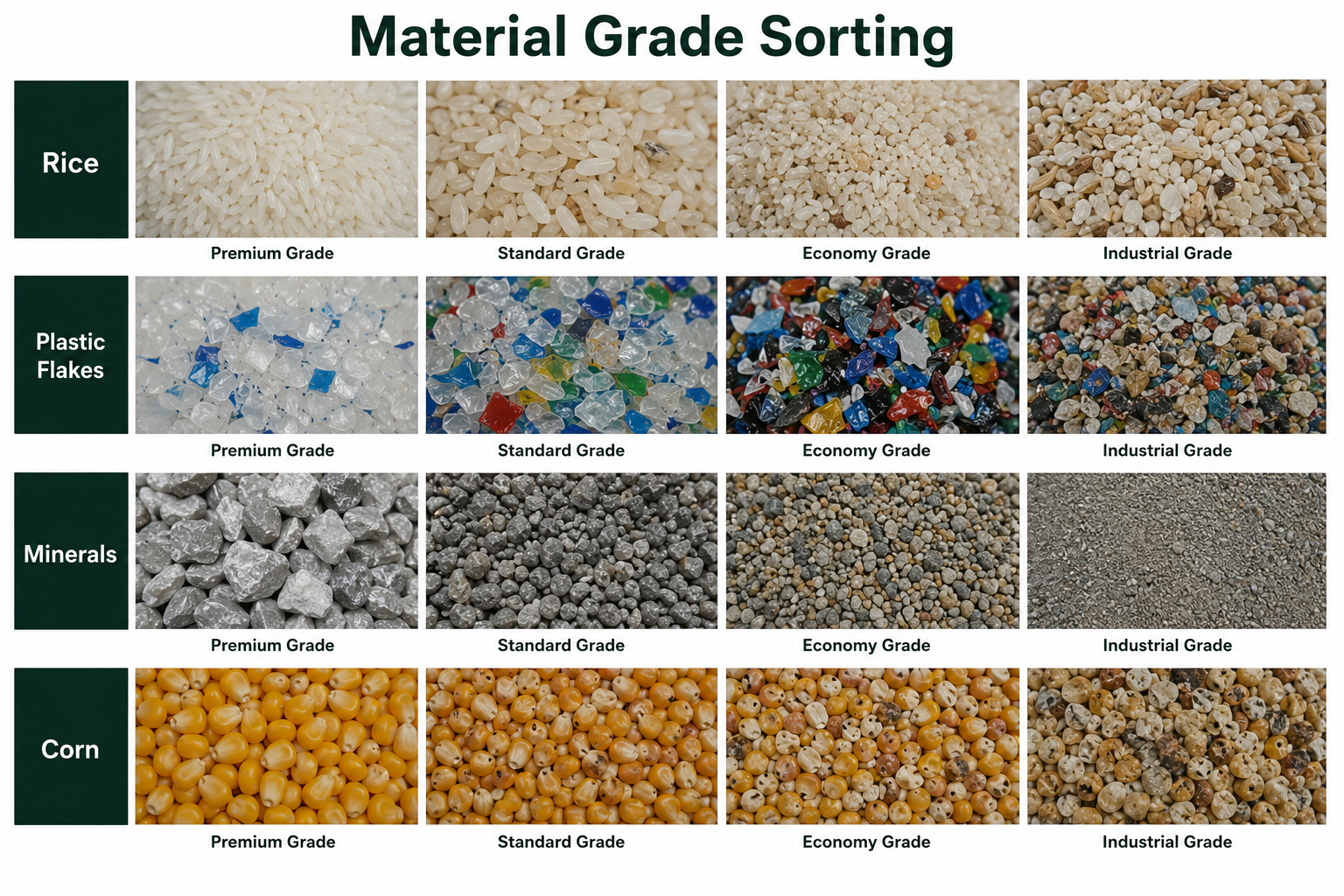
Material grade sorting is an advanced classification process that utilizes high-precision optical sorters and multi-spectral sensors to separate products based on quality tiers, size specifications, compositional purity, and performance characteristics. This technology ensures that materials are precisely categorized into premium, standard, economy, and industrial grades, maximizing market value and enabling application-specific utilization. With growing demand for consistent quality in global supply chains, grade sorting has become essential for processors seeking to optimize revenue across different market segments.
Modern material grade sorting solutions cater to diverse industries including agricultural processing, mineral beneficiation, plastic recycling, and pharmaceutical manufacturing. These systems help producers extract maximum value from single input streams by creating multiple output grades that command different price points. Whether it's separating rice into export-grade and domestic-grade, classifying plastic flake by melt-flow index, or sorting minerals by purity levels, automated grade sorting delivers consistency that manual methods cannot achieve.
Why Choose Material Grade Sorting?
❌ Limitations of Manual Grade Sorting
Inconsistent grade boundaries between different workers
Unable to detect subtle quality differences (protein content, moisture)
Slow throughput limits multi-grade separation capability
Subjective decision-making affects market pricing
Difficult to maintain documentation for grade traceability
Limited to 2-3 visible grade categories maximum
✅ Advantages of Automated Grade Sorting
Up to 6+ grade categories from single pass
Objectively consistent grade boundaries 24/7
Detects chemical and physical property differences
Maximizes revenue by optimizing grade distribution
Full traceability with grade-specific production logs
99%+ classification accuracy for most materials
🎯 Core Components of Material Grade Sorting System
Multi-Grade Optical Classification
High-resolution CCD cameras with programmable color and size thresholds enable separation into 2-8 distinct grade categories based on visual quality parameters.
NIR Composition Analysis
Near-infrared spectroscopy measures protein content, moisture levels, oil percentage, and other chemical properties to determine functional grade suitability.
Precision Size & Shape Sorting
Multi-dimensional laser profiling separates materials by length, width, thickness, and aspect ratio for consistent dimensional grading.
Multi-Stream Ejection System
Advanced nozzle array with programmable diversion paths directs each grade category to separate collection bins simultaneously.
Technical Specifications & Performance Metrics
Grade Categories
2-8 programmable grades
Premium / Standard / Economy
Industrial / Specialty / Reject
Processing Capacity
2-25 tons/hour
Up to 100,000 items/min
Grade-dependent throughput
Grade Accuracy
Premium grade: 99.5%
Standard grade: 98.5%
Overall classification: 99%
Detection Parameters
Color (RGB): 16.7M shades
NIR: 900-2500nm
Size: 0.1-100mm
Ejection Configuration
4-8 output channels
128-512 nozzles
Multi-grade simultaneous ejection
Yield Optimization
Grade distribution analytics
Real-time grade adjustment
Premium yield maximization
Grade Classification Parameters by Material Type
| Material Category | Grade Tiers | Sorting Parameters | Target Application |
|---|---|---|---|
| 🌾 Rice & Grains | Super, Grade A, Grade B, Broken, Brewery | Chalkiness % / Whole kernel % / Size | Export / Domestic / Processing / Beer |
| 🥜 Nuts & Seeds | Premium, Standard, Splits, Crushed, Industrial | Color uniformity / Size grading / Defect count | Snack / Bakery / Confectionery / Oil |
| 🫘 Pulses & Legumes | Premium, Grade 1, Grade 2, Split, Animal feed | Color / Size / Protein content / Moisture | Human consumption / Dal milling / Feed |
| ♻️ Plastic Recyclates | Clear/White, Mixed Color, Opaque, Industrial | Color purity / Melt-flow index / Density | High-value molding / Non-critical / Blending |
| Mineral & Aggregates | Premium grade, Standard, Low-grade, Tailings | Purity % / Particle size / Density | High-spec / Construction / Filler / Waste |
Grade Configuration & Market Value Optimization
| Configuration Mode | Grade Distribution | Value Strategy | Best For |
|---|---|---|---|
| Premium Maximization | 20% Premium / 50% Standard / 30% Economy | Highest price for top fraction | Export-oriented processors |
| Balanced Value | 10% Premium / 60% Standard / 30% Economy | Optimized total revenue | Multi-market producers |
| Standard Focus | 5% Premium / 80% Standard / 15% Economy | Maximum volume at mid-tier | High-volume commodity processors |
| Custom Grading | Tailored to buyer specifications | Contract-specific requirements | Private label / Contract processing |
How Material Grade Sorting Works
Material grade sorting systems integrate multiple detection technologies to evaluate each product against predefined grade specifications. As material flows through the inspection zone, optical cameras assess color uniformity and surface quality, NIR sensors measure chemical composition, and laser profilers determine dimensional characteristics. Advanced classification algorithms then assign each item to the appropriate grade category based on weighted scoring across all parameters.
The process begins with bulk material entering the vibratory feeder system, which creates a controlled single-layer stream for optimal inspection. As items pass through the multi-sensor detection zone, real-time analysis determines grade classification within milliseconds. The ejection system then directs each item to the corresponding grade collection bin using precisely timed air jets or mechanical diverters. Continuous monitoring of grade distribution enables real-time adjustment of classification thresholds to optimize yield and value.
📊 Grade Classification Workflow
Bulk Material Stream — Mixed quality product enters single-layer feeder system.
Multi-Sensor Detection — Color, NIR, and laser sensors collect quality data.
AI Classification — Algorithms assign each item to grade category 1-8.
Separate Collection — Each grade directed to dedicated collection bin.
Core Benefits of Material Grade Sorting
Revenue Maximization
Extract highest possible value from single input stream by creating multiple grade tiers for different market segments.
Consistent Quality
Eliminate subjective grade variation with objective, repeatable classification based on programmable parameters.
Market Expansion
Access premium markets requiring specific grade specifications while serving multiple customer tiers simultaneously.
Production Intelligence
Real-time grade distribution data enables dynamic adjustment of classification thresholds to optimize yield and value.
Flexible Configuration
Quick-change grade profiles allow rapid switching between different product specifications and market requirements.
Grade Traceability
Complete production records for each grade tier support quality certification and customer documentation requirements.
Selection Guide for Material Grade Sorting Equipment
📝 Step 1: Define Grade Tiers
Identify how many grade categories your market requires and the specific quality parameters that define each tier.
📏 Step 2: Establish Specifications
Quantify grade boundaries for color, size, composition, and defect tolerance for each output category.
⚙️ Step 3: Match Sensor Technology
Select appropriate detection methods: RGB for color, NIR for composition, laser for dimensional sorting.
🏭 Step 4: Determine Output Channels
Ensure sufficient ejection channels and collection bins for your required number of grade categories.
🔧 Step 5: Evaluate Changeover Time
Consider how quickly the system can switch between different grade profiles for various products.
🧪 Step 6: Test Material Samples
Conduct trials with your actual materials to validate grade separation accuracy and yield distribution.
Maintenance & Calibration Best Practices
Clean optical lenses and illumination windows
Verify grade bin assignment and labeling
Check product spread uniformity
Validate grade calibration with reference samples
Inspect and clean all air nozzles and filters
Review grade distribution reports for anomalies
Full camera and sensor recalibration
Grade threshold verification with certified standards
Software update and algorithm optimization