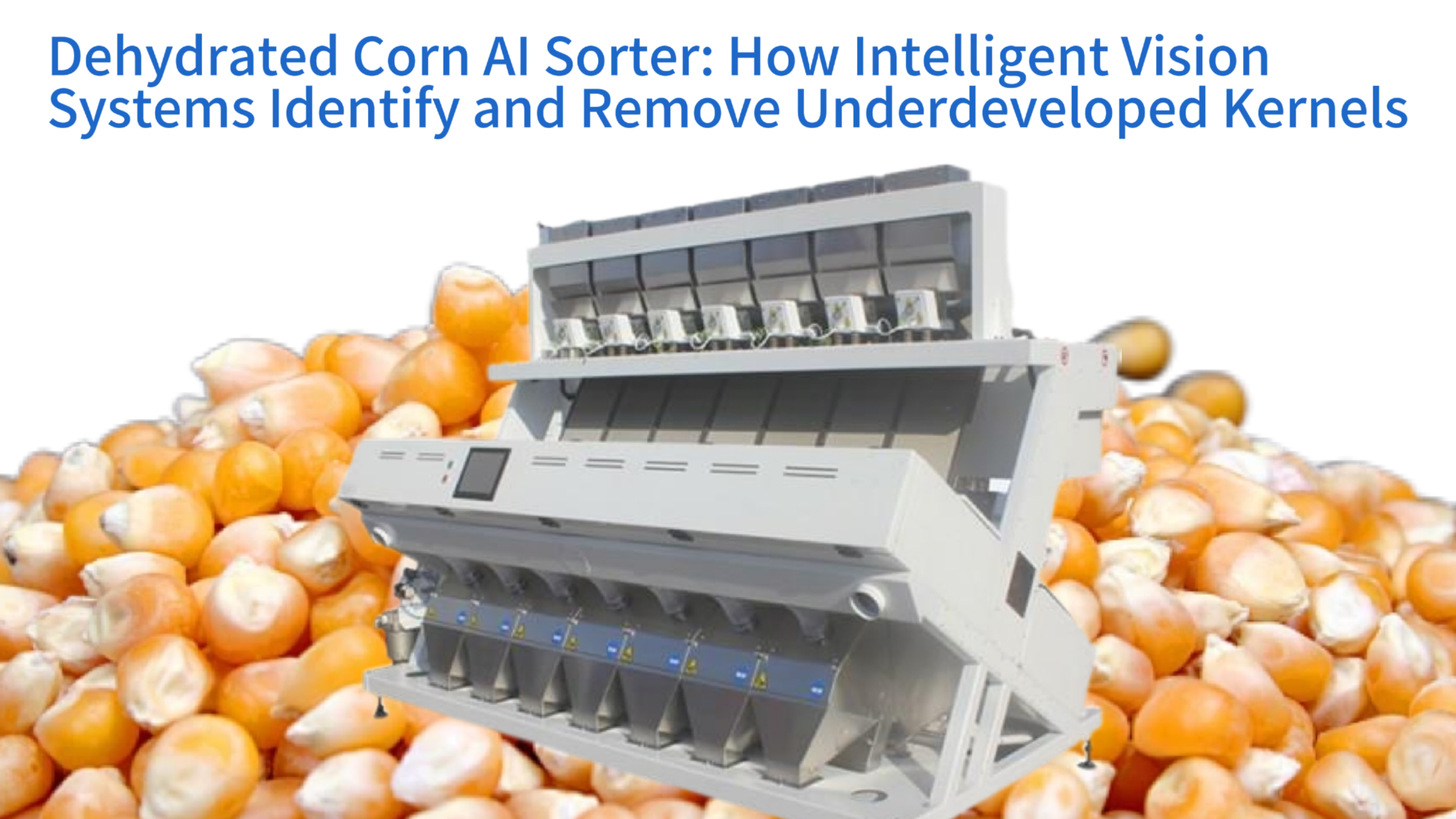
The agricultural processing industry faces a persistent challenge in maintaining product uniformity, particularly when dealing with dehydrated corn kernels destined for human consumption or animal feed. Underdeveloped kernels, characterized by their diminished size, lighter weight, incomplete starch formation, and often wrinkled or shrunken appearance, can significantly compromise the final product quality, affecting everything from taste and texture to nutritional value and commercial grading. Traditional mechanical screening methods, such as vibrating screens or gravity separators, prove largely inadequate for this task because underdeveloped kernels often share similar dimensions and density profiles with fully mature grains. This technological gap has driven the development of sophisticated AI sorter systems specifically calibrated for dehydrated corn, which leverage advanced optical recognition and deep learning algorithms to achieve what human sorting teams cannot match in terms of speed, consistency, and analytical depth. The following exploration details how these intelligent machines transform raw harvested corn into premium dehydrated products through precise identification and removal of sub-standard kernels.
Understanding the Physical Characteristics of Underdeveloped Dehydrated Corn Kernels
| Feature | Mature Dehydrated Corn | Underdeveloped Dehydrated Corn |
| Shape & Appearance | Plump, rounded, uniform | Wrinkled, shrunken, uneven |
| Color | Deep golden, amber | Pale yellow, white, chalky |
| Density | High density, full starch | Low density, hollow interior |
| Surface Texture | Smooth, uniform micropattern | Rough, cracked, blister-like |
| Optical Property | High NIR reflectance | Low reflectance, high transmission |
Before examining how artificial intelligence identifies defective kernels, it is essential to understand what makes an underdeveloped dehydrated corn kernel physically distinct from its fully matured counterpart. During the natural maturation process, corn kernels undergo a complex sequence of biochemical transformations, including starch accumulation, protein synthesis, and moisture reduction. When kernels are harvested prematurely or experience environmental stress during development, these processes remain incomplete, resulting in kernels that are thinner, lighter in weight, and possess different optical properties. Under a high-resolution imaging system, these underdeveloped kernels exhibit reduced translucency, irregular surface纹理, and often display a characteristic "chalky" appearance where the endosperm fails to achieve proper density. The dehydration process further accentuates these differences, as fully mature kernels maintain their plump, rounded形状 while underdeveloped kernels shrink unevenly, creating distinctive wrinkles and collapsed structures that AI algorithms can be trained to recognize with exceptional precision.
The challenge of identifying underdeveloped kernels extends beyond simple visual inspection, as these defective grains can vary significantly in their presentation depending on the specific corn variety, growing conditions, and dehydration parameters used. Some underdeveloped kernels may appear only slightly smaller than acceptable grains but possess internal voids or incomplete starch layers that affect their processing behavior. Others may exhibit color variations ranging from pale yellow to almost white, contrasting with the deep golden hue of properly matured dehydrated corn. Advanced belt type AI sorting machine configurations utilize multi-spectral imaging to capture these subtle differences across multiple wavelength bands, enabling the system to detect not just surface appearance but also subsurface structural characteristics that human inspectors cannot perceive. This multi-dimensional approach to defect recognition forms the foundation upon which accurate, reliable kernel sorting depends, ensuring that even borderline cases are evaluated consistently according to programmed quality standards.
Optical Property Differences Between Mature and Underdeveloped Kernels
When light encounters a fully mature dehydrated corn kernel, the dense, crystalline starch structure creates predictable patterns of reflection, absorption, and transmission that optical sensors can quantify with remarkable accuracy. Mature kernels typically exhibit high levels of near-infrared reflectance due to their complete starch granule formation, along with specific color signatures in the visible spectrum that correspond to optimal carotenoid content. Underdeveloped kernels, by contrast, display significantly different optical signatures across all wavelengths. Their incomplete starch structure allows greater light penetration, reducing reflectance while increasing transmission in ways that create distinct spectral profiles. Modern optical sorter technology exploits these differences by illuminating each kernel with precisely controlled light sources and capturing the resulting interactions across multiple spectral bands simultaneously, generating a unique "fingerprint" for every individual kernel passing through the inspection zone.
The practical application of optical property analysis extends to detecting internal defects that show no visible external indicators. For example, some kernels may appear properly sized and colored on their outer surface but contain hollow internal cavities or partially formed endosperm layers that will cause them to behave unpredictably during downstream processing, such as producing excessive fines during milling or absorbing oil unevenly during frying. These subsurface conditions create distinctive patterns of light scattering and absorption that specialized sensors can detect using techniques such as hyperspectral imaging. By training AI algorithms on thousands of examples showing both visible and hidden defects, the system develops the ability to identify problematic kernels regardless of whether their defects are apparent to the human eye. This capability represents a fundamental advantage of AI-driven sorting over traditional manual inspection or simple color-based automated systems.
Shape and Texture Signatures That Indicate Incomplete Development
The three-dimensional geometry of a dehydrated corn kernel provides valuable clues about its developmental history and subsequent processing suitability. Fully mature kernels maintain relatively consistent proportions, with well-defined crown regions, smooth lateral surfaces, and characteristic endosperm configurations. Underdeveloped kernels, however, exhibit distinctive shape anomalies that AI vision systems can be trained to recognize. These include excessive concavity on the crown surface, asymmetric contraction during dehydration, and irregular edge profiles where the kernel failed to expand properly during the maturation phase. High-resolution sensor based sorting machine configurations capture multiple images of each kernel from different angles, constructing a detailed three-dimensional model that allows the AI to assess geometric deviations against established standards for acceptable product.
Texture analysis adds another layer of discriminatory capability, as the surface characteristics of underdeveloped kernels differ markedly from those of properly matured grains. Mature dehydrated corn typically displays relatively smooth surfaces with fine, uniform micropatterning resulting from controlled moisture removal during dehydration. Underdeveloped kernels often exhibit exaggerated wrinkling, surface cracking, or areas where the outer pericarp failed to adhere properly to the underlying endosperm. Some defects manifest as blister-like elevations where internal voids have caused localized separation of kernel layers. The AI system analyzes these textural features using convolutional neural networks that have been trained on thousands of annotated kernel images, learning to distinguish between acceptable natural surface variations and those indicative of developmental problems. This sophisticated approach to morphological assessment ensures that even kernels that appear superficially acceptable in terms of color and size are rejected when their shape or texture suggests underlying quality issues.
Density and Mass Considerations in Dehydrated Product Streams
While optical inspection provides the primary screening mechanism for most AI sorting applications, the physical property of kernel density offers complementary information that can enhance sorting accuracy, particularly for borderline cases where visual assessment alone may prove inconclusive. Underdeveloped kernels consistently exhibit lower density than fully mature grains because their incomplete starch formation leaves microscopic air spaces within the endosperm structure. This density difference manifests as reduced mass per unit volume, which affects how kernels behave during pneumatic conveying and influences their final product characteristics such as bulk density and rehydration behavior. Some advanced sorting systems incorporate density measurement capabilities using techniques such as air classification or vibration-based analysis, integrating this physical data with optical assessments to achieve superior discrimination accuracy.
The integration of density information becomes particularly valuable when sorting dehydrated corn intended for specific applications with stringent quality requirements. For example, corn destined for instant soup mixes or breakfast cereals requires consistent rehydration properties that underdeveloped kernels cannot provide, regardless of their external appearance. Similarly, corn flour produced from mixed batches containing underdeveloped kernels exhibits altered rheological properties that affect dough handling and finished product texture. By combining optical analysis with density assessment, chute type AI sorting machine systems can achieve near-perfect separation based on functional quality rather than purely visual characteristics. This multi-parameter approach represents the cutting edge of industrial food sorting technology, enabling processors to deliver products with unprecedented consistency and reliability.
How Multi-Spectral Imaging Captures Kernel Quality Data
The journey from raw optical data to actionable sorting decisions begins with the capture of high-fidelity images across multiple wavelengths of the electromagnetic spectrum. Standard visible light imaging, while useful for basic color sorting, fails to reveal many of the subtle differences that distinguish underdeveloped kernels from their mature counterparts. Multi-spectral imaging systems overcome this limitation by illuminating each kernel with carefully controlled light sources spanning the visible, near-infrared, and sometimes short-wave infrared ranges, then capturing the resulting reflected and transmitted light using specialized sensor arrays. Each wavelength interacts with different chemical and physical components of the kernel structure, providing unique information about starch content, protein distribution, moisture levels, and structural integrity. When these individual data channels are combined and analyzed by the AI system, they create a comprehensive quality profile that reveals far more about each kernel than any single imaging technique could provide alone.
The practical implementation of multi-spectral imaging in advanced detection systems requires careful attention to illumination geometry, sensor calibration, and environmental control. The sorting machine maintains consistent lighting conditions regardless of ambient factory lighting, using high-intensity LED arrays that provide stable, repeatable illumination across the entire inspection zone. Sensors are calibrated regularly against reference standards to ensure that color and spectral measurements remain accurate over time, compensating for any sensor drift or LED degradation. The enclosure design prevents stray light from entering the imaging area while also protecting sensitive optical components from dust and moisture commonly present in food processing environments. This robust engineering ensures that the quality data captured by the system remains reliable hour after hour, day after day, maintaining consistent sorting performance regardless of changing conditions in the surrounding facility.
Visible Spectrum Analysis for Color-Based Defect Detection
Within the visible spectrum ranging from approximately 400 to 700 nanometers, mature and underdeveloped dehydrated corn kernels display distinct color characteristics that provide the first level of quality discrimination. Fully mature corn typically exhibits rich golden to amber hues resulting from its carotenoid content, including lutein and zeaxanthin, which contribute both to visual appeal and nutritional value. Underdeveloped kernels often appear noticeably paler, sometimes verging toward white or pale cream, due to their reduced pigment accumulation during the abbreviated maturation period. Some defect categories, such as kernels affected by certain fungal growths or insect damage, may display atypical colors including greyish patches, pinkish discoloration, or dark lesions. High-resolution color cameras capturing millions of pixels per second enable the AI system to detect these color variations with precision far exceeding human visual capabilities, identifying kernels that deviate from established color acceptance criteria by even minimal margins.
The AI's approach to color analysis extends beyond simple threshold-based rejection; the system learns to recognize complex color patterns that correlate with specific defect types. For instance, a kernel showing a small dark spot at the tip cap might still be acceptable for many applications, whereas the same spot located on the crown region might indicate more extensive internal damage. Similarly, subtle gradients of color from the kernel base to the tip can indicate the direction and completeness of starch filling during development. The neural network processes these spatial patterns holistically, considering not just the absolute color values at each pixel but also their arrangement and relationships across the kernel surface. This sophisticated approach allows the system to achieve high accuracy while minimizing false rejections of kernels that appear unusual but remain functionally acceptable. The result is a sorting process that removes true defects efficiently while preserving maximum yield of saleable product.
Near-Infrared Technology for Internal Structure Assessment
The near-infrared spectrum, spanning approximately 700 to 2500 nanometers, provides access to information about kernel composition and internal structure that visible light cannot reveal. In this wavelength range, different chemical bonds within the kernel material absorb light at characteristic frequencies, creating spectral signatures that indicate the presence and concentration of specific compounds. Starch, proteins, lipids, and water each produce distinctive absorption patterns that the AI system can quantify to assess kernel development status. Underdeveloped kernels consistently show altered spectral signatures in multiple regions, with reduced starch-associated absorption features and sometimes elevated protein or moisture signals depending on the specific developmental deficiency. By analyzing these spectral patterns, the AI can determine not just whether a kernel is underdeveloped but also provide insight into the specific nature of the developmental problem, enabling more nuanced sorting decisions for different quality grades.
The application of near-infrared technology in high-speed sorting environments presents significant engineering challenges, as the sensors required for this spectral range are typically more expensive and slower than visible light cameras. However, recent advances in sensor technology and data processing algorithms have made practical NIR-based sorting increasingly feasible for commercial operations processing dehydrated corn sorting machine applications. Modern systems employ specialized indium gallium arsenide sensors that capture NIR data at speeds compatible with industrial throughput requirements, processing thousands of kernels per second while maintaining spectroscopic accuracy. The AI system compresses the high-dimensional spectral data into actionable decisions using models optimized for rapid execution on specialized hardware. This technological convergence enables processors to benefit from the superior detection capabilities of NIR analysis without sacrificing the throughput essential for economical operation.
Fusion of Multiple Data Streams for Comprehensive Assessment
The true power of AI-driven sorting emerges from the intelligent fusion of data from multiple sensor types, each contributing unique information that collectively enables far more accurate decisions than any single sensor could provide alone. A kernel that appears acceptably colored in visible light might still be rejected based on NIR evidence of incomplete starch development, while another kernel with slightly atypical coloration might pass inspection if NIR and shape analysis confirm its functional quality remains intact. The AI system must weigh these sometimes contradictory signals according to programmed quality priorities, making split-second decisions that optimize the balance between defect removal and yield preservation. This multi-sensor integration requires sophisticated algorithmic approaches, including Bayesian inference networks and ensemble learning methods that combine multiple specialized models into a unified decision framework.
The implementation of sensor fusion in commercial sorting equipment relies on precise synchronization between different imaging systems and the downstream ejection mechanism. Each kernel generates multiple data points as it traverses the inspection zone, and the AI must associate these measurements with the correct physical kernel while compensating for the slight time offsets between different sensors positioned along the material flow path. Modern AI xray sorting machine configurations achieve this synchronization through precise timing control and sophisticated tracking algorithms that maintain kernel identity across the entire inspection sequence. The result is a coherent quality assessment that considers all available information before triggering the ejection decision. This comprehensive approach to data integration represents a fundamental advantage of AI-based systems over earlier generations of sorting technology, enabling processors to achieve quality levels previously considered unattainable in high-volume food production.
The Deep Learning Process: Training AI to Recognize Underdevelopment
Before an AI sorter can reliably identify underdeveloped corn kernels, it must undergo an extensive training process during which the system learns to recognize the visual and spectral patterns associated with kernel immaturity. This training begins with the collection of thousands of representative kernel samples, meticulously labeled by human experts who classify each kernel according to its developmental status and overall quality grade. These labeled samples are then presented to the AI system, which analyzes each kernel's optical properties across all available sensor channels while its internal neural network gradually adjusts its connection weights to produce correct classifications. The learning process continues iteratively, with the system comparing its predictions against the human-provided labels and modifying its internal parameters to reduce classification errors. After processing the entire training set multiple times, the neural network develops the ability to generalize from its training examples, correctly classifying new kernels it has never encountered before based on the patterns it has learned.
The sophistication of modern deep learning approaches extends far beyond simple pattern matching; the AI develops hierarchical representations of kernel features that mirror the way human visual processing works but with far greater consistency and attention to detail. Lower layers of the neural network learn to detect basic features such as edges, corners, and color gradients, while higher layers combine these primitive features into more complex concepts such as kernel shape, surface texture patterns, and the spatial arrangement of color regions. This hierarchical learning enables the AI to recognize underdevelopment even when it manifests in unusual ways that differ from any specific training example. For instance, the system can apply knowledge about normal kernel geometry to detect anomalous shapes, even if the exact abnormal configuration was not present in the training set. This ability to extrapolate from learned patterns makes deep learning systems remarkably robust when facing novel defect presentations that would confuse simpler classification algorithms.
Training Data Collection and Annotation Methodology
The quality of any AI sorting system ultimately depends on the quality and comprehensiveness of its training data, making data collection and annotation a critical phase in system development. Expert human sorters examine thousands of kernels representing the full range of developmental states, from clearly mature to severely underdeveloped, along with all the ambiguous borderline cases that challenge consistent classification. Each kernel receives detailed annotations describing not just its overall acceptability but also specific defect characteristics, including the nature and severity of underdevelopment, the presence of any additional defects, and its suitability for various end-use applications. This rich annotation allows the AI to learn nuanced distinctions that support multiple grading standards, enabling the same basic system to be configured for different quality requirements simply by adjusting which kernel categories are considered acceptable for a particular production run.
The annotation process extends beyond simple good/bad classification to capture the continuous spectrum of quality that exists in real agricultural products. Rather than forcing every kernel into a binary category, annotators typically rate kernels on multiple continuous scales: developmental completeness, color intensity, surface integrity, and overall appearance. This graded approach produces training data that reflects the inherent ambiguity present in natural products, enabling the AI to make similarly nuanced decisions. When the trained system encounters a borderline kernel, it can report not just a classification but also a confidence level, allowing the overall sorting process to be tuned for either maximum purity or maximum yield as required by current production priorities. This flexibility represents a significant advantage over traditional sorting systems that can only make rigid accept/reject decisions based on fixed thresholds, often resulting in either excessive false rejects or insufficient defect removal.
Neural Network Architecture for Agricultural Product Sorting
The specific neural network architecture employed for kernel sorting applications has been optimized through years of research into the unique challenges of agricultural product inspection. Unlike general-purpose image recognition tasks where the subject fills most of the frame, kernel sorting requires analyzing multiple small objects passing through the field of view simultaneously while maintaining individual identity tracking. The network architecture incorporates attention mechanisms that help focus computational resources on the most informative regions of each kernel, ignoring background areas and managing occlusions where kernels partially overlap. Residual connections allow the network to maintain information across multiple processing layers, preserving fine detail needed to detect subtle defect indicators that might otherwise be lost in deeper network layers. These architectural choices enable the system to achieve high accuracy while maintaining the computational efficiency required for real-time operation at industrial throughput rates.
Training such specialized networks requires careful attention to optimization techniques that prevent overfitting, where the system memorizes specific training examples rather than learning generalizable patterns. Data augmentation techniques artificially expand the training set by applying transformations such as rotation, scaling, and slight color adjustments to existing images, teaching the network to remain invariant to these natural variations in kernel presentation. Regularization methods penalize overly complex network configurations that might fit training data perfectly but fail on new examples. Dropout layers randomly deactivate portions of the network during training, forcing the remaining connections to learn more robust features. These techniques, combined with careful validation testing using data withheld from the training process, ensure that the final network performs reliably on previously unseen kernels from production environments, maintaining accuracy even as growing conditions and corn varieties vary across seasons.
Continuous Learning and Model Updating in Production Environments
The learning process does not end when the sorting system enters production; modern AI sorters incorporate continuous learning capabilities that allow them to adapt to changing conditions over time. As new corn varieties are introduced, processing parameters are modified, or quality requirements shift, the system can be updated with additional training examples that reflect these changes. Some advanced configurations implement semi-supervised learning approaches where the system generates tentative labels for production data, then incorporates human feedback only for borderline or uncertain cases, efficiently using expert attention where it provides the most value. This ongoing adaptation ensures that sorting performance remains optimal even as the production environment evolves, without requiring complete system retraining each time conditions change.
Practical implementation of continuous learning requires robust data management infrastructure that preserves the integrity of the training process. Historical data must be maintained and properly versioned to enable regression testing when models are updated, ensuring that improvements for current conditions do not degrade performance on previously mastered defect types. The system must also guard against concept drift, where gradual changes in sensor characteristics or lighting conditions might slowly degrade model performance if not properly compensated. Regular validation runs using retained test sets provide objective measurement of current model performance, triggering alerts when accuracy falls below acceptable thresholds. This disciplined approach to model lifecycle management ensures that AI sorters maintain their accuracy advantage over traditional systems throughout their operational lifetime, delivering consistent value from initial installation through years of production service.
High-Speed Ejection Mechanisms for Precise Defect Removal
Once the AI system has identified an underdeveloped kernel requiring removal, the physical ejection of that specific kernel from the product stream must occur with extreme precision and speed. The typical detection-to-ejection window lasts only a few milliseconds, during which the kernel continues moving at high velocity along its trajectory through the machine. The ejection system must accurately target the specific defective kernel while avoiding impact on adjacent acceptable kernels, a challenge compounded by the random spatial distribution of defects within the product stream. High-speed solenoid valves, precisely timed using the AI's decision output, release short bursts of compressed air directed at the identified defect, propelling it from the main product stream into a reject collection system. The engineering challenge lies in achieving this selective ejection with sufficient accuracy to remove the target defect while maintaining a low "carryover" rate where acceptable kernels are accidentally ejected along with defects.
The performance characteristics of the ejection system directly determine both the purity of the accepted product stream and the yield loss associated with the sorting process. Systems with fast valve response times and precisely focused air jets can achieve high defect removal efficiency while minimizing false rejections of acceptable kernels. Modern high speed ejection technology employs individually controllable valves for each ejection channel, with nozzle designs that produce tightly focused air streams matched to the typical kernel size. Valve actuation times below one millisecond enable precise targeting even at high throughput rates, while advanced driver electronics compensate for any variation in valve response characteristics to maintain consistent performance over millions of operating cycles. The integration of these mechanical components with the AI's decision outputs requires careful system-level design to minimize latency from image capture to valve actuation, preserving the accuracy of the spatial targeting calculation.
Optimizing Ejector Positioning for Maximum Accuracy
The geometric relationship between the detection zone, the ejector nozzles, and the kernel trajectory significantly influences sorting accuracy. Ejectors must be positioned sufficiently far from the detection zone to allow the AI processing time to complete its analysis and reach a decision, but close enough that kernel position predictions remain accurate given the inevitable variations in kernel velocity and trajectory. Most systems position ejectors approximately 100 to 300 millimeters downstream from the last detection sensor, a distance that provides adequate processing time while maintaining positional accuracy within a few millimeters. The exact optimal distance depends on factors including kernel velocity, typical velocity variation, and the AI's processing latency, with faster processors enabling shorter distances and consequently more accurate targeting.
The physical arrangement of ejector nozzles across the sorting width presents additional optimization challenges. For belt-type systems where kernels are distributed across a wide conveyor, multiple ejector rows may be staggered to achieve complete coverage without gaps between nozzle influence zones. Each nozzle's air jet must be characterized to understand its spatial distribution of force, ensuring that the intended target receives sufficient impulse for deflection while adjacent kernels experience minimal disturbance. Advanced systems incorporate self-diagnostic capabilities that monitor each valve's operation and can detect developing problems such as sticky valves or clogged nozzles before they affect sorting performance. This attention to ejector system design and maintenance ensures that the AI's intelligent decisions are faithfully executed, delivering the defect removal performance that makes these systems valuable investments for quality-focused processors.
Carryover Management and Yield Optimization Strategies
Even with optimal ejector design, some acceptable kernels will inevitably be caught in the air jet paths aimed at nearby defects, resulting in yield loss that represents a direct economic cost to the processor. Managing this carryover requires careful balancing between defect removal completeness and yield preservation, with optimal strategies varying based on product value and quality requirements. For high-value applications such as premium instant corn products destined for retail packaging, processors typically accept higher carryover rates to ensure exceptional purity, while for lower-value applications such as animal feed ingredients, minimizing yield loss may take priority over achieving the highest possible defect removal. Modern AI sorters allow operators to adjust this balance through user-configurable parameters that control ejection aggressiveness and the spatial margins applied around detected defects.
Advanced sorting systems incorporate real-time monitoring of carryover rates and defect removal efficiency, providing operators with continuous feedback on sorting performance. When carryover rates exceed target levels, the system may automatically adjust ejection parameters to reduce impact on acceptable kernels, while maintaining defect removal within acceptable limits. Some configurations implement advanced ejection algorithms that consider kernel spacing and local defect density when making ejection decisions, reducing carryover in areas where defects are clustered while maintaining aggressive ejection for isolated defects. This intelligent approach to ejection control represents a significant advance over traditional systems that apply the same ejection intensity regardless of local conditions, enabling better optimization of the fundamental tradeoff between purity and yield that lies at the heart of all sorting operations.
Chute-Type Versus Belt-Type Configurations for Dehydrated Corn
Gravity fed, high throughput
Low maintenance
Compact vertical design
Ideal for free-flowing corn
Gentle product handling
Stable kernel presentation
Suitable for coated corn
Wide inspection coverage
The two primary mechanical configurations of AI sorters, chute-type and belt-type, offer distinct advantages for dehydrated corn sorting applications depending on specific product characteristics and processing requirements. Chute-type systems accelerate kernels by gravity as they slide down an inclined, carefully polished surface, achieving high velocities that maximize throughput while maintaining stable kernel orientation. This configuration excels for free-flowing granular materials where individual kernels separate naturally during acceleration, providing excellent conditions for optical inspection. The absence of moving parts in the product contact zone simplifies cleaning and reduces maintenance requirements, while the compact vertical design occupies minimal floor space relative to throughput capacity. For large-scale corn processing operations handling consistent product streams, chute-type systems often represent the most economical choice, delivering high capacity at moderate equipment cost.
Belt-type systems transport kernels on a wide, high-speed conveyor belt that presents the product to the inspection zone in a stable, well-controlled manner. This configuration offers advantages for materials that do not flow freely through chute systems, such as kernels with high moisture content or those that have been coated with oils or seasonings. The belt provides gentle acceleration that minimizes kernel damage, an important consideration for fragile products or when preserving kernel integrity matters for downstream processing. The wider inspection zone possible with belt systems allows higher total throughput for a given belt speed, though the moving belt introduces additional maintenance considerations compared to chute designs. For specialized dehydrated corn applications such as coated or flavored products, belt-type sorters often provide superior performance despite their higher initial cost and ongoing maintenance requirements.
Gravity-Fed Chute Systems for High-Volume Processing
Chute-type AI sorters achieve their high throughput capacity through the efficient use of gravity as the accelerating force, eliminating the need for powered mechanisms in the product feed section. Kernels enter at the top of the chute through a carefully designed vibratory feeder that spreads them into a thin, uniform layer. As they slide down the polished chute surface, they accelerate to velocities between 2 and 4 meters per second depending on chute angle and surface friction characteristics. At these speeds, a single sorting lane can process several tons of corn per hour, with multi-lane configurations scaling capacity proportionally. The stable, predictable trajectory produced by the chute ensures that kernels pass through the inspection zone in consistent positions and orientations, simplifying the AI's task and enabling high detection accuracy even at maximum throughput rates.
Chute design for corn sorting requires careful attention to material selection and surface finish to ensure reliable flow without sticking or accumulation. The chute surface must be sufficiently hard to resist wear from the abrasive action of flowing kernels, yet smooth enough to maintain consistent acceleration without inducing tumbling that would complicate optical inspection. Stainless steel chutes with specialized surface treatments offer good wear resistance for most corn applications, while some systems employ ceramic-coated surfaces for extended service life under high-volume operation. The chute angle must be optimized for each specific product, with steeper angles increasing velocity and throughput but potentially reducing inspection time and accuracy. Modern systems incorporate adjustable chute designs that allow operators to tune these parameters for optimal performance with different corn varieties and processing conditions.
Wide Belt Conveyors for Sensitive or Coated Products
Belt-type sorting machines offer distinct advantages when processing dehydrated corn that has undergone additional value-added processing such as coating with seasonings, oils, or other functional ingredients. These added materials can make kernels sticky or prone to clumping, conditions that disrupt the single-layer presentation required for accurate optical inspection. The wide, moving belt of a belt type color sorting machine gently accepts the product from the feed system and transports it through the inspection zone with minimal disturbance, maintaining the kernel spacing established by the vibratory feeder. The belt's continuous surface provides a consistent background against which the AI can analyze each kernel, free from the edge effects and optical distortions that can occur at chute boundaries. For coated products where maintaining coating integrity matters for final product quality, the belt's gentle handling reduces coating loss compared to the more aggressive acceleration of chute systems.
Belt selection represents a critical design decision for these systems, as the belt material affects both optical performance and operational durability. High-quality sorting belts feature precisely controlled surface properties that provide consistent kernel positioning while minimizing reflection artifacts that could interfere with optical inspection. Belt color is typically chosen to provide optimal contrast with the product being sorted, with dark belts used for light-colored corn and light belts for darker varieties. The belt must remain dimensionally stable across temperature and humidity variations, maintaining tension and tracking to prevent wandering that would misalign kernels with the inspection zone. When properly maintained, modern sorting belts achieve service lives exceeding 5000 operating hours, though regular inspection and replacement remain important preventive maintenance tasks for maximizing system performance and reliability.
Economic Impact and Quality Assurance Benefits
The implementation of AI sorting technology for underdeveloped kernel removal delivers substantial economic returns through multiple channels, including reduced quality complaints, increased usable yield from raw material, and decreased labor costs for manual inspection. A typical AI sorter processing dehydrated corn can replace 10 to 20 manual sorters while operating continuously without the performance degradation that occurs when human inspectors fatigue after extended work periods. The consistency of AI-based sorting ensures that product quality remains uniform across all production shifts, eliminating the variation that often occurs when different human inspection teams apply slightly different standards. For processors supplying demanding customers such as major food manufacturers or export markets with strict quality requirements, this consistency represents critical value that directly impacts customer retention and market access.
The payback period for AI sorting equipment varies based on production volume, product value, and current defect levels, but many installations achieve full return on investment within 6 to 18 months of operation. Beyond the direct cost savings from reduced labor and increased yield, AI sorters enable processors to access higher-value markets by consistently achieving quality grades that manual sorting cannot reliably maintain. A processor previously limited to commodity markets due to quality inconsistency can, with AI sorting capability, pursue premium contracts that might double the per-ton revenue for the same raw material. This strategic value often exceeds the direct operational savings, transforming the sorting equipment from a cost center into a profit generator that differentiates the processor from competitors still relying on traditional methods. For dehydrated corn processors seeking to improve their competitive position, AI sorting technology represents not merely an incremental improvement but a fundamental capability upgrade that enables entirely new business strategies.
Reduction in Customer Complaints and Returns
The financial impact of customer complaints extends far beyond the immediate cost of replacing returned product, encompassing damaged relationships, potential delisting by major customers, and erosion of brand reputation that can take years to rebuild. AI sorting systems dramatically reduce complaint rates by providing consistent, documented quality control that catches defects human sorters might miss, particularly during peak production periods when fatigue affects performance. Each kernel receives the same rigorous inspection regardless of when it was processed, eliminating the end-of-shift quality decline that plagues manual sorting operations. For processors who have experienced the cascading costs of a major quality failure, the insurance value of AI sorting technology represents a compelling return even before considering the day-to-day operational savings.
The data logging capabilities of modern AI sorters provide additional quality assurance benefits beyond the sorting process itself. The system records quality metrics continuously, generating reports that document the performance of both the sorting equipment and the upstream processes that influence raw material quality. When a customer receives a shipment, the processor can provide documentation showing that the product met specified quality standards at the time of sorting, reducing disputes about quality upon arrival. For situations where quality issues do arise, the detailed records help identify root causes, whether raw material problems, sorting equipment malfunction, or post-sorting contamination. This traceability capability has become increasingly important as major food companies implement more rigorous supplier quality management programs requiring documented evidence of process control throughout the production chain.
Increased Recovery of Saleable Product from Raw Material
While the primary purpose of AI sorting is removing defects, the technology's precision enables processors to recover more saleable product from their raw material by reducing the false rejection of acceptable kernels that occurs with less sophisticated sorting methods. Traditional sorting approaches using mechanical screens or simple optical systems often reject borderline kernels to avoid the risk of passing defects, sacrificing yield for safety. The superior discrimination capability of AI systems allows tighter sorting parameters that remove true defects while retaining acceptable kernels that exhibit minor variations from ideal specifications. For a large-scale processor, recovery improvements of even one or two percent translate into substantial annual value, particularly when processing expensive raw materials or selling into high-value markets.
Beyond the direct yield improvement from reduced false rejection, AI sorting enables processors to implement multi-stage sorting strategies that maximize overall recovery. The first sorting pass can be set to aggressive parameters that remove clear defects while sending borderline material to a second sorting pass with different parameters. The AI system's ability to make consistent decisions across multiple passes, combined with its logging of each kernel's characteristics, enables sophisticated material routing that would be impossible with manual sorting. Some processors implement closed-loop systems where rejected material passes through a regrind or rework process before another sorting attempt, recovering value from material that would otherwise become waste. This optimization of overall material utilization represents a significant competitive advantage in markets where raw material costs represent the largest component of finished product expense.