E-Waste Preprocessing to Metal Recovery Workflow
Appliance Decommissioning
Refrigerant/Foam Recovery
Dismantling
Component Extraction
Radiator Sorting
Al-Cu Separation
Pure Metal Recovery
Recycling & Reuse
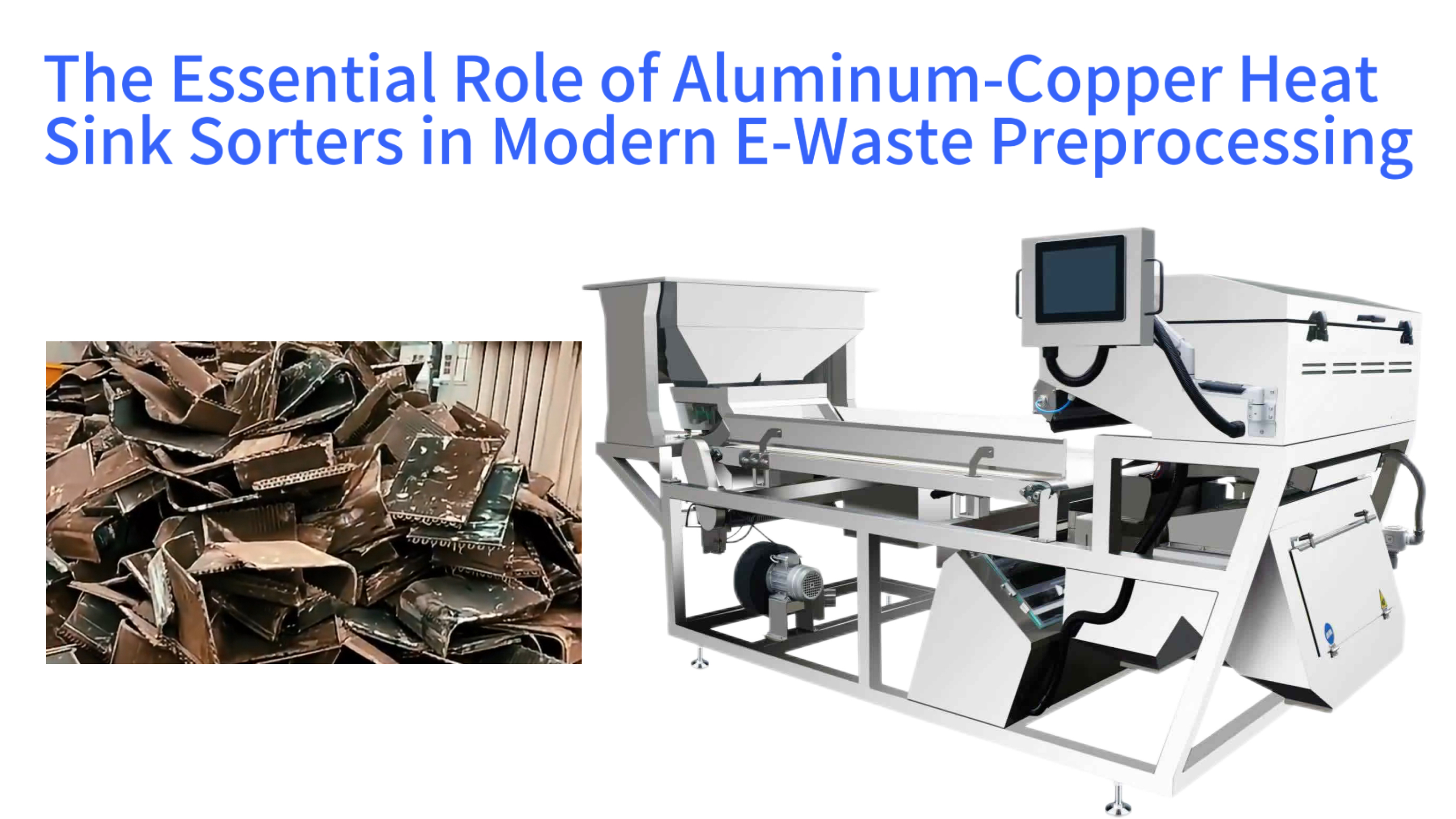
The journey of an old refrigerator or air conditioner from a scrap heap back into the manufacturing cycle begins with a critical, often overlooked step: preprocessing. This initial phase in e-waste sorting is where bulky, complex appliances are broken down into their core material streams. Among the most valuable components liberated during this stage are aluminum-copper heat sinks and radiators, commonly found in cooling systems. This article explores the specialized technology behind sorting these composite metal parts, explaining how dedicated aluminum-copper radiator sorting machines work, their integration into broader e-waste processing lines, and the significant economic and environmental benefits they deliver by ensuring pure, high-quality metal fractions are recovered for recycling.
The Growing Challenge of Appliance Disposal and Material Recovery
Energy Savings: Recycled vs Virgin Metals
| Metal Type | Virgin Production Energy | Recycled Production Energy | Energy Savings |
|---|---|---|---|
| Aluminum | 100% | ~5% | ~95% |
| Copper | 100% | ~15% | ~85% |
The global volume of discarded large and small home appliances represents one of the fastest-growing segments of the electronic waste stream. Unlike simpler e-waste items, appliances like refrigerators, air conditioners, and washing machines are complex assemblies of various materials—plastics, insulating foams, glass, and multiple types of metals. These units are not suitable for direct shredding or processing in a general small appliance sorting machine. The presence of hazardous refrigerants, oils, and composite parts requires a methodical dismantling process first. The primary goal of this preprocessing stage is to safely remove dangerous substances and manually or mechanically extract high-value, separable components before the remaining carcass is granulated.
Within these appliances, heat exchange systems—condensers and evaporators—are prime targets for recovery. They are typically constructed from intertwined tubes of copper, prized for its excellent thermal conductivity, and fins of aluminum, which are lightweight and cost-effective. A single large air conditioning unit can contain several kilograms of these non-ferrous metals. However, the metals are often mechanically joined or bonded, making them a classic example of a composite material. Sending this mix directly to an aluminum-only or copper-only recycling stream contaminates the batch and drastically reduces its market value. Therefore, efficiently separating aluminum from copper at the preprocessing stage is not just beneficial; it is essential for maximizing revenue from scrap appliances and ensuring the quality of recycled metals.
Why Heat Sinks and Radiators Are a Priority Target
Aluminum-copper radiators are designated as a priority stream in appliance recycling due to their concentrated metal content and relatively easy accessibility compared to other components. From an economic perspective, copper is a highly valuable commodity, and even when mixed with aluminum, the composite unit holds significant scrap value. Efficiently splitting this composite into its pure metal constituents can increase the value of the output material by a substantial margin, often making the preprocessing operation profitable. This financial incentive drives the adoption of targeted sorting technology at the front end of the recycling line.
From an environmental standpoint, recovering these metals directly from appliances reduces the need for virgin mining. Producing new aluminum from recycled scrap requires only about 5% of the energy needed to produce it from bauxite ore. Similarly, recycling copper saves up to 85% of the energy required for primary production. By focusing on clean separation at the source—during appliance preprocessing—the overall efficiency of the metal recycling loop is greatly enhanced, contributing directly to a circular economy model and reducing the carbon footprint associated with new metal production.
The Limitations of Manual Dismantling and Sorting
Traditionally, the separation of aluminum fins from copper tubes in radiators was a labor-intensive manual task. Workers would use pry bars, hammers, and sheer physical force to tear the materials apart. This method is not only slow and costly in terms of labor but also presents significant safety risks, including injuries from sharp metal edges and repetitive strain. The throughput of a manual disassembly station is inherently limited, creating a bottleneck in high-volume recycling facilities.
Furthermore, manual sorting is inconsistent and often imperfect. Small pieces of aluminum may remain attached to the copper tubes, and vice-versa, leading to cross-contamination. A batch of copper contaminated with several percent aluminum sells for a much lower price than pure copper. Conversely, aluminum contaminated with copper can cause processing issues in aluminum smelters. This lack of purity and consistency makes the output from manual preprocessing less desirable to metal buyers, underscoring the need for automated, precise separation technology to achieve the quality standards demanded by today's recycling markets.
The Preprocessing Workflow: From Whole Appliance to Sorted Metals
Appliance Preprocessing Workflow
The integration of a dedicated aluminum-copper sorter into an appliance recycling plant follows a logical and sequential workflow. The process starts with the safe decommissioning of the appliance. For refrigeration equipment, this involves the certified recovery of ozone-depleting or greenhouse gas refrigerants and insulating foams, a critical environmental and regulatory step. Once made safe, the appliance enters a dismantling line where large components are removed. The outer cabinet, compressor, glass shelves, and plastic liners are typically taken off, often with the aid of semi-automated tools or by workers at dedicated stations.
After the initial tear-down, the heat exchanger unit—the radiator or condenser coil—is extracted. This component may still be attached to other parts or be soiled with dust and oils. It is often cleaned or roughly prepared before being fed into the dedicated sorting system. This preparation is part of the smart material feeding concept, ensuring the sorter receives a consistent and processable stream of material. The remaining appliance shell, now stripped of its most valuable and hazardous parts, is usually compacted and sent to a shredder for further recovery of ferrous metals and mixed plastics, a process supported by other specialized systems like a plastic-metal sorting machine.
Initial Preparation and Feeding of Radiator Units
Before radiators meet the core sorting technology, they often undergo initial preparation to optimize the separation process. This may involve a coarse shredding or crushing step specifically designed for radiator units. Some systems are built to handle entire, lightly compacted coils, while others work more efficiently with material that has been pre-cut into smaller, more uniform pieces. The goal of this stage is to create a feedstock where the physical connections between aluminum fins and copper tubes are sufficiently broken or stressed, making the subsequent separation action more effective.
The feeding system to the sorter is crucial for maintaining high throughput and accuracy. A well-designed smart material feeding system ensures radiators are presented to the detection and separation unit in a singulated manner, not in large clumps. This might involve vibratory feeders, conveyor belts with separators, or staging hoppers that meter the material flow. Consistent presentation allows the sensor system to analyze each piece individually and for the ejection system to make a clean, targeted separation decision, maximizing both the purity and the recovery rate of the output metals.
The Conveyance Path Through the Sorting System
Once fed, the radiator material travels along the main conveyance path within the sorter, typically a high-speed, durable conveyor belt. This belt transports the fragments through the machine's inspection zone. The design of this conveyor system is integral to the machine's overall performance; it must be robust enough to handle sharp, heavy metal pieces while maintaining a stable and consistent speed. The even distribution of material on the belt is critical to prevent overlapping, which could obscure pieces from the sensors and lead to mis-sorting.
As the material moves, it passes under or over the machine's primary detection array. The belt's speed is synchronized with the ultra-fast processing speed of the sensor and ejection systems. In high-performance models, the system is designed to analyze and make decisions on hundreds or even thousands of individual pieces per minute. This phase transforms a chaotic mix of shredded metal into a mapped stream of data, where each particle's position and material composition are identified in real-time, setting the stage for the precise physical separation that follows.
Core Technology: How the Aluminum-Copper Sorter Identifies and Separates
Sorter Core Technology Process
Sensor Detection
Eddy Current / XRT / AI X-ray
Data Analysis
Real-time Material Classification
High-speed Ejection
Air Jet / Mechanical Pusher
Material Collection
Pure Al & Cu Streams
At the heart of a modern radiator sorter lies its advanced detection system. The primary technology employed is often a combination of sensors tailored to distinguish between aluminum and copper. While color sensors can sometimes differentiate between the distinctive red-gold hue of copper and the silvery white of aluminum, this method is unreliable if the metals are oxidized, painted, or soiled. Therefore, more fundamental property-based detection is used. One common method involves electromagnetic conductivity or eddy current sensing, which can readily distinguish between the highly conductive copper and the less conductive aluminum.
These sensors scan every piece on the conveyor belt, collecting data on its material signature. This information is instantly processed by the machine's central control unit. Sophisticated software algorithms classify each fragment as either "aluminum" or "copper" based on the sensor's readings. This decision happens in milliseconds. The system then tags the geographical coordinates of that fragment on the moving belt. All this data feeds into the coordination system that controls the ejection mechanism, ensuring that when the identified fragment reaches the ejection point, a precisely timed action will divert it from its original path into the correct collection chute or bin.
Sensor Fusion for Unmatched Accuracy
The most effective sorters utilize a form of sensor fusion, combining data from multiple sensing technologies to achieve accuracy rates exceeding 99%. For instance, a dual-energy X-ray transmission (XRT) system can be exceptionally effective. This technology works by measuring how different materials absorb X-rays at two different energy levels. Since aluminum and copper have distinct atomic densities and compositions, they produce unique X-ray absorption signatures. An AI X-ray sorting machine can be trained to recognize these signatures with extreme precision, even if the metals are painted or dirty.
This multi-layered approach to material detection significantly reduces error rates. While one sensor might be confused by a particular coating or size of fragment, the combination of data from two or more independent sensor systems provides a much more reliable identification. The onboard computer uses advanced algorithms to weigh the inputs from each sensor, cross-reference the data, and arrive at a definitive conclusion about the material type. This robust analysis is what allows these machines to deliver the high-purity output that makes automated preprocessing economically viable and superior to manual methods.
The High-Speed Ejection and Separation Mechanism
Following accurate detection, the physical separation is executed by a high-speed ejection system. The most common technology for this final step is the precision air jet. Once the control system determines a fragment is, for example, aluminum and needs to be removed from the main copper stream, it calculates the exact moment the fragment will pass over a series of compressed air nozzles. At the precise microsecond, a powerful, short burst of air is fired from the correct nozzle, knocking the aluminum fragment off its trajectory and into a separate collection chute.
The coordination required for this is remarkable. The system must account for the speed of the belt, the exact position of the fragment, and the delay between issuing the command and the air valve firing. Modern sorters feature arrays containing hundreds of these nozzles, each independently controllable, allowing for the simultaneous and accurate ejection of multiple small pieces. For larger, heavier radiator chunks, some systems may employ mechanical fingers or pushers. This entire subsystem, central to the machine's function, is a prime example of high-speed ejection technology, engineered for reliability, speed, and minimal maintenance despite operating in a demanding industrial environment.
Technical Advantages and Operational Benefits of Dedicated Sorters
Manual vs Automated Sorting Comparison
Manual Sorting
Throughput: ~10-20 units/hour
Purity: ~90-95%
Safety: High injury risk
Cost: High labor dependency
Automated Sorters
Throughput: Several tons/hour
Purity: 98-99.5%
Safety: Low injury risk
Cost: Reduced labor costs
Incorporating a dedicated aluminum-copper radiator sorter into an appliance preprocessing line offers a compelling array of technical and operational benefits. The most immediate impact is a dramatic increase in throughput and consistency. While a skilled worker might process a certain number of radiators per hour, an automated sorter can process material continuously at a rate of several tons per hour, depending on the model and feed preparation. This creates a scalable solution for recycling facilities, allowing them to handle larger volumes of incoming scrap appliances without a linear increase in labor costs or processing time.
From a quality perspective, the output purity is consistently high, often achieving 98% to 99.5% pure aluminum and copper streams. This level of purity is a key selling point. Recyclers can market their output as a premium, furnace-ready material, commanding higher prices from smelters and metal brokers. The consistent quality also builds trust and leads to long-term supply contracts, providing financial stability for the recycling operation. This automated precision effectively turns a problematic mixed waste stream into two reliable, high-value commodity products.
Enhancing Safety and Reducing Labor Dependency
Worker safety is dramatically improved with automated sorting. Employees are removed from the direct, hazardous task of manually prying apart sharp metal pieces. Their role shifts to machine operation, monitoring, and maintenance—tasks that carry a significantly lower risk of laceration, impact, or repetitive motion injuries. This not only creates a more humane workplace but also reduces costs associated with workplace accidents, insurance, and employee turnover. The recycling industry has historically been labor-intensive and physically demanding; technology like this represents a crucial step toward modernizing and professionalizing the field.
Furthermore, automation reduces the operation's dependency on the availability and skill level of manual labor. Operating a sorter requires technical training, but it is less susceptible to the variability, fatigue, and turnover associated with highly physical manual sorting jobs. The machine produces the same high-quality output on the first shift of the week as it does on the last, providing operational predictability and reliability that manual methods cannot match. This allows management to focus on optimizing logistics and volume rather than constantly managing a large, specialized manual workforce.
Positive Environmental Impact and Data Tracking
The environmental benefits extend beyond energy savings from metal recycling. By cleanly separating aluminum and copper, the sorter ensures that each metal can enter its optimal recycling pathway. Contaminated metal streams often require additional, energy-intensive processing or may even be downcycled into lower-grade applications. Pure streams support closed-loop recycling, where old radiators can become new radiators or other high-quality products. This efficient use of resources is a cornerstone of sustainable material management.
Moreover, modern sorters are data-rich devices. They can track and log metrics such as throughput rates, purity levels, ejection counts, and machine health indicators. This data is invaluable for facility managers. It allows for precise reporting on material recovery rates, essential for demonstrating compliance with recycling regulations and sustainability goals. It also enables predictive maintenance, as the machine can alert operators to potential issues before they cause downtime, and provides concrete metrics to justify the investment and calculate the return on investment based on increased metal revenue and reduced processing costs.
Integration with a Comprehensive E-Waste Sorting Ecosystem
E-Waste Sorting Ecosystem Integration
An aluminum-copper radiator sorter does not operate in isolation; it is a key node within a broader, interconnected e-waste sorting ecosystem. In a full-scale appliance recycling facility, the radiator sorter is strategically positioned after the manual depollution and dismantling stations but before the main shredding and fine-sorting lines. Its function is to act as a "value concentrator," pulling out one of the most lucrative, clean material streams early in the process. This strategic removal simplifies and improves the efficiency of downstream processes.
For instance, once the radiators are cleanly removed, the remaining appliance carcass—primarily steel, some plastics, and circuit boards—can be shredded. The shredded material then passes through a series of other automated sorters. Ferrous metals are removed by magnets, and non-ferrous mixes might be further separated by sensor-based sorting machines using technologies like near-infrared (NIR) or X-ray fluorescence (XRF). Any printed circuit boards liberated during shredding would be captured and sent to a specialized circuit board sorting machine for recovery of precious metals. Each machine in the line plays a specialized role, and the radiator sorter's early extraction of a clean metal stream prevents contamination and adds significant value upfront.
Synergy with Other Specialized E-Waste Sorting Lines
The output from appliance preprocessing, including sorted aluminum and copper from radiators, feeds into larger commodity markets. The pure aluminum bales may be combined with aluminum recovered from other streams, such as shredded non-ferrous fractions processed by a general aluminum sorting machine, to create a larger, consistent lot for sale. Similarly, the clean copper is a high-grade feedstock for copper recyclers. This synergy between preprocessing (targeted component sorting) and post-shredding (bulk material sorting) is what allows modern facilities to achieve total recovery rates of over 95% for the metals present in electronic waste.
Furthermore, the operational principles learned from radiator sorting—smart feeding, multi-sensor detection, and high-speed ejection—are directly applicable to other challenging e-waste streams. The technology and logic are similar to that used in a battery sorting machine, which must safely and accurately identify different battery chemistries, or in sorting mixed wires and cables. Investing in this core sorting capability for appliances thus builds expertise and technological infrastructure that can be leveraged across multiple facets of a sophisticated e-waste recycling operation, creating a more resilient and adaptable business model.
Considerations for Implementation and Long-Term Operation
Implementation & Operation Key Considerations
| Factor | Details | Priority |
|---|---|---|
| Feedstock Analysis | Volume/type of scrap appliances, material consistency | High |
| Physical Integration | Conveyor layout, utilities (power/air), space allocation | High |
| Operator Training | Machine operation, troubleshooting, data monitoring | Medium-High |
| Maintenance Plan | Sensor cleaning, nozzle inspection, wear part replacement | Medium-High |
| Cost-Benefit | ROI calculation based on metal value & throughput | Medium |
Successfully implementing an aluminum-copper radiator sorter requires careful planning beyond the purchase of the machine itself. Facilities must first analyze their incoming feedstock. The volume and consistency of scrap appliances available will determine the required processing capacity, or tonnage-per-hour rating, of the sorter. A facility processing mostly residential air conditioners will have different feed characteristics than one handling industrial chillers. Matching the machine's capabilities to the specific material stream is crucial for achieving the advertised performance and economic return.
Physical integration is another key consideration. The sorter needs to be fitted into the existing material flow of the preprocessing line. This involves logistical planning for conveyor infeed and outfeed, collection bunkers for the sorted aluminum and copper, and access to utilities like electrical power (often three-phase industrial power) and compressed air for the ejection system. Adequate space for operation and maintenance access must be allocated. Furthermore, the work environment should be considered; while the machines are built to be robust, controlling dust and managing the noise associated with metal handling can improve working conditions and machine longevity.
Training, Maintenance, and Lifecycle Management
Effective operation hinges on proper training. Operators need to understand not just how to start and stop the machine, but how to interpret its interface, monitor key performance indicators, and perform basic troubleshooting. They should be familiar with the material feeding requirements to prevent jams or suboptimal performance. This human-machine interface is critical; a well-trained operator can fine-tune settings to adapt to slight variations in the feedstock, maximizing yield and purity.
Like all industrial equipment, radiator sorters require a disciplined maintenance regimen to ensure long-term reliability and consistent performance. This includes daily cleaning of sensors and inspection of the ejection nozzles to prevent blockages. Regular lubrication of moving parts, inspection of conveyor belts for wear, and checking of air filters and compressors are all part of a standard schedule. Having a ready supply of common wear parts, such as specific nozzles or belt sections, minimizes downtime. Many manufacturers offer service contracts and remote diagnostic support. Investing in this ongoing care protects the capital investment and ensures the sorter remains a productive asset for many years, continuously extracting maximum value from every scrap appliance that comes through the door.