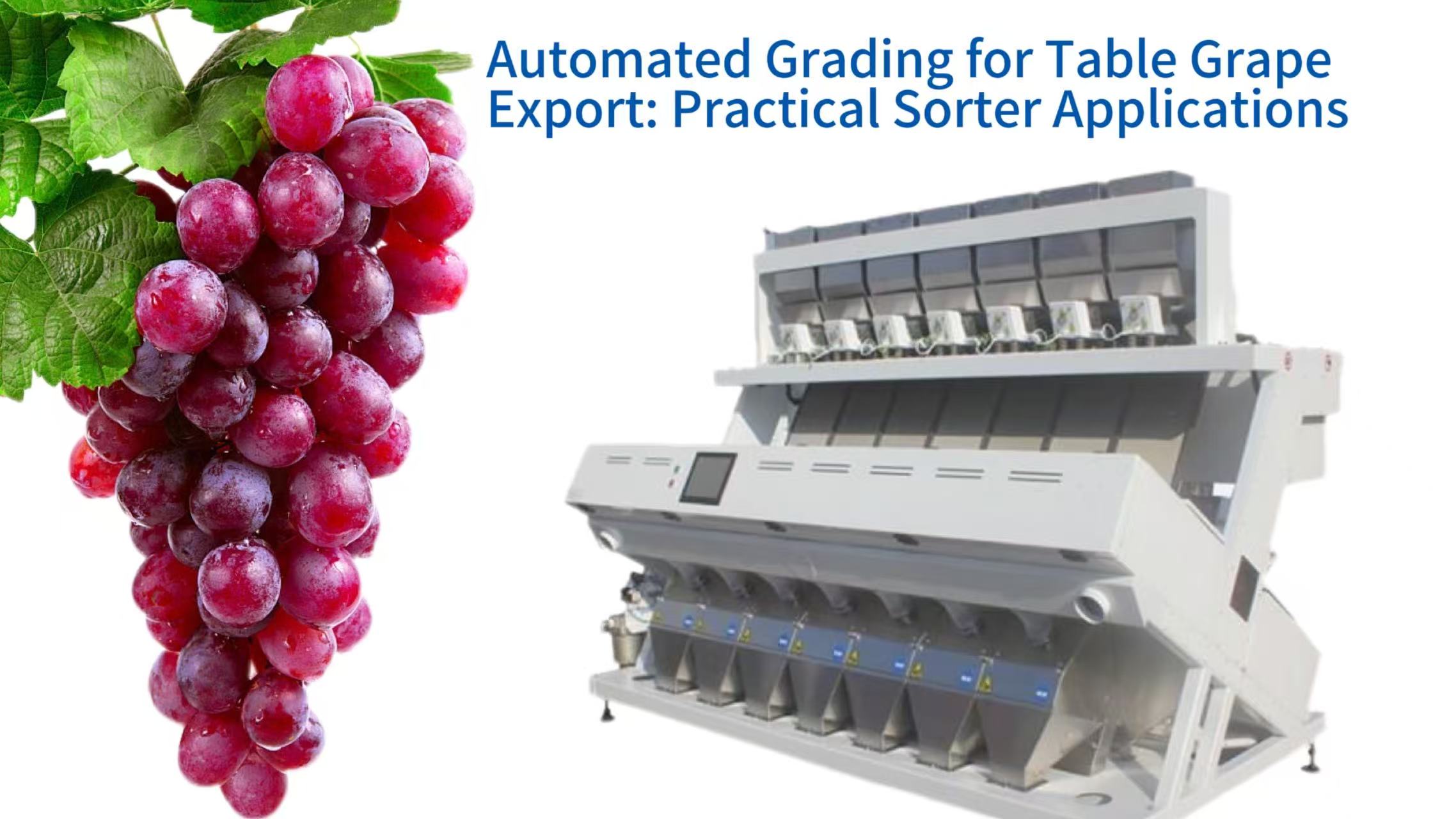
Automated Grape Sorting Workflow for Export
Feeding
Gentle intake (belt/water)
Multi-Angle Inspection
CCD + Multispectral
AI Analysis
Quality classification
Precision Ejection
Air-based removal
Data Logging
Export documentation
Table grapes are one of the most strictly graded fresh fruits in international trade. Export markets demand uniform size, consistent color, freedom from defects, and absolute absence of foreign material. A single shipment rejected at the destination port can cost exporters hundreds of thousands of dollars and damage hard-won customer relationships. Traditional manual grading, still common in many packing houses, struggles to meet these exacting standards consistently. Human sorters tire, miss subtle defects, and vary in their judgments. Automated grape sorting machines, equipped with advanced optical sensors and artificial intelligence, have become essential tools for successful grape exporters. These systems inspect every single berry at high speed, sorting by color, size, shape, and detecting defects that human eyes would miss. This article explores how automated grading technology is applied in table grape export operations, the types of machines available, their core functions, and the tangible business benefits they deliver to exporters worldwide.
What Is an Automated Grape Sorting Machine and How Does It Work for Export Grading
An automated grape sorting machine is an industrial system that uses high-resolution cameras, multispectral sensors, and artificial intelligence to inspect and grade table grapes based on multiple quality parameters simultaneously. Unlike simple color sorters, modern grape graders analyze berry color uniformity, size distribution, shape characteristics, surface defects, and even internal quality indicators. These machines are designed to integrate seamlessly into export packing lines, handling both loose berries and whole clusters with equal precision .
Core Technology: Multi-Dimensional Vision System with AI
The foundation of any grape sorter is its vision system. High-resolution CCD cameras capture images of each grape or cluster from multiple angles, detecting color variations that indicate maturity levels, surface defects such as bruising or sunburn, and shape irregularities. Advanced systems employ at least three cameras per inspection channel, ensuring comprehensive coverage with no blind spots. This multi-dimensional view allows the machine to identify defects that might be hidden from a single camera, such as a small area of decay on the underside of a berry .
The artificial intelligence integrated into modern grape sorters represents a significant advance over conventional technology. These systems use deep neural networks trained on thousands of images of both export-grade and defective grapes. When the sorter encounters a new type of defect or an unusual blemish, it compares that item against its training database and makes a classification decision. The AI continuously learns and refines its recognition capabilities, adapting to variations in different grape varieties, growing regions, and seasonal conditions . This self-optimizing capability ensures consistent sorting performance throughout the export season.
Multispectral and Hyperspectral Sensing for Defect Detection
While color cameras excel at detecting visible defects, multispectral sorters integrate multiple light wavelengths, including near-infrared, to detect a broader range of grape anomalies. These systems can identify early-stage rot, mold development, and some foreign materials that standard color systems would miss. For export-oriented facilities where product consistency and food safety are paramount, multispectral technology provides an additional layer of quality assurance .
At the pinnacle of optical sorting technology, hyperspectral systems analyze hundreds of continuous wavelength bands to identify even minute differences in chemical composition. These advanced sorters are particularly valuable for detecting internal defects that show no external signs, such as early decay or physiological disorders that could affect shelf life during long-distance shipping. Although these systems command premium prices, they deliver unmatched precision for the most demanding export markets .
Gentle Handling Systems for Delicate Table Grapes
Table grapes are among the most delicate fresh fruits, prone to bruising, splitting, and bloom removal. Automated graders must handle them with exceptional care. Modern grape sorters incorporate specially designed feeding systems that minimize impacts and abrasion. Belt-type conveyors provide stable support, preventing the tumbling that would damage berries in free-fall designs. Water-based feeding systems offer the gentlest handling, cushioning grapes as they move through the inspection zone .
The ejection mechanism must also be gentle. High-speed ejection systems use precisely aimed bursts of compressed air to remove defective grapes or clusters without disturbing the surrounding good fruit. The air pressure is carefully regulated to provide enough force for removal while avoiding damage to delicate berries. This combination of careful feeding and gentle ejection keeps damage rates below 5 percent, ensuring that exported grapes arrive at their destination in perfect condition.
Real-Time Data and Traceability for Export Documentation
Modern grape sorters are not just sorting machines; they are comprehensive data collection platforms. They record detailed information about every batch processed, including the number of grapes accepted or rejected, the distribution of color grades and sizes, and the types of defects encountered. This data can be used to generate quality certificates, track performance against export specifications, and provide customers with documented proof of product quality .
Traceability is increasingly critical for grape exporters. Importing countries and major retailers require documentation that demonstrates compliance with phytosanitary standards and quality agreements. Automated sorters with data logging capabilities provide this documentation automatically, reducing administrative burden and simplifying audits. The data can also be used to identify quality trends over time, helping exporters work with growers to improve crop quality and maximize the percentage of fruit meeting export grades.
Main Types of Grape Sorting Machines for Export Operations
Grape exporters have different needs depending on whether they handle loose berries or whole clusters, the volume of their operation, and the specific requirements of their target markets. Manufacturers offer several configurations of grape sorters, each optimized for particular applications. Selecting the right type is essential for maximizing both throughput and quality.
Belt-Type Optical Sorters for High-Volume Export Lines
Belt-type sorters are the workhorses of large-scale grape export operations. In these machines, grapes are conveyed on a flat belt through the inspection area, where cameras and sensors capture data from above and, in some configurations, from below. The belt provides stable support, ensuring that berries are presented consistently to the vision system. Belt widths ranging from 300 mm to 2800 mm accommodate various production volumes, with wider belts handling higher throughput .
Belt-type AI color sorting machines are particularly effective for sorting loose grapes destined for export as fresh fruit or for processing into juice concentrate. They can achieve throughputs of several tons per hour while maintaining sorting accuracy above 95 percent. For large cooperatives and export-oriented packing facilities, belt-type sorters deliver the combination of capacity and precision required to compete in global markets.
Free-Fall Cascade Sorters for Delicate Varieties
Free-fall or cascade sorters operate by letting grapes drop past high-speed cameras and sensors, allowing inspection from multiple angles in a compact footprint. This design is particularly suitable for smaller operations or for handling delicate grape varieties that require minimal contact with machine surfaces. The grapes are only in free fall for a fraction of a second, limiting opportunities for damage .
While free-fall sorters typically have lower throughput than belt-type machines, their compact size and flexible installation make them attractive for packers with limited floor space or those processing multiple varieties that require frequent changeovers. Buyers in emerging wine regions and smaller export operations often find these machines offer the best balance of capability and investment.
Integrated Grading Lines with Multiple Sensor Types
For the most demanding export markets, integrated grading lines combine multiple sensor technologies into a single, comprehensive system. These lines might include color sorters for visual inspection, near-infrared sensors for internal quality assessment, and electronic weighing systems for precise size grading. By fusing data from multiple sensors, these systems can make sophisticated sorting decisions that no single technology could achieve alone .
Integrated lines are particularly valuable for exporters supplying premium markets with strict quality requirements. They can, for example, ensure that grapes not only meet visual standards but also achieve minimum sugar content levels required for certain export destinations. The data from all sensors is synchronized, providing a complete quality profile for every batch and enabling exporters to target multiple market segments with different specifications.
Punnet Inspection Systems for Packed Product
Some advanced sorting applications extend beyond individual berries to inspect finished punnets of grapes before they are shipped. These systems use AI-powered cameras to assess the quality of grapes already packed in consumer containers, approving or rejecting entire punnets based on user-defined specifications. This final quality checkpoint ensures that only perfect packages reach the export shipping container .
Punnet inspection systems can save 30 to 50 percent of the labor typically required for final quality checks while improving consistency. They also provide valuable data on quality trends, allowing exporters to fine-tune their upstream sorting processes. For exporters supplying major retailers with private label programs, this technology provides documented proof that every package meets the agreed specifications.
Core Functions of Grape Sorters for Export Quality Control
Key Export Quality Control Functions
Color Sorting
>95%
Color consistency accuracy
Detects maturity-related color shifts
Size Grading
±2g
Weight measurement accuracy
95% pass rate for size specs
Defect Detection
>95%
Defect sorting accuracy
Detects 1mm+ surface defects
Foreign Material Removal
100%
Critical contaminant detection
Prevents shipment rejection
Automated grape sorters perform multiple critical functions that directly impact export success. These machines do far more than simply remove obvious defects; they enable precise grading that maximizes the value of each harvest while ensuring compliance with international standards.
Color Sorting for Maturity and Variety Consistency
Color uniformity is one of the most important quality attributes for exported table grapes. Buyers expect consistent coloration within each package, whether that means uniform green for Thompson seedless or consistent red for Flame seedless. Automated sorters analyze the color of every berry, separating grapes into defined color grades with accuracy exceeding 95 percent. This precision enables packers to assemble packages with perfect color consistency, commanding premium prices in discerning markets .
The color sorting function extends beyond simple green/red discrimination. Advanced systems can detect subtle variations that indicate different maturity levels, ensuring that all grapes in a package will have similar eating quality and shelf life. For varieties where color changes during storage, sorters can be calibrated to select grapes at the optimal maturity stage for long-distance shipping, balancing appearance at departure with expected condition at arrival.
Size Grading for Export Market Specifications
Export markets have strict size requirements, often specifying berry diameter ranges or minimum counts per package. Electronic weighing systems integrated into grape sorters measure each berry or cluster with remarkable precision, typically achieving accuracy of ±2 grams with a 95 percent pass rate. This data is used to assign grapes to different size grades, ensuring that every package meets the dimensional specifications of the target market .
The ability to sort into multiple size categories simultaneously is particularly valuable for exporters serving diverse markets. A single sorting line can separate grapes into three or four size grades, directing the largest berries to premium markets while allocating smaller ones to juice processing or less demanding destinations. This optimization maximizes the value derived from every ton of harvested fruit.
Defect Detection and Removal
Export-grade grapes must be free from defects including sunburn, scarring, bruising, insect damage, and decay. Automated sorters detect these imperfections with remarkable reliability, achieving defect sorting accuracy above 95 percent. The machines identify subtle defects that human sorters would miss, particularly when working at high speed or during long shifts. A small area of sunburn that might escape notice during manual inspection is reliably detected and rejected by optical sensors .
For decay detection, multispectral and hyperspectral systems offer particular advantages. Fungal infections often begin internally or in inconspicuous areas, becoming visible only after decay is well advanced. Near-infrared sensors can detect the chemical changes associated with early decay before any visual symptoms appear, ensuring that affected berries are removed before they can contaminate other fruit in the package during shipping .
Foreign Material Removal
Foreign material in export shipments can trigger immediate rejection and significant penalties. Common contaminants include leaves, stems, insect fragments, and occasionally stones or other debris from the vineyard. Automated sorters excel at detecting and removing these materials because their optical properties differ dramatically from grapes. Leaves reflect light differently than berries; stems have distinct color and shape characteristics; stones and other dense materials trigger sensor responses that immediately flag them for ejection .
The removal of foreign material protects both the exporter's reputation and the importer's business. A single shipment found to contain prohibited material can result in the entire container being refused entry, with costs for return, disposal, or destruction falling on the exporter. Automated sorting provides documented proof that every effort was made to remove contaminants, supporting due diligence claims in the event of disputes.
Grape Varieties and Forms Processed by Export Sorters
Export Grape Varieties & Market Distribution
Green Seedless (55%)
Markets: Europe, Asia | Key specs: Uniform green color, no ambering
Red/Black Varieties (30%)
Markets: North America, Middle East | Key specs: Deep color uniformity
Organic/Specialty (10%)
Premium markets | Key specs: Custom defect tolerance
Other Varieties (5%)
Regional specialties | Custom sorting criteria
Table grapes encompass hundreds of varieties, each with unique characteristics that affect sorting requirements. Automated graders must accommodate this diversity while maintaining accuracy and gentle handling appropriate to each type.
Green Seedless Varieties for European and Asian Markets
Green seedless grapes such as Thompson Seedless, Sugraone, and Autumn King dominate export volumes to European and Asian markets. These varieties require sorting for uniform green color without ambering or yellowing, which indicates over-maturity. Export sorters for green grapes must be calibrated to detect the subtle color shift from desirable light green to less acceptable yellow-green, ensuring that only fruit at the optimal maturity stage is shipped .
Grape sorting machines for green varieties also need to detect specific defects common to these grapes, including russeting (a brown, net-like pattern on the skin) and water berries (berries with low sugar content that appear translucent). The machines can be trained to recognize these defects and remove affected berries, ensuring that exported fruit meets the exacting standards of premium markets.
Red and Black Varieties for North American and Middle Eastern Markets
Red and black grapes, including Flame Seedless, Crimson Seedless, and Autumn Royal, are prized for their rich coloration. Export sorters for these varieties must assess color intensity and uniformity, ensuring that all berries in a package have achieved the deep coloration that commands premium prices. The machines can distinguish between fully colored berries and those with incomplete color development, directing the latter to less demanding markets or processing .
Defect detection for colored varieties presents unique challenges. Dark berries against dark backgrounds can make some defects harder to detect with conventional imaging. Advanced sorters address this through multispectral approaches that use non-visible wavelengths to enhance contrast, ensuring that even subtle defects on dark-skinned varieties are reliably identified and removed.
Loose Berries vs. Whole Clusters
Some export markets prefer whole clusters of grapes, while others accept loose berries for specific applications. Automated sorters must accommodate both forms with appropriate handling systems. Cluster sorting requires larger inspection zones and different presentation methods to ensure that all berries in the cluster are visible to the sensors. Some systems use rotating mechanisms that flip clusters during inspection, providing complete surface coverage .
For loose berry applications, the sorter must handle individual fruit without the protection of the cluster structure. Gentle handling becomes even more critical, as loose berries are more susceptible to bruising and splitting. Belt-type sorters with soft surfaces and minimal drops are preferred for loose berry operations, ensuring that fruit reaches the package in perfect condition.
Organic and Specialty Export Programs
Organic grapes command premium prices in export markets, but they also come with heightened expectations for quality. Because organic production prohibits many synthetic fungicides, the fruit may show more surface imperfections from natural causes. Sorting organic grapes requires a careful balance between removing defects and preserving as much marketable fruit as possible .
Specialty varieties and proprietary club varieties often have unique quality specifications defined by the variety owner. Automated sorters with flexible programming can accommodate these special requirements, applying custom grading criteria that may include specific color ranges, size distributions, or defect tolerances. This flexibility enables exporters to participate in premium programs that would be impossible to manage with manual sorting alone.
Technical Principles Behind Automated Grape Sorting for Export
Technical Principles of Grape Sorting
High-Resolution CCD Imaging
1mm defect detection, multi-angle capture
Machine Learning Analysis
Defect classification, continuous learning
Multispectral/NIR Sensing
Internal quality, early decay detection
Precision Ejection Control
1000+ cycles/sec, millisecond timing
The exceptional capabilities of modern grape sorters rest on sophisticated technology that combines optics, mechanics, electronics, and artificial intelligence. Understanding these technical principles helps exporters appreciate what their equipment can achieve and how to optimize its performance for specific export programs.
High-Resolution CCD Cameras and Multi-Angle Inspection
The cameras used in grape sorters capture images with resolutions fine enough to detect defects as small as one millimeter. Each inspection channel is typically equipped with multiple cameras positioned to view the fruit from different angles, ensuring that no surface goes uninspected. This multi-angle approach is essential for grapes, where a defect on the hidden side of a berry could compromise the entire package if not detected .
The cameras operate at frame rates that freeze the motion of fruit traveling at several meters per second. Advanced triggering systems ensure that images are captured precisely when the grape is in the optimal position, maximizing the quality of the data available for analysis. The combination of high resolution and high speed allows the system to inspect every berry thoroughly, even at peak throughput.
Machine Learning Algorithms for Classification
The data captured by optical sensors must be interpreted instantly to make sorting decisions. This interpretation falls to sophisticated machine learning algorithms trained on thousands of images of both export-grade and defective grapes. These algorithms learn to recognize the subtle patterns that distinguish acceptable fruit from fruit that should be rejected. They understand that a slight color variation might indicate desirable maturity in one variety but signal a defect in another .
As the sorter processes grapes, its algorithms continue learning and refining their classification criteria. If the machine encounters a new defect type not represented in its initial training, it compares that defect against its existing knowledge base and makes a probabilistic decision. Over time, as operators confirm or correct these decisions, the system updates its models, becoming increasingly accurate. This continuous learning capability ensures that grape sorters maintain peak performance despite variations in growing conditions and variety characteristics.
Multispectral and Near-Infrared Analysis
Beyond visible light, advanced grape sorters incorporate sensors operating in the near-infrared spectrum. These NIR sensors detect characteristics invisible to color cameras, including internal sugar content, moisture levels, and the presence of compounds associated with decay or physiological disorders. By combining visible and NIR data, the sorter builds a comprehensive picture of each grape's quality, making decisions based on both external appearance and internal condition .
For export applications where shelf life and eating quality are critical, NIR analysis provides valuable insights that visual inspection alone cannot deliver. Grapes with adequate sugar content will maintain quality better during long-distance shipping and arrive ready for immediate consumption. Those with marginal sugar can be directed to closer markets or processed, ensuring that only fruit capable of satisfying distant consumers is shipped.
Precision Ejection Technology
Once a defective grape or foreign object is identified, the sorter must remove it from the product stream instantly without damaging surrounding fruit. This is accomplished through arrays of high-speed solenoid valves that fire precisely aimed bursts of compressed air. These valves operate at frequencies exceeding 1000 cycles per second, meaning they can eject individual defects without disturbing the good fruit around them .
Precision acceleration systems track each grape's position after inspection and calculate exactly when it will reach the ejection zone. At that moment, the appropriate valve fires, diverting the target into a reject chute. The timing must be perfect, as grapes travel through the inspection zone at several meters per second, and the ejection window lasts only milliseconds. Modern ejection systems achieve this precision reliably, maintaining accuracy even at maximum throughput.
Business Value and ROI for Grape Exporters
Investing in automated grape sorting technology represents a significant capital decision for any export operation. However, the returns generated through improved quality, reduced waste, enhanced efficiency, and risk mitigation typically justify the investment within months rather than years.
Labor Cost Reduction and Labor Shortage Solutions
A single automated grape sorter can replace dozens of manual sorters, operating continuously without breaks, shift changes, or the management overhead required for large sorting teams. For a medium-sized export packing facility, the annual savings in wages, benefits, and associated costs can easily exceed $200,000. These savings compound over the machine's multi-year service life .
Beyond direct cost savings, automation addresses the growing challenge of labor availability. Many grape-producing regions face chronic shortages of agricultural workers, particularly during peak harvest periods. By reducing reliance on manual sorting, exporters insulate themselves from labor market fluctuations and ensure that they can process their entire crop regardless of worker availability. This operational reliability is increasingly valuable in tight labor markets.
Reduced Waste and Increased Exportable Yield
Manual sorting tends to be conservative, rejecting some good fruit along with the bad to ensure that no defects slip through. This over-rejection can waste 5 to 10 percent of the crop, representing substantial financial loss. Automated sorters, with their precise, consistent decision-making, reduce this waste significantly. Yield improvements of 3 to 5 percent are common, meaning more of the harvest is sold as premium export fruit rather than being diverted to lower-value uses .
For an exporter handling 5,000 tons of grapes annually, a 4 percent yield increase translates to an additional 200 tons of exportable fruit. At typical export prices, this can add hundreds of thousands of dollars to annual revenue. Over time, these yield improvements compound, making the sorter a powerful tool for improving profitability.
Consistent Compliance with Export Standards
Export markets have zero tolerance for certain defects and strict limits on others. A single shipment that fails to meet these standards can result in rejection, with costs for return, disposal, or destruction reaching hundreds of thousands of dollars. Automated sorters provide consistent compliance by applying identical criteria to every grape, every shift, every day. This consistency eliminates the variability inherent in manual sorting and reduces the risk of costly rejections .
The documented proof provided by automated sorters is equally valuable. When questions arise about shipment quality, exporters can provide data demonstrating that every batch was inspected and met specifications. This documentation protects against unwarranted claims and supports rapid resolution when legitimate issues occur. Over time, the reputation for consistent quality builds customer trust and strengthens long-term relationships.
Access to Premium Markets and Premium Pricing
Exporters using automated sorting can position their fruit in premium market segments that demand the highest quality standards. Supermarkets in Europe, North America, and Asia require suppliers to meet strict specifications that often cannot be achieved without automated grading. By investing in sorting technology, exporters open doors to these attractive markets, accessing customers willing to pay premium prices for guaranteed quality .
Beyond market access, automated sorting enables participation in variety-specific programs with proprietary quality standards. Some high-value grape varieties are licensed with requirements for specific color ranges, size distributions, and defect tolerances that can only be met consistently with automated grading. These programs offer premium pricing and long-term contracts, providing stability and profitability that commodity markets cannot match.
Rapid Payback and Long-Term Competitive Advantage
Key Benefits of Automated Grape Sorting for Export
<5%
Damage Rate
Gentle handling preserves fruit quality
>95%
Sorting Accuracy
Consistent export quality standards
12-24
Months ROI
Fast payback with long-term benefits
100%
Compliance Assurance
Documented quality for export markets
When all the benefits are tallied—labor savings, yield improvements, risk reduction, and premium pricing—the payback period for an automated grape sorter is typically 12 to 24 months. In high-volume operations with premium market access, payback can be even faster. After the machine is paid off, it continues to generate savings and revenue for many years, with proper maintenance extending its useful life to a decade or more .
Beyond the financial return, automated sorting provides strategic competitive advantage. As global quality standards become more stringent and labor becomes harder to find, exporters with automated grading are positioned to thrive while competitors relying on manual methods struggle. The technology becomes not just a tool for efficiency but a fundamental enabler of business sustainability in an increasingly demanding global marketplace.
If you are considering upgrading your grape export operation with automated sorting technology, exploring the range of grape sorting solutions available can help you find the perfect match for your varieties, volumes, and target markets. The benefits in quality, efficiency, and market access are clear, and the investment pays dividends for years to come.