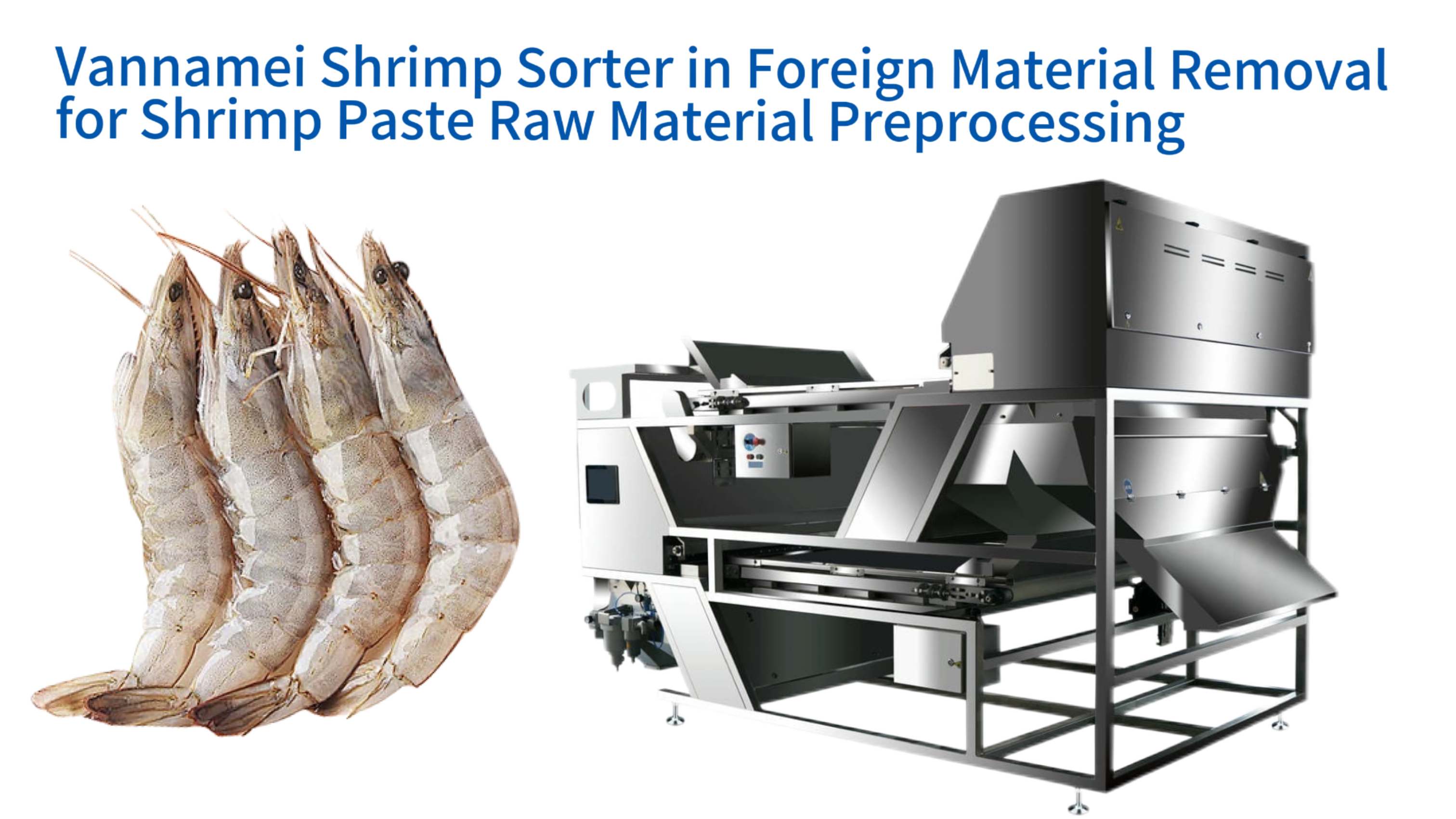
This page provides a comprehensive overview of how a Vannamei shrimp sorter is transforming shrimp paste production by removing foreign materials before further processing. Readers will learn about the core technology behind AI-powered sorting, the different machine configurations suitable for shrimp paste raw materials, and the specific foreign materials these systems can detect. The article also covers workflow integration, the commercial benefits of automation, and maintenance practices for consistent performance. Each section explains how intelligent sorting addresses the unique challenges of sticky, wet, and variably sized shrimp used in paste production.
The Unique Challenges of Preparing Raw Shrimp for Paste Production
| Challenge Type | Impact |
|---|---|
| High Moisture & Sticking | Contaminants hidden in clumps |
| Variable Sizes & Shapes | Uneven detection efficiency |
| Hard Contaminants | Gritty texture, quality failure |
| High Speed Production | Manual sorting accuracy decline |
Shrimp paste manufacturing begins with raw shrimp that often contains shells, legs, mixed species, and physical contaminants from harvesting. Unlike whole shrimp sold for direct consumption, shrimp destined for paste must be reduced to a homogeneous mixture where any hard or discolored particle becomes a quality defect. Traditional manual inspection struggles with high-speed production lines, as workers experience fatigue and inconsistency when examining thousands of small shrimp per hour. The shrimp sorting machine addresses this bottleneck by automating the detection of unwanted materials before the grinding stage. Furthermore, fresh shrimp intended for paste production often arrives with varying moisture levels and can include broken pieces from previous handling steps, making it difficult for conventional mechanical separators to distinguish between acceptable soft tissue and hard contaminants like shell fragments or small stones.
High Moisture Content and Sticking Issues in Raw Shrimp Batches
Raw shrimp destined for paste production typically retains significant surface moisture from washing and thawing processes, causing individual pieces to clump together on inspection belts. This clumping behavior creates hiding spots where small foreign materials like sand grains or shell shards can escape visual detection, as they become trapped between overlapping shrimp pieces. Traditional sorting methods relying on vibration or air flow cannot reliably separate these sticky clusters without damaging the delicate shrimp tissue. A specialized AI sorter addresses this by using controlled belt speeds and optimized feeding mechanisms that gently spread the shrimp into a uniform monolayer, exposing each piece to optical sensors for thorough inspection before any clumps can form.
Variable Sizes and Shapes of Shrimp Components After Initial Processing
Shrimp arriving for paste production includes whole small shrimp, large shrimp that have been cut into segments, and naturally broken pieces from previous handling steps, creating a highly heterogeneous mixture. This size variability challenges fixed parameter sorting systems because a foreign material that is obvious on a large shrimp piece might be hidden behind a smaller overlapping piece. The Vannamei shrimp sorter overcomes this by using adaptive algorithms that evaluate each object's size relative to its surrounding neighbors, adjusting rejection thresholds dynamically. This capability ensures that a tiny shell fragment on a small shrimp receives the same detection priority as a larger contaminant on a big shrimp, maintaining consistent final paste purity across all incoming material variations.
Distinguishing Soft Tissue from Hard Contaminants in Shrimp Paste Feedstock
The most critical challenge in shrimp paste preprocessing is the reliable separation of soft, grindable shrimp tissue from hard contaminants such as shell fragments, leg pieces, and sand grains. These hard materials, if allowed to reach the grinder, will produce a gritty texture that ruins the smooth mouthfeel expected from premium shrimp paste. Manual sorters struggle with this distinction because some shell pieces are soft and translucent, while others are hard and opaque, creating constant decision fatigue. A NIR sorter solves this by measuring the near-infrared reflectance of each piece, which differs significantly between protein-rich shrimp muscle and chitin-based shell material, enabling automated rejection of all hard contaminants regardless of their visible color or size.
Speed and Consistency Demands of Modern Shrimp Paste Production Lines
Industrial shrimp paste facilities process multiple tons of raw shrimp per hour, creating a throughput requirement that far exceeds human manual sorting capabilities. Even a well-trained team of manual sorters will experience declining accuracy after the first hour of work, with error rates increasing as fatigue sets in. The Vannamei shrimp sorter operates continuously at speeds of up to ten tons per hour while maintaining a consistent rejection accuracy above ninety-nine percent throughout an entire shift. This reliability allows production planners to schedule consistent output without building in extra time for manual re-inspection, directly improving the facility's overall equipment effectiveness and reducing per-unit labor costs significantly.
How Multi-Spectral Vision Enables Detection of Foreign Materials in Shrimp Paste Raw Stock
The core technology powering modern shrimp paste preprocessing is a multi-spectral vision system integrated into a belt type AI sorting machine. This system uses high-resolution CCD cameras alongside near-infrared sensors to analyze each shrimp piece as it travels along the inspection belt. While standard color cameras detect visible differences like discoloration or bruising, near-infrared technology penetrates the surface to identify variations in moisture and organic composition. A piece of shrimp tail has a different spectral signature than a section of intestine or a bit of plastic netting from harvest, allowing the machine to make accurate reject decisions. These optical sensors capture data at a rate of thousands of pieces per minute, with detection precision down to one millimeter.
High-Resolution CCD Imaging for Surface Color and Texture Analysis
The first layer of detection in the Vannamei shrimp sorter uses high-resolution CCD cameras that capture detailed color and texture information from each shrimp piece passing through the inspection zone. These cameras detect subtle color variations that indicate melanosis, bruising, or early spoilage, all of which would negatively impact the final paste's appearance and flavor profile. The system analyzes not just the dominant color of each piece but also the distribution of colors across its surface, flagging items where discolored areas exceed user-defined thresholds. This surface analysis is particularly valuable for identifying shrimp that have started to deteriorate from the tail or head area while the main body remains apparently healthy, preventing off-flavors from entering the paste batch.
Near-Infrared Spectroscopy for Subsurface Material Identification
Complementing the visible light cameras, near-infrared sensors provide the shrimp sorter with the ability to see beneath the surface of each piece, detecting material composition differences that are invisible to human eyes or standard cameras. When a near-infrared beam strikes a piece of shrimp tissue, it reflects differently than when it strikes a piece of shell, a fish scale, or a plastic fragment, creating a unique spectral signature for each material type. The advanced detection algorithms compare each measured signature against a library of known shrimp tissue spectra, immediately rejecting any object whose signature does not match acceptable shrimp meat. This technology is especially effective at finding translucent shell fragments that would otherwise blend into the surrounding meat color and escape manual detection completely.
Deep Learning Algorithms for Adaptive Contaminant Recognition
The AI capabilities of modern shrimp sorters go far beyond simple color matching, incorporating deep learning neural networks that continuously improve their detection accuracy over time. As the Vannamei shrimp sorter processes more material, its algorithms learn to recognize new variations of both acceptable shrimp tissue and foreign contaminants, adapting to seasonal changes in raw material characteristics. This machine learning approach means that the system becomes more effective the longer it operates, rather than requiring frequent manual recalibration by technical specialists. When a new type of contaminant appears in the raw material, such as a different color of plastic netting from a changed harvest practice, the AI sorter can be trained on a small number of example images and will then recognize that contaminant reliably going forward.
Real-Time Decision Making with Millisecond Response Times
The combination of high-speed cameras and powerful onboard processors enables the Vannamei shrimp sorter to make accept or reject decisions within milliseconds of each piece passing under the optical sensors. This rapid processing is essential for maintaining high throughput rates while ensuring that no foreign material escapes detection, as even a brief processing delay would require slowing down the entire production line. The system's real-time capability is achieved through parallel processing architectures that analyze multiple data streams simultaneously, examining color, shape, texture, and spectral information all at once. When a reject decision is made, the ejection system receives its firing command within a fraction of a millisecond, precisely timed to hit the exact offending piece as it reaches the ejection zone without disturbing neighboring acceptable shrimp pieces.
Belt Type versus Chute Type Sorters for Sticky and Wet Shrimp Feedstock
• Max throughput: 10 tons/hour
• Suitable: Wet / sticky shrimp
• Advantage: Gentle handling, high accuracy
• Floor space: Standard occupation
• Throughput: +50% higher than belt type
• Suitable: Dry / free-flowing shrimp
• Advantage: High efficiency, space-saving
• Defect: Easy to break fragile shrimp
When selecting equipment for shrimp paste raw material, one of the primary decisions is between a belt type and a chute type configuration. A belt type AI sorting machine is generally preferred for wet or sticky products because the flat, moving conveyor belt provides a stable surface that prevents shrimp pieces from tumbling or sticking together. This design ensures that each item passes under the sensors with its full surface exposed, maximizing detection accuracy. For shrimp that may have residual moisture or be coated in ice from thawing, the belt type machine also allows for gentler handling, reducing the creation of fines or broken meat. Conversely, a chute type AI sorting machine may be suitable for drier or free-flowing shrimp that have been pre-treated to reduce surface moisture.
Belt Type Configuration for Gentle Handling of Wet and Delicate Shrimp
The belt type configuration features a wide, slow-moving conveyor belt that carries shrimp pieces through the inspection zone at a controlled speed, minimizing physical stress on the delicate raw material. This gentle handling is particularly important for shrimp intended for paste production, as excessive breakage creates fines that are difficult to sort and may carry contaminants through the ejection system inadvertently. The belt's surface is typically made of food-grade polyurethane with a textured pattern that provides traction for wet shrimp without allowing them to slide or roll, maintaining each piece in an optimal orientation for optical inspection. For processors dealing with highly variable raw material moisture levels, the belt type machine allows easy adjustment of belt speed to match the current product characteristics, ensuring consistent monolayer coverage regardless of stickiness.
Chute Type Configuration for High-Throughput Processing of Pre-Dried Shrimp
The chute type design relies on gravity acceleration as shrimp pieces slide down an inclined polished surface, achieving very high linear speeds that enable throughput rates up to fifty percent higher than belt type machines of comparable width. This configuration is most effective when the shrimp have been pre-treated with a drying step or surface coating that reduces stickiness, allowing them to flow freely without clumping. The chute type Vannamei shrimp sorter requires less floor space for a given throughput capacity, making it attractive for facilities where production area is limited. However, the higher impact forces at the bottom of the chute can increase breakage rates for very delicate shrimp, and the fixed angle of the chute offers less flexibility for tuning to batch-specific moisture variations compared to variable-speed belt systems.
Selecting the Right Configuration Based on Shrimp Freshness and Processing Stage
The optimal machine configuration depends heavily on the specific characteristics of the incoming shrimp and the point in the production line where sorting occurs. For fresh, never-frozen shrimp that are processed immediately after harvest, the higher moisture content favors a belt type machine that can handle sticky surfaces without material buildup. Conversely, shrimp that have been frozen and thawed typically release more free water, which can be drained before sorting, making the chute type a viable option. Many large shrimp paste producers install both configurations in parallel lines, dedicating the belt type machines to the most challenging raw material batches while routing drier, more uniform product to chute type sorters for maximum efficiency and throughput.
Integration with Upstream Dewatering and Downstream Grinding Equipment
Regardless of whether a belt type or chute type Vannamei shrimp sorter is selected, proper integration with upstream and downstream equipment is essential for realizing the full benefits of automated sorting. The sorter should be positioned after a dewatering screen or centrifugal dryer that removes excess surface moisture, as this improves both optical inspection accuracy and material flow characteristics. Downstream, the accepted shrimp pieces should feed directly into a grinder or mincer without intermediate storage that could allow recontamination. The food sorting system's ejection port should connect to a separate collection bin for rejected materials, allowing operators to periodically verify that no acceptable shrimp are being incorrectly rejected and to inspect the types of foreign materials being removed from the process stream.
Identifying and Removing Specific Foreign Materials from Shrimp Paste Batches
Shrimp paste raw material can contain a surprising variety of foreign materials that must be eliminated before grinding. The most common include natural impurities such as shell fragments, shrimp legs, antennae, and the sand vein, all of which affect paste texture and appearance. Additionally, harvest and transport can introduce plastic pieces from ice bags, metal fragments from processing equipment, and even small stones. A dedicated Vannamei shrimp sorter equipped with both color and near-infrared sensors can be trained to recognize each of these material types based on unique optical signatures. Beyond physical contaminants, the system also identifies biological defects such as black spot disease, melanosis, or early spoilage signs that manifest as color changes.
Shell Fragments and Crustacean Parts: The Most Common Contaminants
Shell fragments represent the most frequent foreign material found in shrimp paste raw material, originating from incomplete peeling operations or from mixing of peeled and unpeeled shrimp during harvest and transport. These fragments range in size from large pieces easily visible to the naked eye down to tiny flakes barely a millimeter across, yet any fragment larger than a grain of sand will create a detectable gritty texture in the final paste. The sensor based sorting machine detects shell fragments through their distinct near-infrared signature, which differs from shrimp muscle tissue due to the chitin content of the shell. This detection method works even when the shell fragment is the same color as the surrounding shrimp meat, a scenario where manual sorting and conventional color sorters would fail completely, allowing processors to achieve true shell-free paste for premium market segments.
Plastic and Metal Contaminants from Harvesting and Processing Equipment
Modern shrimp harvesting operations use plastic nets, plastic-lined ice bags, and various plastic tools that can break and introduce fragments into the raw shrimp supply, while processing equipment can shed metal pieces from worn bearings or broken blades. These synthetic contaminants pose serious food safety risks, as plastic fragments can cause choking or digestive injuries while metal shards present obvious physical hazards to consumers. The Vannamei shrimp sorter's multi-spectral vision system detects plastics through their distinct reflectance patterns in both visible and near-infrared wavelengths, while metal pieces are identified through their opacity and unique surface reflectivity. Some advanced configurations also integrate optional x ray sorter technology for applications where metal detection is particularly critical, providing an additional layer of assurance for high-risk production environments.
Biological Defects: Black Spot, Melanosis, and Early Spoilage
Shrimp are susceptible to a natural enzymatic reaction called melanosis or black spot, which causes dark discoloration on the shell and underlying meat within hours of harvest if not properly treated. This discoloration, while not harmful to consume, creates an undesirable appearance in the final shrimp paste and indicates that the raw material may be past its peak freshness. The Vannamei shrimp sorter identifies affected shrimp pieces through their characteristic dark patches, removing them before they can enter the paste production stream. Additionally, the system detects early spoilage signs such as color changes to yellow or pink hues, texture changes that affect light reflection, and the presence of visible bacterial colonies, all of which would accelerate degradation of the finished paste product.
Sand, Grit, and Mineral Contaminants from Harvest Environments
Shrimp harvested from pond or wild environments inevitably pick up small amounts of sand and grit, which may adhere to the exterior surface or become trapped inside the body cavity during processing. These mineral contaminants are particularly dangerous for shrimp paste quality because they are extremely hard and will survive the grinding process as abrasive particles that create a unpleasant sandy sensation in the final product. The Vannamei shrimp sorter detects sand and grit through their high density and characteristic light reflection patterns, which differ significantly from the soft, translucent shrimp tissue. Even sand grains as small as half a millimeter can be detected and rejected by modern high-resolution systems, resulting in a paste that meets the most stringent quality standards for premium export markets where any detectable grit would lead to immediate customer rejection.
Integrating AI Sorting into the Shrimp Paste Production Workflow
Positioning the AI sorter correctly within the overall production line is essential for maximizing its benefits. Typically, the Vannamei shrimp sorter is placed after initial washing and dewatering but before the grinding or mincing step. This location allows the machine to inspect whole or semi-broken shrimp pieces before they become a homogenous paste, where contaminants would be impossible to remove later. A vibratory feeder evenly distributes the wet shrimp onto the belt, and a high-speed ejection system directs rejected materials into a separate chute for manual inspection or disposal. Integration also involves connecting the sorter to the facility's central control system for data collection and analytics.
Optimal Placement Between Washing and Grinding Operations
The most effective location for the Vannamei shrimp sorter is immediately after the final washing and dewatering stage, where surface moisture has been reduced but before any size reduction equipment that would make contaminant removal impossible. Placing the sorter here allows it to inspect intact shrimp pieces where foreign materials are most easily identified, as contaminants embedded inside a shrimp will only become visible after cutting or grinding. The sorter's output feeds directly into the grinder hopper, creating a continuous flow of inspected, contaminant-free raw material. This arrangement also simplifies rejected material handling, as the rejected shrimp pieces have not yet been mixed with other ingredients or undergone expensive processing steps, allowing their value to be recovered through alternative lower-grade uses.
Vibratory Feeding Systems for Uniform Material Distribution
Consistent, uniform presentation of shrimp pieces to the optical sensors is critical for achieving high detection accuracy, and this begins with the vibratory feeding system that transfers material onto the inspection belt. The feeder uses controlled vibration to spread the shrimp into a single layer without overlapping, with adjustable amplitude and frequency settings that can be tuned for different shrimp sizes and moisture levels. A well-calibrated feed system ensures that each shrimp piece has its own space on the belt, with sufficient separation that foreign materials adhering to one shrimp do not contaminate its neighbors when ejection occurs. The smart material feeding system also includes sensors that detect belt loading levels and automatically adjust feed rates to maintain optimal density even as incoming raw material flow varies during production shifts.
Ejection System Design for Precise Contaminant Removal
The ejection system is the final critical component of the Vannamei shrimp sorter, responsible for physically removing detected foreign materials from the product stream using precisely timed bursts of compressed air. High-speed solenoid valves control individual air nozzles arranged across the width of the inspection belt, each covering a specific zone, allowing the system to reject only the offending pieces while leaving neighboring acceptable shrimp undisturbed. The timing of each ejection pulse is calculated based on the detected contaminant's position and the belt speed, ensuring that the air blast strikes the target piece precisely as it passes over the ejection zone. This precision minimizes the amount of good shrimp carried away with rejected material, with typical systems achieving a rejection accuracy exceeding ninety-nine percent while keeping the ratio of good to bad material in the reject stream below ten to one.
Data Collection and Real-Time Production Monitoring
Modern Vannamei shrimp sorters generate a wealth of operational data that can be used to optimize both the sorting process itself and upstream production stages. The system records the number and types of foreign materials rejected per minute, providing early warning of issues such as increased shell content from a specific supplier or rising metal fragments from a damaged piece of upstream equipment. This data can be displayed on a local operator interface, sent to a central supervisory system, or made available for remote monitoring by quality assurance personnel. By analyzing rejection trends over time, production managers can identify patterns that lead to quality issues and take corrective action before contaminated product reaches customers, transforming the sorter from a passive inspection device into an active tool for continuous process improvement.
Economic and Quality Benefits of Automated Foreign Material Removal
| Indicator | Specific Data |
|---|---|
| Manual workers replaced | 10 ~ 15 persons |
| Sorting accuracy | ≥ 99% |
| Maximum processing capacity | 10 tons per hour |
| Investment return cycle | 6 ~ 12 months |
| Qualified product loss rate | < 5% |
Investing in an AI-powered shrimp sorter delivers measurable economic returns for shrimp paste producers. The most immediate benefit is the reduction of labor costs, as one automated sorter can replace ten to fifteen manual sorters working on a fast-moving line. Additionally, the machine operates continuously without fatigue, maintaining a consistent removal rate throughout long shifts. Many facilities report a return on investment within six to twelve months, driven by lower staffing needs and reduced rework expenses from contaminated batches. Quality improvements also contribute directly to profitability, as premium shrimp paste products command higher prices when they are guaranteed free of shells, sand, and discolored pieces.
Labor Cost Reduction and Consistent Sorting Quality
The economic case for automated shrimp sorting begins with direct labor savings, as a single Vannamei shrimp sorter typically replaces a team of ten to fifteen manual sorters working on the same production line. Beyond the obvious reduction in payroll expenses, automated sorting eliminates the indirect costs associated with manual inspection, including training time, shift scheduling complexity, worker turnover, and quality control supervision. More importantly, the machine maintains the same high rejection accuracy from the first minute of operation to the last, while manual sorters inevitably experience declining performance as fatigue accumulates through the shift. This consistency translates directly to higher final product quality and fewer customer complaints, benefits that are difficult to achieve with any purely manual inspection system regardless of how well it is managed.
Reduction of Product Recalls and Liability Risks
Foreign material contamination is one of the leading causes of food product recalls, and shrimp paste containing shell fragments, plastic pieces, or metal shards can trigger expensive recalls that damage brand reputation for years. The Vannamei shrimp sorter dramatically reduces this risk by providing a documented, verifiable inspection step that removes contaminants before they enter the finished product. Many food safety certification schemes and retail customer codes of practice now require or strongly recommend automated optical sorting for high-risk product categories, recognizing that manual inspection alone cannot provide the same level of assurance. The initial investment in sorting equipment is therefore not just a production cost but also an insurance premium against potentially devastating recall events, with the added benefit of making the facility eligible for higher-margin contracts that demand superior food safety controls.
Improved Yield Through Precise Rejection of Only Contaminated Pieces
While removing foreign materials is the primary goal of sorting, minimizing the amount of good shrimp that is rejected along with contaminants is equally important for profitability. The Vannamei shrimp sorter achieves very high selectivity by using precise ejection timing and adjustable sensitivity settings, allowing operators to fine-tune the balance between removal rate and good product loss. Typical systems achieve rejection rates above ninety-nine percent for target contaminants while keeping the carryover of acceptable shrimp in the reject stream below five percent by weight. This high selectivity means that a facility processing twenty tons of raw shrimp per day loses less than one ton to the reject stream, compared to three to five tons that might be lost with less sophisticated sorting equipment or manual inspection that errs on the side of safety by discarding ambiguous pieces.
Premium Pricing for Verified Contaminant-Free Products
End consumers of shrimp paste, particularly in developed markets and the food service sector, are increasingly willing to pay premium prices for products that carry verified quality assurances such as shell-free or contaminant-free claims. The ability to market shrimp paste as having passed through an AI sorter with documented removal of all detectable foreign materials provides a powerful competitive differentiator in crowded market segments. Export-oriented processors find that automated sorting certificates open doors to customers who would otherwise require costly third-party inspections or lot-by-lot testing. Furthermore, retailers and food manufacturers who use shrimp paste as an ingredient often specify automated sorting in their supplier quality agreements, making investment in this technology a prerequisite for winning and retaining high-volume contracts rather than merely an option for operational improvement.
Maintenance Protocols for Consistent Sorter Performance in Wet Environments
Shrimp paste preprocessing creates a challenging environment for electronic equipment due to high humidity, salt content, and organic residues. Therefore, daily cleaning of the Vannamei shrimp sorter is mandatory to prevent buildup on optical windows, conveyor belts, and ejection nozzles. Operators should use food-grade cleaning agents and avoid high-pressure water jets directed at sealed electronic compartments. The precision of the sorting process relies on unobstructed airflow and clean sensor surfaces to maintain its stated accuracy, making sanitation a key performance factor. In addition to daily cleaning, weekly inspections should verify the calibration of the ejection system and the alignment of the lighting modules.
Daily Cleaning Procedures for Optical Components and Conveyor Belts
Each production day must begin and end with a thorough cleaning of all surfaces that come into contact with shrimp material, with special attention to the optical windows that protect the cameras and sensors. Operators should use soft, non-abrasive cloths and food-grade cleaning solutions approved for use on optical surfaces, removing any protein or salt film that could scatter light and reduce detection accuracy. The conveyor belt itself requires scrubbing to remove adherent shrimp residue, particularly at the edges and seams where organic material can accumulate and support bacterial growth. After cleaning, a brief test run with a small sample of known-quality shrimp verifies that the system is operating correctly before the start of full production, preventing quality issues from contaminated or misaligned sensors.
Weekly Calibration Checks and Air Nozzle Inspections
Once per week, or more frequently if processing conditions are particularly challenging, maintenance personnel should perform a comprehensive calibration verification of the Vannamei shrimp sorter. This process involves running standardized test pieces through the machine and confirming that they are detected and rejected with the expected accuracy, making adjustments to camera exposure settings or rejection thresholds as needed. The air nozzle system also requires weekly inspection, as salt and protein residues can partially clog nozzles or cause sticking of the solenoid valves that control compressed air flow. A simple nozzle test pattern, where all nozzles are fired in sequence while observing the resulting air jets, quickly identifies any clogged or underperforming ejection points that would otherwise create gaps in contaminant removal coverage.
Preventing Corrosion in High-Salt, High-Humidity Environments
The combination of salt from shrimp tissue and high humidity from washing operations creates a highly corrosive environment that can degrade unprotected electronic and mechanical components over time. The Vannamei shrimp sorter uses stainless steel construction for all food contact surfaces and sealed enclosures with gasketed doors to protect sensitive electronics from moisture ingress. Additional preventive measures include applying dielectric grease to electrical connectors, coating circuit boards with conformal coating, and using air purges to create positive pressure inside optical enclosures. Operators must never use high-pressure washers directed at the machine's electrical panels or sensor housings, as even sealed units can be compromised by water jets exceeding their ingress protection rating. Following these corrosion prevention protocols ensures that the sorting equipment continues to perform reliably for years rather than months in demanding seafood processing environments.
Long-Term Maintenance Scheduling and Spare Parts Management
A well-planned long-term maintenance program extends the operational life of the Vannamei shrimp sorter and prevents unexpected breakdowns that could halt production for hours or days. Critical components with predictable wear lives, such as conveyor belts, air nozzle solenoids, and light sources, should be replaced on a scheduled basis before they fail, using the machine's operating hour counter to trigger replacement intervals. A recommended spare parts inventory includes replacement belts, a full set of nozzle solenoids, spare camera modules, and a variety of seals and gaskets for the optical enclosures. Maintenance records should document all repairs and part replacements, creating a history that helps predict future maintenance needs and demonstrates due diligence during food safety audits. By treating maintenance as a proactive investment rather than a reactive expense, shrimp paste processors can achieve consistently high sorting performance with minimal unplanned downtime.