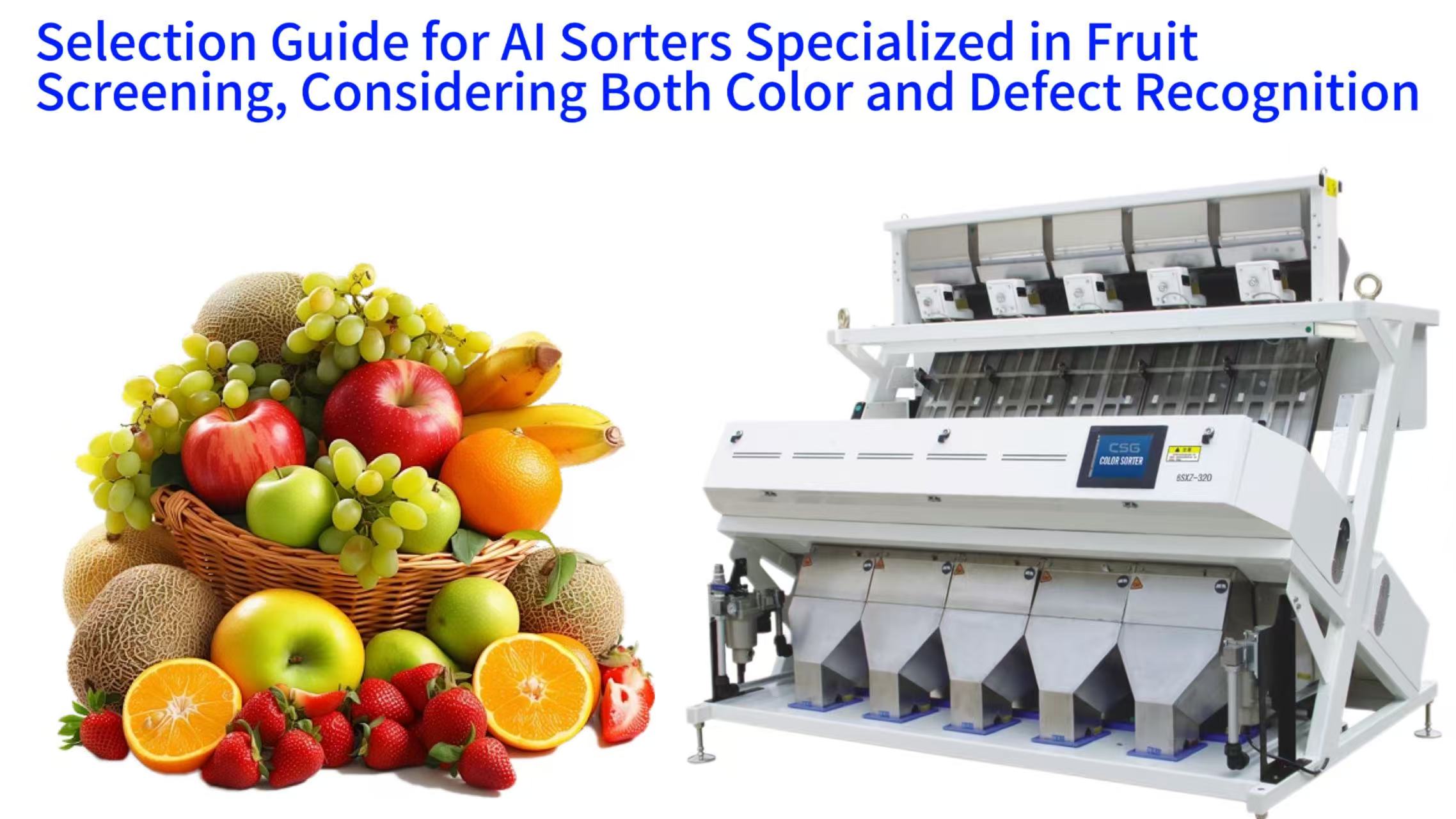
Modern fruit processing facilities face a dual challenge: meeting consumer demand for visually perfect, uniformly colored produce while simultaneously ensuring the removal of defective, damaged, or unsafe items. Traditional sorting methods often struggle with this balance, as they may excel at one task—like basic color sorting—but lack the sophistication to identify subtle defects such as bruising, rot, insect damage, or stem scars. Artificial Intelligence (AI) sorters have emerged as a transformative solution, capable of analyzing multiple material characteristics simultaneously to perform both high-precision color grading and complex defect detection in a single pass. This guide provides a structured approach to selecting the right AI sorter for your fruit screening application, moving beyond generic specifications to focus on the practical integration of color and defect recognition. We will examine the core technologies, evaluate key performance criteria for different fruit types, and outline a decision-making process that considers both immediate operational needs and long-term strategic goals in quality control and automation.
Understanding the Dual Mandate: Color Consistency and Defect Elimination in Fruit Processing
| Sorting Objective | Key Metrics | AI Advantage Over Traditional Methods |
|---|---|---|
| Color Consistency | CIELAB (L*, a*, b*) values, color grade accuracy | Beyond RGB: multispectral data + contextual color analysis (ripeness/variety-specific tolerance) |
| Defect Elimination | Defect detection rate, false accept/reject rate | Contextual defect recognition (geometry-aware) + subsurface flaw detection (NIR/hyperspectral) |
The commercial value of fresh and processed fruit is intrinsically linked to its visual appeal and physical integrity. Color serves as a primary indicator of ripeness, variety, and overall quality, directly influencing consumer purchasing decisions and allowing processors to segment products into premium grades. Concurrently, the presence of defects—whether from biological, mechanical, or environmental sources—poses risks to shelf life, consumer safety, and brand reputation. An effective sorting system must therefore operate with a dual mandate: to classify fruit based on precise color parameters and to identify and reject a wide spectrum of imperfections. This requires a sensor and software suite that transcends simple RGB analysis, delving into spectral data, texture mapping, and shape analysis to build a comprehensive understanding of each piece of fruit.
Artificial Intelligence brings a contextual understanding to this task. Unlike rigid rule-based systems, AI algorithms, particularly deep learning models, can learn the natural variation within an acceptable color range for a specific fruit variety while remaining acutely sensitive to off-colors indicative of disease or immaturity. Similarly, these models can be trained to recognize defects not just by their appearance but by their context within the fruit's surface geometry. For instance, a dark spot on the curvature of an apple may be evaluated differently than the same color at the stem bowl. This nuanced decision-making, powered by continuous learning from operational data, is what sets modern AI sorters apart and forms the foundation for a truly integrated color-and-defect sorting solution.
The Science of Color Perception in AI Sorting: Beyond Human Vision
AI sorters perceive color through high-resolution cameras and specialized lighting systems, but their analysis extends far beyond human visual capabilities. They quantify color in standardized color spaces like CIELAB, which defines color based on lightness (L*), red-green (a*), and blue-yellow (b*) components. This allows for the establishment of highly precise, numerically defined acceptance zones for color grades. Furthermore, multispectral imaging can capture data from beyond the visible spectrum. Near-Infrared (NIR) sensors, for example, can detect moisture content and internal bruising or rot that has not yet manifested as a visible color change on the skin, providing a critical early-warning system for defects.
The consistency of this color measurement is paramount. Advanced sorters employ structured LED lighting with controlled wavelengths and intensity to eliminate shadows and specular reflections that could mislead the system. The AI software is then tasked with reconciling data from multiple spectral bands to make a final judgment on color grade. This process ensures that a peach is graded as "Extra Fancy Red" based on a reproducible scientific measurement, not a subjective visual assessment, enabling consistent branding and meeting the exacting standards of major retailers who often define color tolerances in their procurement contracts.
Defect Recognition: From Surface Blemishes to Subsurface Flaws
| Defect Type | Traditional Sorting | AI Sorter (Surface Only) | AI Sorter (Hyperspectral) |
|---|---|---|---|
| Surface Bruising | ✓ | ✓ | ✓ |
| Subsurface Bruising | ✗ | ✗ | ✓ |
| Mold/Fungal Growth | ✓ (Visible) | ✓ | ✓ (Early Detection) |
| Stem/Blossom Defects | ✓ (Inconsistent) | ✓ | ✓ |
| Internal Rot | ✗ | ✗ | ✓ |
Defect recognition in fruit is a profoundly complex computer vision challenge. Defects are diverse, including punctures, cuts, scabs, sunscald, bruising, fungal growth, insect stings, and stem punctures. Each has a unique visual signature that can vary with fruit type, variety, and growing conditions. AI-powered defect detection systems are trained on vast libraries of annotated images, learning to distinguish between harmless natural features (like lenticels on an apple) and true defects that impact quality. The most advanced systems use convolutional neural networks (CNNs) that analyze image patterns at multiple scales, effectively "seeing" both the gross feature and the fine texture of a potential flaw.
For many critical defects, surface analysis is insufficient. Impact bruising, a major cause of post-harvest loss, often occurs beneath the skin with little immediate visible change. Hyperspectral imaging technology, which captures a full spectrum of light at each pixel, can identify the biochemical changes associated with bruising, such as cell wall breakdown and enzymatic browning, before they are visible. This allows for the removal of fruit that would otherwise deteriorate during storage or transport, significantly reducing waste and protecting the quality of the entire shipment. Integrating this subsurface detection capability is a key differentiator for sorters targeting high-value or long-shelf-life fruit products.
Core Hardware Selection: Matching Machine Configuration to Fruit Characteristics
| Characteristic | Chute-Type AI Sorter | Belt-Type AI Sorter |
|---|---|---|
| Handling Style | Free-fall past inspection array | Gentle conveyor transport |
| Ideal Fruit Types | Robust, free-flowing (nuts, cherries, olives) | Delicate (strawberries, peaches, tomatoes) |
| Throughput | Very high (tens of thousands pieces/hour) | Adjustable (balances speed & inspection detail) |
| Inspection Coverage | Partial (tumbling flight; panoramic lenses help) | 360° full surface inspection |
| Orientation Control | Variable (uncontrolled flight) | Controlled (singulated/oriented presentation) |
The physical design of the AI sorter must be carefully matched to the morphological and physiological characteristics of the fruit being processed. The two dominant configurations—chute-type and belt-type—offer distinct advantages and limitations based on fruit size, shape, fragility, and required throughput. A chute-type sorter, where fruit free-falls past an inspection array, offers extremely high-speed inspection, often processing tens of thousands of individual pieces per hour. However, this method subjects the fruit to impact and is less suitable for very delicate items like berries or for fruit that cannot be reliably singularized in free-fall. The orientation of the fruit in flight is also variable, which can challenge the inspection system to capture all surfaces.
In contrast, a belt-type sorter gently transports fruit on a conveyor, providing stable, controlled presentation to the inspection cameras. This allows for multiple imaging stations to capture top, bottom, and side views, ensuring full surface inspection. It is the preferred method for soft, easily bruised fruit, large items, or applications requiring precise orientation. The selection between these platforms is a fundamental first step, as it dictates the mechanical handling, inspection geometry, and ultimately, the maximum achievable accuracy for both color and defect detection. The choice is not merely about speed but about optimizing the conditions for the AI's "eyes" to perform their most accurate analysis.
Chute-Type Systems for High-Volume, Robust Fruit Streams
Chute-type AI sorters are engineered for efficiency and speed in processing high volumes of relatively robust, free-flowing fruit. Typical applications include nuts, dates, smaller potatoes, cherries, and olives. In these systems, fruit is fed into multiple parallel channels where it accelerates down a steep slide. As it passes through a scanning zone, high-speed line-scan cameras capture images under precisely controlled lighting. The key advantage is the incredible throughput; a single machine with multiple chutes can process several metric tons per hour. The AI must make its sorting decision—based on color and defect analysis—within milliseconds before the fruit reaches an array of high-speed air ejectors that deflect rejects into a separate channel.
The effectiveness of a chute-type sorter for defect detection hinges on the ability to image a sufficient portion of the fruit's surface during its brief, tumbling flight. Advanced systems may employ cameras with panoramic lenses or multiple camera angles to increase coverage. The chute-type AI sorting machine configuration demands a robust AI model that can make accurate judgments even from partial views and in varying orientations. For color grading, the consistent, strobed LED lighting is critical to "freeze" the motion and provide a clear, non-blurred image for precise color measurement. This configuration excels when the primary defects are surface-based and clearly visible, and when the fruit can withstand the physical demands of the chute system.
Belt-Type Systems for Delicate Fruits and Full-Surface Inspection
Belt-type sorters provide a gentler, more controlled handling solution, making them indispensable for delicate fruits like strawberries, raspberries, peaches, apricots, and tomatoes. The fruit is typically singulated and often oriented on a flat or custom-shaped conveyor belt that transports it through an inspection tunnel. Inside, a combination of area-scan cameras, often paired with lasers for 3D profiling, captures comprehensive data. A major strength of this configuration is the ability to implement 360-degree inspection. By using mirror tunnels, prismatic systems, or multiple camera stations, the sorter can construct a complete surface model of each fruit, leaving no hidden defects.
This complete visualization is crucial for reliable defect detection. It allows the AI to assess stem and blossom ends, shoulders, and any creases or folds that might harbor rot or insect damage. For color grading, it ensures the measured color is a true average of the entire surface, not a snapshot of one side. The belt-type AI sorting machine also facilitates integration with other technologies. For instance, weight sensors can be added to the belt line for simultaneous weight grading, and near-infrared (NIR) sensors can be mounted overhead to gather spectral data on internal quality. The belt speed is adjustable, allowing processors to balance throughput with the level of inspection detail required, making it a versatile choice for premium fresh markets and processing lines.
Evaluating the AI Engine: Software Capabilities for Integrated Sorting Logic
The hardware captures the data, but the AI software is the brain that makes the critical sorting decisions. When evaluating an AI sorter for fruit, the sophistication of its software platform is as important as the quality of its cameras. The system must not only run powerful defect detection algorithms but also seamlessly integrate color grading rules into a single, cohesive decision for each piece of fruit. This requires a software architecture that can manage multiple, sometimes conflicting, criteria. For example, a piece of fruit might have perfect color but a small defect, or an acceptable defect in an area that does not affect usability. The software must apply business rules—defined by the processor—to accept or reject such borderline cases.
A truly advanced AI platform features continuous learning. As the sorter operates, it encounters new variations in fruit appearance and defect types. A self-learning system can flag uncertain cases for operator review, and this feedback is then used to retrain and improve the underlying model automatically. This means the sorter's performance improves over time, adapting to new seasons, different growing regions, or changing quality standards. The interface should provide transparent tools for managers to set and adjust these complex rules, view real-time performance dashboards, and access historical data for traceability and process optimization. The software's ability to unify color and defect analysis into a streamlined workflow is what ultimately determines the business value of the investment.
Algorithm Training and the Importance of Representative Image Libraries
The accuracy of an AI sorter is directly proportional to the quality and diversity of the image data used to train its algorithms. Before deployment, the system's neural networks must be trained on thousands of labeled images showcasing the full range of acceptable colors and every type of defect that needs to be detected. This library must be representative of the actual fruit supply, accounting for different varieties, sizes, maturities, and growing conditions. A supplier with deep experience in fruit sorting will have pre-trained models for common fruits, which can significantly reduce setup time. However, these generic models almost always require fine-tuning with images from the processor's own supply chain to achieve optimal performance.
When assessing a supplier, inquire about their process for building this training library. Do they conduct on-site trials with your fruit? Can they simulate different lighting and background conditions? The goal is to create a robust model that generalizes well, meaning it can correctly identify defects and colors on fruit it has never seen before, under slightly varying conditions. The process of continuous learning extends this principle. As the sorter operates in your facility, it should be capable of securely collecting data on its own performance, allowing for periodic model retraining to maintain and enhance accuracy, ensuring the system evolves alongside your product and quality requirements.
User Interface and Rule Configuration for Quality Managers
The power of AI must be accessible through an intuitive user interface. Quality managers and line operators need tools to define what constitutes a pass or fail without requiring expertise in machine learning. Modern interfaces allow users to set color grades by simply clicking on acceptable and unacceptable fruit samples displayed on the screen. For defects, they can draw bounding boxes around examples and classify them (e.g., "bruise," "cut," "mold"). The software then learns from these examples. More importantly, the interface must allow for the creation of sophisticated sorting programs that combine color and defect rules. For instance, a program could specify: "Grade by color into Premium, Class I, and Class II. Within each color grade, reject any fruit with defects larger than 3mm, but allow small stem scars in Class II."
Real-time monitoring is another critical feature. The interface should display key performance indicators (KPIs) like throughput, acceptance/rejection rates per defect type, and color distribution. This data is vital for making immediate adjustments and for long-term analysis. For example, a sudden spike in bruise detection might indicate a problem with an upstream harvesting or handling machine. The integration of this data into factory-wide systems via advanced detection analytics platforms enables proactive quality management. The ease with which personnel can interact with, trust, and leverage the AI's capabilities will determine how effectively the technology is adopted and utilized on the plant floor.
Performance Validation and Total Cost of Ownership Analysis
Selecting an AI sorter requires moving beyond marketing claims to a rigorous validation of performance under your specific operating conditions. The ultimate test is how accurately and consistently the machine sorts your fruit, balancing the dual objectives of color grading and defect removal while maintaining high throughput. This validation should be conducted through a controlled trial using a representative sample of your product, ideally spanning the expected quality variation from your supply base. The trial must measure not just overall accuracy, but specific metrics like false reject rate (good fruit mistakenly discarded) and false accept rate (defective fruit mistakenly passed), as each has a direct and different cost implication for the business.
The financial analysis must encompass the total cost of ownership (TCO), not just the purchase price. Key factors include energy consumption, compressed air usage for ejection, required maintenance, cost and frequency of spare parts (like LED lights and camera lenses), and software licensing or update fees. Perhaps the most significant TCO component is the value generated by the sorter: increased yield from more accurate grading, reduced waste from early defect removal, higher revenue from premium product segmentation, and lower labor costs. A machine with a higher initial price but superior accuracy and lower operating costs often provides a faster return on investment. The analysis should project these costs and benefits over a 5 to 7-year period to understand the true financial impact.
Conducting a Material Test: The Definitive Performance Benchmark
The most reliable way to evaluate an AI sorter is a live material test. Reputable suppliers should offer to test a batch of your fruit at their facility or provide a mobile test unit. During this test, you should define clear success criteria. Run several hundred kilograms of fruit through the machine and then manually inspect both the accepted and rejected streams. Quantify the sorter's performance by calculating key metrics: Color Sorting Accuracy (percentage of fruit placed in the correct color grade), Defect Detection Rate (percentage of target defects correctly removed), and Good Product Loss (percentage of sound fruit erroneously rejected). These metrics should be measured across different defect types and color grades to identify any weaknesses.
It is also crucial to test the system's stability over time. Run the test for an extended period to see if performance degrades due to factors like lens heating, lighting drift, or software latency under load. Observe the system's interface for ease of adjusting parameters during the run. For instance, if you notice it is rejecting too many fruit with minor stem scars, can you easily adjust the sensitivity for that specific defect without affecting bruise detection? This test is not just about peak performance but about practical usability and reliability. The results will provide a data-driven foundation for your purchasing decision and set realistic expectations for operational performance post-installation.
Calculating Operational Efficiency and Return on Investment
The financial justification for an AI sorter lies in its ability to improve operational efficiency and create value. Start by quantifying your current costs and losses: manual labor for sorting, product giveaway due to inconsistent grading, customer rejections due to defects, and waste disposal costs for unsellable product. An AI sorter directly addresses these points. It can operate continuously with consistent accuracy, reducing reliance on manual sorters whose performance fluctuates. By precisely grading color, it maximizes the volume of fruit achieving premium price points. By removing defects early, it prevents the cost of processing and packaging fruit that will later be rejected or cause spoilage in a container.
To build an ROI model, translate the performance metrics from your material test into financial terms. If the sorter improves your premium grade yield by 5%, what is the additional annual revenue? If it reduces waste from defects by 3%, what are the annual savings in raw material cost and disposal? Factor in the hard cost savings from reduced labor and increased throughput. Offset these gains against the TCO. A sophisticated sorter with high-speed ejection and superior vision might have a higher price but achieve payback in under 18 months through dramatic yield improvements and waste reduction. This financial modeling turns the technical selection process into a strategic business investment decision.
Integration and Support: Ensuring Long-Term Success in Your Processing Line
The final selection criterion involves the practicalities of integrating the new AI sorter into your existing processing line and the quality of support you will receive. The machine is not an island; it must connect physically and digitally with upstream equipment (washers, dryers, conveyors) and downstream systems (packers, labelers, data recorders). Consider the required floor space, power and air supply needs, and network connectivity for data exchange. The supplier should provide detailed integration plans and work with your engineering team to ensure a smooth installation with minimal disruption to production. The goal is a seamless fit where the sorter becomes a reliable, data-generating node within your broader automation ecosystem.
Long-term success is heavily dependent on the supplier's support structure. This includes comprehensive training for operators, technicians, and quality managers, covering not just machine operation but also basic troubleshooting and data interpretation. Assess the availability of spare parts and the responsiveness of technical support, including options for remote diagnostics. Given the rapid evolution of AI technology, inquire about the supplier's roadmap for software updates and hardware upgrades. A partnership-oriented supplier will view the sale as the beginning of a relationship, providing ongoing support to help you adapt the sorter's capabilities to new fruit varieties, quality standards, and production challenges over its entire lifecycle.
Pre- and Post-Processing Handling Considerations
The performance of the AI sorter is profoundly influenced by the condition of the fruit presented to it. Effective pre-processing is essential. Fruit must be cleaned and dried to remove dirt, wax, or water droplets that could obscure the camera's view or be misinterpreted as a defect. It must also be consistently singulated and, for belt-type systems, ideally oriented. This often requires upstream equipment like brush washers, air-knife dryers, and vibration feeders or alignment rollers. The supplier should advise on the necessary pre-processing setup to ensure the AI system receives an optimal feed. Without proper presentation, even the most advanced sorter will underperform.
Similarly, consider what happens after sorting. The rejection system must be capable of handling the ejected fruit without causing additional damage or creating a bottleneck. This might involve separate conveyors to transport reject fruit to a re-inspection station or a waste stream. For multi-lane sorters, the accepted fruit from different color grades must be neatly channeled into their respective collection bins or conveyors without mixing. The integration of smart material feeding and discharge systems is crucial for maintaining the integrity of the sort and maximizing overall line efficiency. A holistic view of the entire process flow, from intake to final packing, is necessary to unlock the full potential of the AI sorting investment.
Supplier Expertise and Future-Proofing Your Investment
Choose a supplier with demonstrated expertise in fruit sorting applications. They should understand the agricultural supply chain, the seasonality of produce, and the specific quality challenges for different fruit types. Their experience will be invaluable during setup, tuning, and troubleshooting. Ask for references from similar operations and case studies detailing the results achieved for other clients. A supplier deeply embedded in the food processing industry is more likely to provide relevant insights and continuous innovation.
Finally, consider the future-proofing of your investment. AI and sensor technologies are advancing rapidly. Does the sorter's architecture allow for easy upgrades, such as adding new camera modules (e.g., hyperspectral) or increasing computing power? Is the software platform built on open standards that allow for integration with emerging Internet of Things (IoT) and data analytics platforms? Selecting a system with a modular, upgradeable design protects your investment against technological obsolescence and ensures your sorting capabilities can evolve to meet future market demands and regulatory requirements, securing a competitive advantage for years to come.