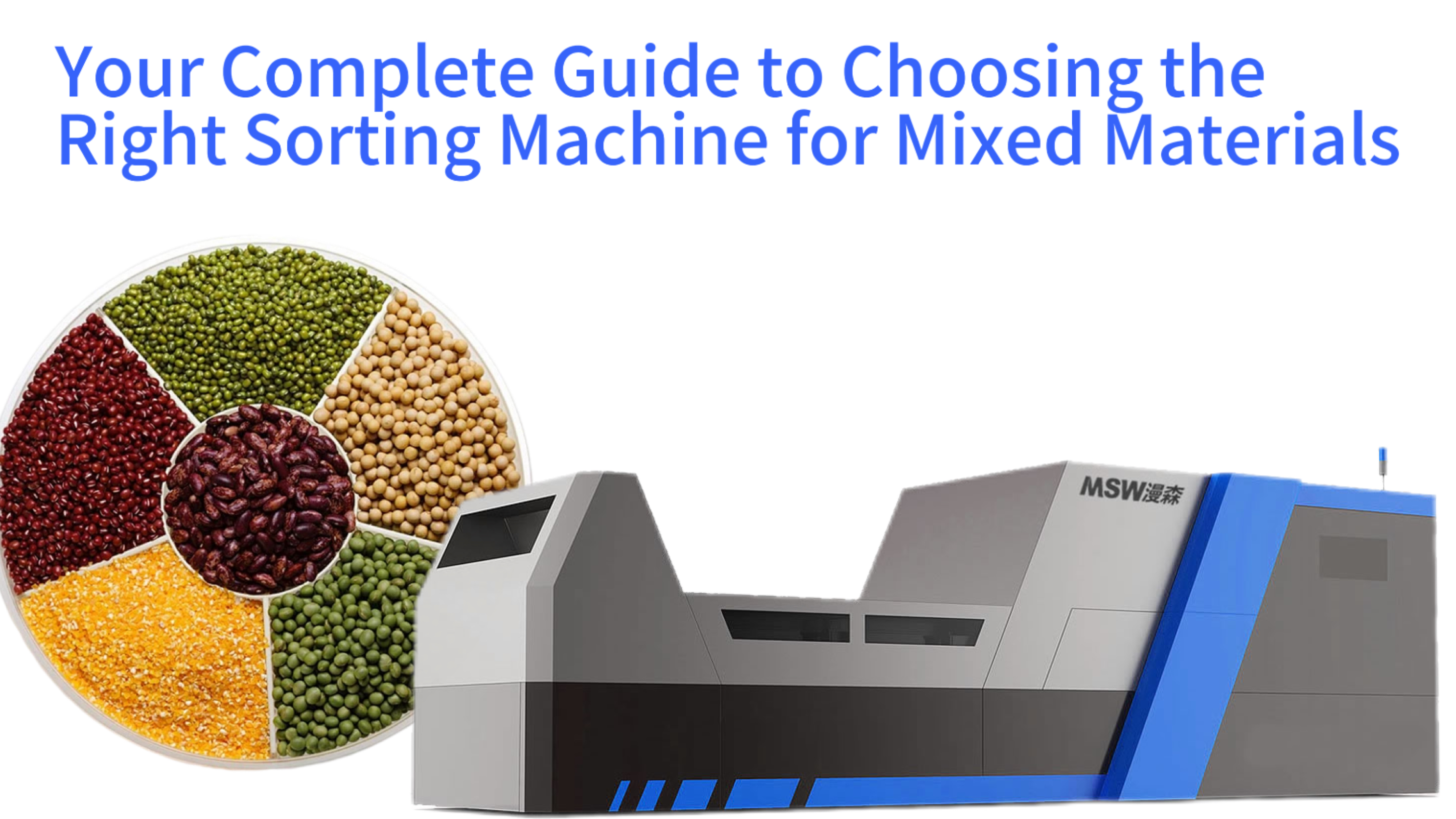
This guide provides a comprehensive overview of the key factors to consider when selecting a sensor-based sorting machine capable of handling multiple material types. We will walk through understanding your specific material mix, comparing core sorting technologies like optical, NIR, and X-ray systems, evaluating critical machine features such as feeding mechanisms and ejection precision, and analyzing the total cost of ownership. By following this structured approach, you can make an informed investment that improves operational efficiency, maximizes material purity, and delivers a strong return on investment for your processing needs, whether in recycling, food production, or mining.
1. Define Material & Goals
Analyze material properties, set purity/recovery/throughput targets
2. Select Sensor Tech
Optical / NIR / X-ray based on material characteristics
3. Evaluate Machine Features
Feeding, ejection, software & UI
4. Assess Costs & Support
TCO, installation, training, scalability
5. Test & Finalize
Material testing, performance guarantees, integration
Understanding Your Material Stream and Sorting Goals
| Material Characteristic | Key Considerations | Impact on Selection | Typical Target Metrics |
|---|---|---|---|
| Particle Size | Range, variability, flow behavior | Determines feeding system (chute/belt) | Consistent single-layer presentation |
| Moisture/Stickiness | Clumping risk, sensor interference | Requires specialized feeders/sealing | <5% moisture for NIR accuracy |
| Purity Target | Contaminant tolerance per output stream | Drives sensor precision/ejection design | 99%+ (PET: 99.5% for food-grade) |
| Throughput | Current volume + 10-20% buffer | Machine size/capacity selection | Tons per hour (varies by material type) |
| Recovery Rate | Balanced with purity goals | Software algorithm tuning | 95%+ (minimizing good material loss) |
Optical Sensor Fit
Best for: Color, texture, shape differences (plastics, agricultural products)
Limitations: Cannot detect internal composition differences
Ideal Material Size: Small to large (belt for irregular shapes)
NIR Sensor Fit
Best for: Molecular composition (plastic polymers, organics)
Limitations: Affected by dirt/wet/black materials
Ideal Material Size: Granular to medium (free-flowing)
X-ray Sensor Fit
Best for: Density/elemental analysis (metals, minerals)
Limitations: Higher cost, regulatory controls
Ideal Material Size: Varied (handles high-density contaminants)
Before evaluating any machine, a deep and clear understanding of your material stream is the most critical first step. This involves more than just listing the materials; it requires a detailed analysis of their physical and compositional characteristics. You must identify the primary materials you wish to recover, the contaminants you need to remove, and the desired final purity levels for each output stream. Consider factors such as particle size distribution, moisture content, shape variability, and the subtle differences—like color, density, or chemical composition—that distinguish valuable material from waste.
Furthermore, defining your operational goals with concrete metrics is essential. Are you aiming for maximum throughput to process high volumes, or is achieving ultra-high purity for a premium product more important? You should establish clear targets for acceptable product loss, desired sortation accuracy (often above 99%), and required processing capacity in tons per hour. Understanding the balance between these sometimes competing goals will directly guide your technology selection. A well-defined starting point prevents the common pitfall of choosing an overpowered or underperforming system, ensuring the selected multi-sensor optical sorter or other technology is perfectly matched to the task.
Analyzing Physical Characteristics of Mixed Materials
The physical properties of your materials heavily influence which sensor technology will be most effective. For mixed streams containing plastics, minerals, or agricultural products, surface features like color, texture, and shape are primary identifiers. Optical sorters excel here, using high-resolution cameras to detect visible differences. However, if your materials are similar in color but differ internally—such as different plastic polymers or ore types—technologies that probe beneath the surface become necessary. The size range of your particles also dictates the choice of feeding system, whether a chute for smaller, free-flowing items or a belt for larger, irregular pieces.
Another crucial physical factor is the material's behavior during processing. Sticky, wet, or irregularly shaped materials may require specialized feeding systems to present them properly to the sensors. Abrasive materials, common in mining and construction waste sorting, demand machines built with wear-resistant components to ensure longevity. Documenting these characteristics helps narrow down suitable machine designs and prevents operational issues like blockages, poor sensor presentation, or accelerated component wear, which can drastically reduce sorting efficiency and increase maintenance costs.
Defining Target Purity and Recovery Rates
Establishing clear, quantitative targets for purity and recovery is fundamental for both selecting equipment and measuring its success post-installation. Purity refers to the percentage of desired material in the output stream, free from contaminants. Recovery rate indicates the percentage of the total target material in the feed that is successfully captured in the good product stream. These two metrics often have an inverse relationship; pushing for extremely high purity can lead to more good material being mistakenly ejected, lowering recovery.
For multi-material sorting, you may have different purity targets for different output streams. In a plastic recycling facility, the PET output stream might require 99.5% purity for food-grade reprocessing, while the HDPE stream could have a lower threshold. Being explicit about these targets allows you to communicate effectively with equipment suppliers and request material tests that simulate your exact conditions. Modern AI-powered sorters are particularly adept at learning these complex distinctions, optimizing the balance between purity and recovery in real-time based on the defined goals, leading to superior yield and profitability.
Assessing Throughput and Capacity Requirements
Throughput, measured in tons or kilograms per hour, is a key economic driver. Your required capacity should be based on both current feed volumes and projected future growth. Underestimating leads to bottlenecks, while overestimating results in unnecessary capital expenditure and potentially higher operational costs per ton. To calculate needed throughput, analyze your average daily input volume and determine the number of operating hours per day. Always include a reasonable buffer, typically 10-20%, to handle peak feed times.
It is also vital to understand that a machine’s maximum rated throughput is often achieved under ideal conditions with a specific material type. When sorting a complex mix of materials, the effective throughput may be lower due to the processing power required for multiple decision algorithms or varied ejection patterns. Discuss your specific mix with manufacturers to get realistic capacity estimates. Furthermore, consider the machine's integration into your existing line; a smart material feeding system before the sorter can regulate flow to match the sorter's optimal speed, preventing overload and ensuring consistent performance.
Comparing Core Sensor Technologies for Multi-Material Sorting
| Technology Type | Detection Principle | Key Applications | Accuracy for Mixed Materials | Cost (Initial + Operational) | Regulatory Requirements |
|---|---|---|---|---|---|
| Optical (RGB/Monochrome) | Visible light + shape/color analysis | Coffee sorting, plastic color separation, e-waste (surface defects) | |||
| Near-Infrared (NIR) | Infrared reflection + molecular fingerprinting | Plastic polymer sorting, organic waste, food processing | |||
| X-ray Transmission (XRT) | Density-based X-ray absorption | Mining, coal cleaning, metal/plastic separation | |||
| X-ray Fluorescence (XRF) | Elemental emission analysis | Metal alloy sorting, ore grade testing, hazardous waste |
The heart of any sorter is its sensing technology, which determines what material properties it can detect. For handling diverse materials, you often need a machine that employs a combination of sensors, a concept known as multi-sensor or multi-spectral sorting. The most common technologies include visible light (optical), near-infrared (NIR), and X-ray. Each technology sees materials differently: optical sensors detect color and shape, NIR identifies molecular composition based on how materials reflect infrared light, and X-ray measures density and atomic structure. The choice depends entirely on which property best differentiates your target materials from contaminants.
Increasingly, machines are being equipped with hybrid systems that combine two or more of these technologies in a single unit. For instance, an optical sorter combined with an NIR sensor can first remove all brown contaminants (optical) and then separate different plastic types that are the same color but different polymers (NIR). This layered approach is extremely powerful for complex streams. When comparing technologies, request side-by-side test results using samples of your actual material. This practical evidence is far more valuable than theoretical specifications and will show you exactly which sensor combination delivers the purity and recovery you need.
Optical Sorting for Color and Surface Defects
Optical sorters are the most widely used type and are exceptionally effective for tasks based on visible differences. They use high-resolution cameras, often combining color (RGB) and monochrome sensors, to capture detailed images of each particle. Advanced software then analyzes these images in real-time for color, shape, size, and even structural integrity. This makes them ideal for removing discolored, misshapen, or damaged items from a stream of good product, such as sorting green coffee beans from brown ones or identifying cracked nuts.
For multi-material applications, optical sorters can be programmed with multiple "accept" and "reject" profiles. In a facility processing electronic waste, an optical sorter might be configured to identify and separate red, blue, and green plastic fragments into different streams based on color. The effectiveness hinges on consistent, high-quality lighting to ensure the camera sees true colors. Modern systems utilize LED lighting with precise spectral control and often incorporate shape recognition algorithms that can distinguish materials of identical color but different forms, significantly enhancing their capability in mixed-waste environments.
Near-Infrared (NIR) Technology for Material Composition
Near-infrared technology operates on a principle completely invisible to the human eye. It works by shining NIR light on a material and analyzing the spectrum of light that is reflected back. Different chemical compounds, like the various polymers in plastics (PET, HDPE, PP) or organic compounds in foods, have unique spectral "fingerprints." An NIR sorter can therefore reliably separate materials that look identical but are chemically different, such as clear PET bottles from clear PVC bottles, a critical task in plastic recycling.
This technology is transformative for recycling and organic sorting. In a municipal waste sorting plant, NIR is the primary tool for segregating different plastic types at high speed. Its limitation is that it primarily analyzes surface composition, so it can be fooled by dirty, wet, or deeply colored black materials (which absorb most NIR light). For the most challenging multi-material streams, NIR is frequently paired with other sensors. For example, a system might use an optical sensor to pre-sort by color and size, then use NIR for final polymer identification, creating a highly efficient, multi-stage sorting process that maximizes both purity and throughput.
X-ray Transmission (XRT) and X-ray Fluorescence (XRF) for Density and Elemental Analysis
X-ray-based sorters provide insight into the internal structure and elemental makeup of materials. X-ray Transmission measures density differences by how much X-ray energy passes through an object. Denser materials like metals or certain minerals absorb more X-rays, appearing darker on the sensor. This makes XRT superb for density-based sorting, such as removing high-density contaminants from coal or separating metals from plastics in electronic scrap. It can even find foreign materials like glass or stones inside food products.
X-ray Fluorescence, on the other hand, identifies the specific elements present in a material by detecting the unique secondary X-rays they emit when excited. This is indispensable in metal recycling and mining, where it can distinguish between different metal alloys (e.g., separating copper from brass) or identify ore grades based on elemental concentration. For complex multi-material streams containing metals, minerals, and high-density plastics, an X-ray sorter offers a detection capability unmatched by optical or NIR technologies. However, these systems generally have a higher initial cost and are subject to stricter regulatory controls due to radiation safety, factors that must be included in the selection calculus.
Evaluating Key Machine Features and Configurations
Feeding System Selection
Choose belt (large/irregular/fragile materials) or chute (small/free-flowing granular) based on particle size/shape
Ejection System Validation
Check high-speed valve response time (microsecond precision), nozzle count, and multi-stream ejection capability
Software/UI Assessment
Verify multi-recipe support, ML-driven accuracy, real-time dashboards, and remote monitoring capabilities
Durability Check
Ensure wear-resistant components for abrasive materials (mining/construction waste) and sealing for wet/sticky materials
| Feature | Belt Feeding System | Chute Feeding System |
|---|---|---|
| Material Suitability | Large, irregular, fragile items (fruits, automotive scrap) | Small, granular, free-flowing (grains, plastic flakes) |
| Throughput Speed | Moderate (stable presentation) | Very High (10,000+ particles/second) |
| Footprint | Larger (belt conveyor) | Compact (sloped channels) |
| Maintenance | Medium (belt wear/replacement) | Low (minimal moving parts) |
| Cost | Medium-High | Low-Medium |
Once the appropriate sensor technology is identified, the next step is to evaluate the mechanical and functional features of the sorter itself. The configuration of the machine must suit the physical nature of your materials and your plant's layout. Two primary design categories exist: belt sorters and chute sorters. Belt sorters transport material on a fast-moving, stable belt past the sensor array, making them ideal for larger, irregular, or delicate items like whole fruits, large plastic pieces, or shredded automotive scrap. They provide excellent control over presentation but may have lower particle-per-second rates compared to chutes.
Chute sorters, in contrast, use a series of sloping channels to create a controlled, free-fall curtain of material. This presentation is optimal for smaller, granular, or free-flowing products like grains, seeds, coffee beans, or plastic flakes. The free-fall allows for very high throughput and multiple inspection points from different angles. The choice between belt and chute will significantly impact the machine's footprint, power consumption, and maintenance needs. Additionally, features like user-friendly software interfaces, network connectivity for data logging, and robust construction for harsh environments are critical for long-term, reliable operation.
Feeding System: Belt vs. Chute Design
The feeding system is responsible for presenting a single layer of material to the sensors—a fundamental requirement for accurate detection. Belt systems offer great versatility. They can handle a wide range of sizes and shapes, from fine powders to large objects, by adjusting belt width and speed. The material rests on the belt, which minimizes tumbling and provides a stable platform for imaging, which is crucial for consistent shape and texture analysis. This stability makes belt sorters a preferred choice for fragile materials or items that need to be inspected from one side, such as inspecting the tops of passing objects.
Chute systems excel in speed and efficiency for suitable materials. As particles slide down the chutes, they accelerate and separate, forming a thin curtain. This allows sensors, often mounted on both sides, to get a complete, unobstructed view of each particle. This design enables incredibly high processing speeds, with some machines capable of analyzing over 10,000 individual particles per second. The key is that the material must be free-flowing and within a compatible size range. For mixed streams containing both large and small items, a precision acceleration feeding system before a chute sorter can be vital to ensure proper separation and presentation, preventing clumps that would blind the sensors and reduce accuracy.
Ejection System Precision and Speed
The ejection system is the actuator that physically removes unwanted particles based on the sensor's decision. Its precision directly determines the final purity of the sorted product. The industry standard is the use of high-speed, electronically controlled valves that release precise bursts of compressed air. The timing of this burst is calculated down to the microsecond to intercept the rejected particle as it passes the ejection bank. The number of valves (or nozzles) correlates with the resolution of ejection; more nozzles allow for targeting smaller defects within a stream of material.
For multi-material sorting where you may be ejecting different types of contaminants into multiple reject streams, the ejection system's complexity increases. Some advanced machines have multiple ejection banks, each capable of being triggered for a different type of defect. The speed of the valve's response is critical, especially at high belt or chute velocities. A delay of even a few milliseconds can mean the air jet hits the wrong particle or misses entirely. Therefore, evaluating the high-speed ejection system's specifications—response time, nozzle count, air consumption, and reliability—is as important as evaluating the sensors. A brilliant detection is worthless without a precise and reliable method of removal.
Software and User Interface Complexity
The software is the brain that interprets sensor data and makes sorting decisions. For multi-material sorting, the software must be powerful yet intuitive. It should allow operators to easily define and save multiple sorting programs for different material mixes. Look for software with graphical tools for setting acceptance thresholds—for example, drawing a color range on a histogram or selecting a spectral fingerprint from a library. The best systems include machine learning capabilities, where the software continuously improves its accuracy by learning from operator corrections, adapting to natural variations in the feed material over time.
Beyond sorting logic, the user interface should provide clear, real-time operational data. Dashboards showing throughput, rejection rates, and machine health are essential for process optimization. Connectivity features like Ethernet or cloud integration enable remote monitoring, diagnostics, and data logging for quality control reports. For facilities with multiple sorters, software that allows centralized management and recipe distribution can streamline operations significantly. The goal is to have software that empowers your team, not confuses them. A steep learning curve can lead to underutilization of the machine's capabilities, so consider the availability of training and technical support from the supplier as part of this evaluation.
Considering Operational and Financial Factors
Capital Expenditure (CapEx)
Machine purchase price
Shipping & installation
Facility modifications (electrical/flooring)
Initial calibration & setup
Operational Expenditure (OpEx)
Electricity (X-ray/NIR systems: higher consumption)
Compressed air (ejection nozzles: major cost)
Maintenance (wear parts: nozzles, belts, filters)
Labor (operators, maintenance technicians)
Value Generation
Increased revenue (high-purity output premiums)
Reduced landfill/disposal fees
Labor savings (automation)
Minimized product loss (higher recovery rates)
| Cost Category | Optical Sorter (5-Year TCO) | NIR Sorter (5-Year TCO) | X-ray Sorter (5-Year TCO) |
|---|---|---|---|
| Initial Purchase | $150,000 - $250,000 | $200,000 - $350,000 | $400,000 - $600,000 |
| Energy Costs | $20,000 - $30,000 | $30,000 - $45,000 | $50,000 - $75,000 |
| Maintenance | $15,000 - $25,000 | $20,000 - $30,000 | $30,000 - $45,000 |
| Spare Parts | $10,000 - $15,000 | $12,000 - $20,000 | $25,000 - $40,000 |
| Estimated Total | $195,000 - $320,000 | $262,000 - $445,000 | $505,000 - $760,000 |
| Cost Per Ton (Avg) | $0.80 - $1.20 | $1.10 - $1.50 | $2.00 - $2.80 |
The selection process must extend beyond technical specifications to encompass the total cost of ownership and operational impact. The purchase price is just the initial investment. A comprehensive financial analysis includes estimating costs for installation, ongoing utilities (compressed air and electricity), routine maintenance, spare parts, and potential downtime. A machine with a slightly higher upfront cost but significantly lower energy consumption or longer service intervals may offer a much better return on investment over a five-year period. It is prudent to calculate the cost per ton sorted, which incorporates all these variables.
Operational factors also play a huge role in successful integration. Consider the physical footprint of the machine and whether it fits into your existing production line layout. Assess the skill level required for operators and maintenance staff—does the supplier offer comprehensive training? Evaluate the supplier's reputation for after-sales service, including the availability of spare parts and the response time for technical support. A reliable, well-supported machine that keeps running is far more valuable than a marginally higher-performing unit that is frequently offline awaiting service. These practical considerations are often the difference between a smooth, profitable operation and a frustrating, costly investment.
Total Cost of Ownership Analysis
Calculating the Total Cost of Ownership involves looking at all expenses from acquisition to decommissioning. Start with the capital expenditure: the machine price, shipping, installation, and any necessary facility modifications like reinforced flooring or electrical upgrades. Then, project the operational expenditures. Energy costs can be substantial, especially for machines requiring large air compressors or X-ray generators. Compressed air, in particular, is very expensive to generate; efficient sorters with optimized air nozzles can save thousands in energy costs annually.
Maintenance costs are another major component. Request the recommended preventive maintenance schedule and the typical cost of common wear items like ejection nozzles, belts, filters, and sensor lenses. Factor in the potential cost of production downtime during maintenance or repairs. Finally, consider the value created by the sorter: the increased revenue from higher-purity output, the reduced landfill fees from better recovery, and the labor savings from automation. A robust TCO analysis will show you the true financial picture, highlighting whether a more capable hyperspectral sorting machine justifies its premium through superior material recovery and product value.
Installation, Training, and Support Services
Professional installation is crucial for achieving the performance promised by the manufacturer's test reports. Proper alignment of feeders, sensors, and ejection systems directly affects accuracy. A reputable supplier will offer supervised installation services to ensure the machine is integrated correctly with your existing conveyors and control systems. They should also commission the machine by running your materials and fine-tuning it to meet your specific purity and recovery targets before final handover. Never underestimate the value of this phase.
Comprehensive training for both operators and maintenance technicians is non-negotiable. Operators need to understand how to load recipes, interpret the interface, and make minor adjustments. Maintenance staff must be trained on daily cleaning procedures, routine checks, and basic troubleshooting to minimize downtime. Inquire about the depth of training provided—is it on-site, at their facility, or via video? Furthermore, evaluate the supplier's support structure. What are their service response times? Do they have local technicians or a network of partners? What is the warranty period and what does it cover? Strong after-sales support is an insurance policy for your investment and ensures the machine remains a productive asset for years to come.
Scalability and Future-Proofing Your Investment
Your business needs will evolve, and your sorting solution should have the capacity to evolve with them. Consider scalability from both a throughput and a capability perspective. If you anticipate volume growth, can the machine handle a 20-30% increase with minor upgrades, or would it require a complete replacement? Some modular systems allow for the addition of extra sensor units or ejection banks to increase capacity or add new sorting functions. This modularity can protect your initial investment.
Future-proofing also involves technological adaptability. The field of sensor-based sorting is advancing rapidly, especially with the integration of artificial intelligence and new sensing modalities. When selecting a machine, inquire about its upgrade path. Can the software be updated to newer versions with improved algorithms? Is the hardware platform designed to accept new types of sensors? Choosing a system from a manufacturer with a strong R&D focus and a history of offering upgrades can extend the useful life of your equipment and keep you competitive without the need for a full capital reinvestment every few years.
Executing a Practical Selection and Testing Process
Step 1: Prepare Representative Material Sample
50-100kg sample reflecting normal variation (size, moisture, contamination) of production stream
Step 2: Share Clear Test Objectives
Provide target purity/recovery rates, throughput goals, and critical material separation requirements
Step 3: Observe & Validate Testing Process
Review material feeding, software configuration, ejection accuracy, and handling of problematic items (wet/irregular)
Step 4: Analyze Test Report
Verify quantified results (purity/recovery/throughput), machine settings, and consistency across multiple runs
Step 5: Secure Performance Guarantees
Negotiate written guarantees (e.g., 98% purity / 95% recovery) tied to contract terms
| Evaluation Criterion | Pass/Fail Threshold | Data to Verify | Action if Not Met |
|---|---|---|---|
| Purity Rate | ≥ Target (e.g., 99% for PET) | Lab analysis of output stream contaminants | Adjust sensor/software settings or reject supplier |
| Recovery Rate | ≥ Target (e.g., 95%) | Mass balance of input vs. recovered target material | Tune ejection timing or switch to higher-precision system |
| Throughput | ≥ Target (with 10-20% buffer) | Measured tons/hour over 4+ hours of testing | Upgrade feeding system or select higher-capacity machine |
| Consistency | ≤ 2% variation across 3 runs | Side-by-side comparison of run results | Check for sensor drift or feeding instability |
| Downtime During Test | 0% (no unplanned stops) | Log of machine errors/blockages | Assess machine durability/design flaws |
Armed with knowledge about your materials, technologies, and costs, the final step is a hands-on, empirical selection process. This moves beyond brochures and datasheets into the realm of proven performance. The most critical action you can take is to insist on a material test using a sample of your actual production stream. A reputable supplier will have a test facility where they can run your material through their equipment under controlled conditions. This test will generate concrete data on achievable purity, recovery rates, and throughput for your specific mix.
During the testing phase, be actively involved. Observe how the material feeds, how the software is configured, and how cleanly the ejection system works. Ask to see the before-and-after samples and discuss any trade-offs made during setup. Request a detailed test report that documents all parameters and results. This report becomes a benchmark for performance. Furthermore, use this process to evaluate the supplier's expertise and responsiveness. A supplier who asks insightful questions about your material and process goals is likely to provide better long-term partnership than one who simply tries to sell a standard unit.
Conducting Material Tests with Potential Suppliers
Organizing a material test is a straightforward but essential procedure. First, prepare a representative sample of your mixed material stream—typically 50-100 kilograms is sufficient. Ensure it reflects the normal variation in size, moisture, and contamination you experience. Ship this sample to the shortlisted suppliers' test labs. Provide them with your target purity and recovery goals for each material you wish to separate. Be present for the test if possible, either in person or via a video link, to observe the process and ask questions in real-time.
The test will reveal the practical capabilities of each machine. Pay attention to how the machine handles problematic items—do wet or oddly shaped pieces cause issues? How does the software handle materials that are on the borderline of acceptance? Compare the results from different suppliers side-by-side. Look not just at the best-case result, but at the consistency of the sorting over multiple runs. This hands-on evidence is invaluable. It reduces risk by proving the technology works on your material before you buy, and it provides a performance baseline that can be used for machine acceptance upon delivery to your facility.
Reviewing Performance Data and Guarantees
After the tests, you will receive performance data from each supplier. Scrutinize these reports carefully. They should clearly state the input material description, the machine settings used, and the quantified results for each output stream (purity percentage, recovery percentage, throughput rate). Be wary of vague promises or "typical" performance figures not derived from your test. The most reliable suppliers will often provide performance guarantees based on the test results, which can be written into the purchase contract.
These guarantees are a form of risk mitigation for you. A guarantee might state, for example, that the machine will achieve a minimum of 98% purity and 95% recovery when processing your defined material mix at a specified throughput. Understand what conditions are attached to these guarantees, such as proper installation, specified feed conditions, and routine maintenance. A supplier confident enough to offer a performance guarantee is demonstrating faith in their equipment's capability to solve your specific multi-material sorting challenge, giving you greater confidence in your final decision.
Finalizing the Decision and Planning for Integration
With test results and financial analyses in hand, you can make a final, data-driven decision. The chosen solution should offer the best balance of technical performance, operational practicality, and financial return. Before signing the contract, ensure all details are clarified: the final quoted price, delivery timeline, installation scope, training package, warranty terms, and agreed-upon performance criteria. Having a clear, written agreement prevents misunderstandings later.
Once the order is placed, begin planning for integration. Assign a project manager within your team to liaise with the supplier. Prepare the installation site according to the supplier's specifications regarding space, power, compressed air, and data connections. Schedule your production to accommodate the installation and commissioning period. Inform and prepare your staff for the upcoming training. A well-managed integration project ensures a smooth transition, gets the machine operational quickly, and allows you to start realizing the benefits of automated, high-precision multi-material sorting, turning a complex challenge into a streamlined, profitable part of your operation.