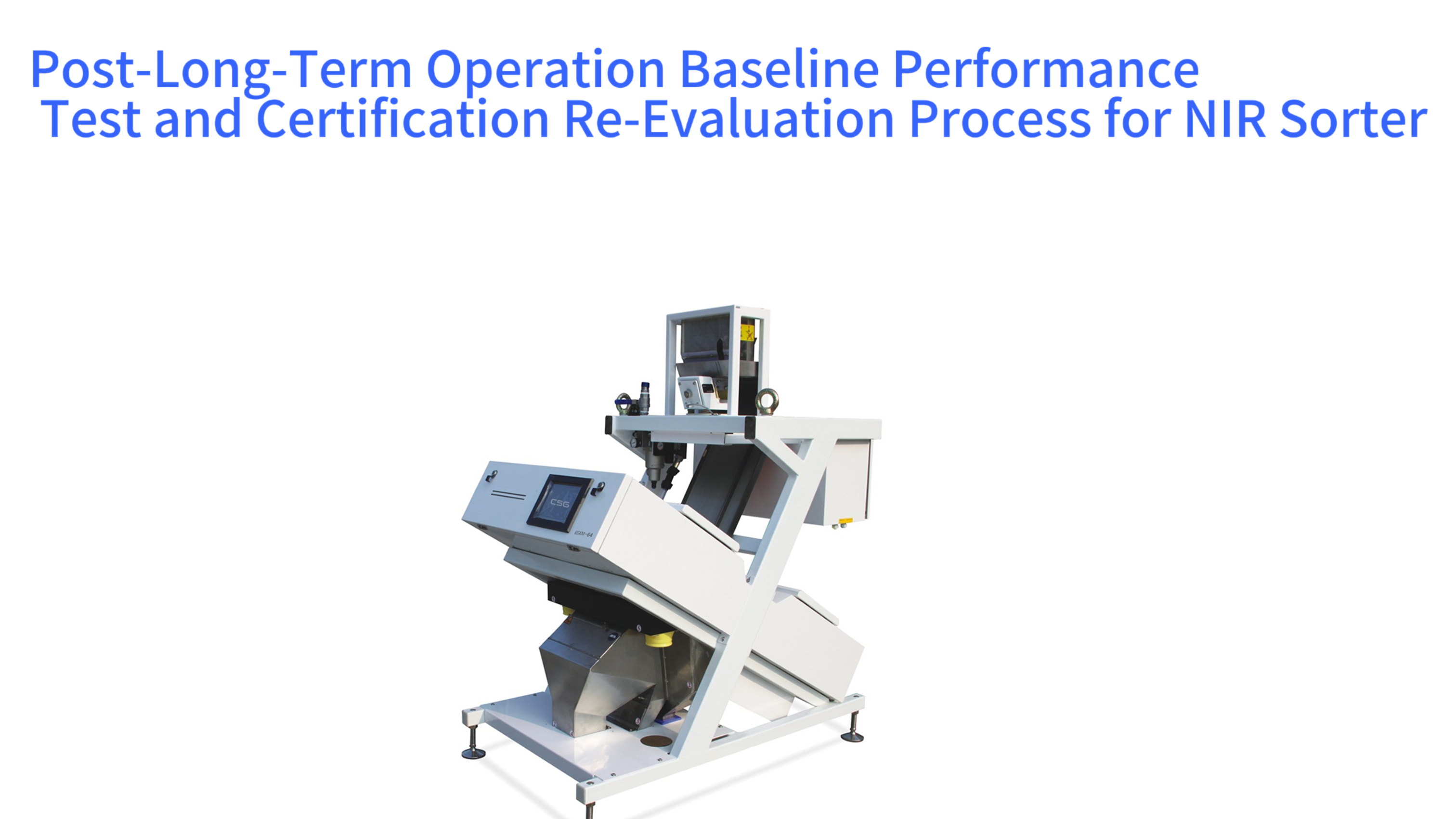
Post-Long-Term Operation Baseline Performance Test and Certification Re-Evaluation Process for NIR Sorter
NIR Sorter Re-Evaluation Core Process Steps
Pre-Test Preparation
Material & Machine Setup
Test Execution
Data & Sample Collection
Data Analysis
Performance Gap Assessment
Certification Review
Recertification Decision
Sustainability Planning
Preventive Maintenance
The sustained accuracy and reliability of a Near-Infrared (NIR) Sorter are fundamental to the operational integrity of any modern material processing facility. Over thousands of hours of operation, these sophisticated machines are subjected to environmental stresses, component wear, and evolving material streams. The initial performance baseline established at commissioning inevitably drifts. This article provides a comprehensive framework for conducting a formal baseline performance test and certification re-evaluation following a period of extended operation. This systematic process, akin to a comprehensive medical check-up for industrial equipment, is not merely a technical exercise but a critical quality assurance protocol. It verifies the machine's continued capability to meet the specified purity and recovery targets, ensuring ongoing compliance with product specifications, safety standards, and operational economics. By documenting the performance against the original benchmarks, this process provides actionable data to guide maintenance, part replacement, or potential upgrades, safeguarding the return on the initial capital investment.
## The Critical Need for Post-Operational Performance Revalidation
Key Factors of NIR Sorter Performance Degradation
| Component/System | Degradation Type | Performance Impact | Typical Onset (Operating Hours) |
|---|---|---|---|
| NIR Light Source | Intensity loss (halogen/LED) | Reduced spectral signal clarity | 2,000-3,000 |
| Optical Lenses/Windows | Scratching/Fouling | Light scattering & noise | 1,000-2,000 |
| Pneumatic Ejectors | Valve wear/latency | Inaccurate material ejection | |
| Vibratory Feeders | Belt wear/misalignment | Uneven material presentation | 2,500-4,000 |
| AI Sorting Model | Data drift | Lower decision confidence | 1,500-3,000 |
Economic Impact of Performance Drift (Plastic Recycling, 3 TPH)
0.5% Recovery Loss (PET)
0.3% Purity Drop
1.5% False Reject Rate
8-Hour Baseline Test
All industrial equipment, particularly sensor-based systems like NIR Sorters, experiences a natural performance degradation over time. This degradation is rarely catastrophic but manifests as a gradual, often imperceptible decline in sorting efficiency. The NIR spectrometer's light source, typically a halogen lamp or high-intensity LED array, loses intensity with use, altering the spectral signal received. The optical lenses and windows can accumulate microscopic scratches or develop a film from ambient dust and oil mist, scattering light and reducing clarity. Mechanical components such as vibratory feeders, conveyor belts, and high-speed pneumatic ejectors wear, leading to changes in material presentation timing and ejection accuracy. These factors collectively conspire to shift the machine's performance away from its original, certified baseline. Without periodic re-evaluation, this drift can result in significant, undetected financial losses through reduced product purity, lower recovery yields of valuable materials, or increased contamination in final products.
Beyond financial implications, a formal re-evaluation process is essential for regulatory compliance and quality certification in many industries, especially food processing and high-purity recycling. Certifying bodies and internal quality management systems often require documented proof that sorting equipment continues to perform within specified tolerances. Furthermore, the material stream itself may change subtly over time; an AI-powered NIR Sorter's algorithm may need retraining on new data to maintain its decision-making edge. A structured re-test provides the empirical data needed to justify software updates, hardware refurbishment, or to validate that the current process still meets all contractual and regulatory obligations. It transforms subjective observations of "the machine seems slower" into objective, quantifiable performance metrics that can be analyzed and addressed with precision.
### Distinguishing Routine Calibration from a Full Baseline Re-Test
It is vital to differentiate between daily or weekly calibration routines and a comprehensive baseline performance test. Routine calibration often involves using a standard reference tile or a known sample to adjust the system's zero point and ensure the spectral response is within a narrow, predefined range. This is a quick health check. A full baseline re-test, however, is a holistic assessment conducted after a significant operational period, typically 2,000 to 5,000 hours or annually. It involves running the machine with a standardized, characterized test feedstock that is identical or statistically equivalent to the material used during the initial acceptance test. The test measures the ultimate outputs: sorting accuracy (purity of the accept stream), material recovery (yield of target material), and false rejection rate. This end-to-end test validates the entire system's performance, from material feeding and presentation to spectral analysis, decision-making, and physical ejection, providing a complete picture of its current state.
### Quantifying the Economic Impact of Performance Drift
The financial consequences of unaddressed performance drift can be modeled. For instance, in a plastic recycling facility processing 3 tons per hour, a mere 0.5% decrease in recovery yield of high-value PET translates to a loss of 15 kilograms per hour. Over a 6,000-hour annual operation, this equates to 90,000 kilograms of lost revenue. Similarly, a 0.3% increase in contamination in a food-grade product stream could lead to an entire batch being downgraded or rejected. The cost of conducting a thorough 8-hour baseline test, including labor and material, is typically a fraction of the potential losses incurred over just a few days of suboptimal operation. The re-evaluation process is therefore a proactive investment in profit protection, providing the data necessary to make cost-effective decisions about maintenance and upgrades before significant value erosion occurs.
### Establishing the Re-Evaluation Schedule and Triggers
Re-Evaluation Schedule & Trigger Events
Scheduled Re-Tests
Intermediate check: Every 1,000 operating hours
Full baseline re-test: Every 4,000 operating hours
Annual audit: Regardless of hour count (regulatory compliance)
Immediate Trigger Events
Major component replacement (spectrometer/light source)
Significant feedstock composition/moisture changes
Software/firmware major update installation
Persistent downstream contamination increases
A proactive approach mandates establishing a fixed schedule for performance re-evaluation, independent of obvious failures. This schedule should be based on the manufacturer's recommendations, the intensity of use (e.g., 24/7 operation vs. single shift), and the abrasiveness of the processed material. A typical schedule might call for an intermediate check every 1,000 hours and a full baseline re-test every 4,000 hours. Beyond scheduled intervals, specific triggers should prompt an immediate re-test. These triggers include a major component replacement (e.g., a new spectrometer module or light source), a significant change in the composition or moisture content of the feedstock, the installation of a major software or firmware update, or if downstream quality control reports a persistent, unexplained increase in contamination levels. Treating these events as triggers ensures the machine's performance is formally re-documented whenever a variable that could affect it is altered.
## Pre-Test Preparation: Ensuring a Valid and Controlled Assessment
Pre-Test Preparation Checklist
| Category | Tasks | Status |
|---|---|---|
| Test Material | Secure archived FAT/SAT material or prepare matched sample (size/moisture/contaminants) | □ Completed |
| Machine Preparation | Clean optical components, replace air filters, calibrate mechanical parts to OEM specs | □ Completed |
| Measurement Tools | Calibrate scales, verify data logging systems, prepare sampling kits | □ Completed |
| Environment | Secure stable power, control ambient light/humidity, isolate from production disturbances | □ Completed |
The validity of the baseline performance test hinges entirely on meticulous preparation. The first and most critical step is securing a representative sample of the test material. This sample must be carefully characterized and, ideally, archived from the original material used during the machine's factory acceptance test (FAT) or site acceptance test (SAT). If an archived sample is unavailable, a new batch must be prepared to match the original specifications in terms of particle size distribution, moisture content, and, crucially, the type and concentration of "defect" or "reject" material it contains. For an NIR Sorter in a plastic recycling plant, this might mean a blended sample with precisely known percentages of PET, HDPE, and PVC flakes. The sample must be large enough to run the test for a statistically significant duration, typically 30 minutes to an hour of continuous operation, to average out normal process variability.
Parallel to material preparation, the machine itself must be brought to a standardized state. This involves performing all routine maintenance tasks that would normally precede a production run. The optical lenses and inspection windows must be meticulously cleaned using approved solvents and lint-free cloths. The air filters for the pneumatic ejection system should be replaced or cleaned to ensure consistent nozzle pressure. All mechanical parts, such as feeder vibrators and belt drives, should be inspected and adjusted to the manufacturer's specifications. The machine should be allowed to reach its normal operating temperature, as the spectrometer and electronics can exhibit slight performance variations with temperature. Any existing sorting program or AI model should be noted, but the test will ultimately evaluate the system's performance with its current, in-use configuration. Documenting all these pre-test conditions and settings is essential for ensuring the test is repeatable in the future.
### Defining the Test Protocol and Success Criteria
Test Protocol & Success Criteria (Plastic Recycling Example)
Test Parameters
Feed rate: 2 tons per hour
Test duration: 45 minutes (steady-state)
Belt speed: 1.2 m/s (OEM nominal)
Ejection delay: 18 ms (calibrated value)
Success Criteria (Minimum)
Accept stream purity: ≥99.5%
PET recovery rate: ≥98.0%
False reject rate: ≤1.5%
System uptime during test: 100%
Before starting the machine, a written test protocol must be established and followed. This protocol details the exact test procedure: the mass of the test sample, the feed rate (e.g., 2 tons per hour), the specific machine settings (e.g., belt speed, vibration amplitude, ejection delay), and the environmental conditions (ambient temperature and humidity, if controlled). Most importantly, it defines the success criteria. These criteria are usually the original performance guarantees provided by the manufacturer or agreed upon at commissioning. Common metrics include a minimum sorting purity (e.g., 99.5% for the accept stream), a minimum recovery rate (e.g., 98.0% of target material), and a maximum false reject rate (e.g., less than 1.5%). The protocol should also specify how the output streams will be collected, weighed, and manually audited to verify the machine's electronic sorting decisions.
### Calibrating Support and Measurement Equipment
The accuracy of the test depends not only on the sorter but also on the supporting equipment. All scales used to weigh the input feedstock and the output accept and reject streams must be calibrated and have a suitable resolution (typically to within 0.1% of the sample weight). If manual auditing of sorted material is required to verify purity, a sampling plan and a consistent method for manual inspection must be defined. For advanced sorters, data logging should be enabled to record key parameters during the test, such as ejection counts, spectrometer signal strength, and internal quality scores for each decision. Ensuring that all measurement and data collection tools are primed and accurate prevents introducing errors that could obscure the true performance of the NIR sorter itself.
### Creating a Controlled Testing Environment
To isolate the machine's performance, external variables must be minimized. The test should be conducted during a period of stable plant operation to ensure consistent electrical power quality. Lighting conditions around the machine should be normalized, as stray light can occasionally interfere with optical sensors. If the process is sensitive to ambient humidity, this should be monitored and recorded. The goal is to replicate, as closely as possible, the standard operating conditions under which the machine is expected to perform daily, but without the fluctuations and disturbances of normal production. This controlled environment ensures that the test results reflect the intrinsic capability of the sorter and are not skewed by external, transient factors.
## Executing the Comprehensive Baseline Performance Test
Test Execution Workflow
With preparations complete, the execution phase begins. The characterized test feedstock is introduced into the sorter's feed system at the precisely controlled rate defined in the protocol. It is critical to allow the system to reach a steady-state condition before official data collection starts; this may take several minutes as the feed hopper stabilizes and the machine's internal parameters settle. Once steady-state is achieved, the official test run commences. The output streams—the "accept" stream (good product) and the "reject" stream (ejected material)—are diverted into separate, pre-weighed collection bins for the entire duration of the test run. Throughout the test, operators should monitor the machine's human-machine interface (HMI) for any alarms, warnings, or unusual parameter readings, noting them in the test log.
Simultaneously, data acquisition systems should be recording operational telemetry. For modern AI-powered sorters, this includes capturing the confidence scores the AI model assigns to each ejection decision, the spectral profiles of borderline cases, and the response times of the ejection valves. This rich dataset provides unparalleled insight into not just *what* the performance is, but *why*. For example, a drop in recovery yield might be correlated with a systematic reduction in the signal-to-noise ratio from the spectrometer, pointing to a failing light source. Or, an increase in false rejects might be linked to the AI model's confidence thresholds drifting due to subtle changes in material appearance over time. The test execution is therefore both a performance audit and a deep diagnostic data-gathering exercise.
### Manual Sampling and Verification for Ground Truth
Manual Verification Sampling Method
| Stream Type | Sample Size (kg) | Sampling Method | Verification Process |
|---|---|---|---|
| Accept Stream | 5-10 kg | Stratified random sampling | Hand-sort to identify contaminants |
| Reject Stream | 2-5 kg | Systematic sampling (every 1 min) | Hand-sort to identify misplaced target material |
While the machine electronically sorts the material, the most definitive performance assessment comes from manual verification. After the test run, samples are taken from both the accept and reject streams. These samples are then meticulously hand-sorted by trained personnel. For the accept stream sample, every particle is examined to identify any "reject" material that the machine failed to remove. For the reject stream sample, every particle is examined to identify any "accept" material that was incorrectly ejected. This manual audit provides the ground truth data. The weight of misplaced material in each stream is used to calculate the actual sorting purity and recovery rate, which are then compared to the machine's own internally calculated metrics. Discrepancies between internal calculations and manual audit results can indicate issues with the machine's sensing or counting algorithms.
### Stress Testing Under Boundary Conditions
A comprehensive baseline test should not only assess performance under ideal conditions but also explore the boundaries of the machine's capability. This may involve a secondary, shorter test run where the feed rate is intentionally increased by 10-15% beyond the nominal capacity. The goal is to observe how performance degrades with overload—does the purity plummet, or does the system maintain reasonable control? Similarly, the test might include a short run with material at the extreme ends of the acceptable moisture or size range. Understanding these performance boundaries is invaluable for process optimization and for making informed decisions about future throughput increases. It reveals the machine's true operational headroom and resilience.
### Documenting Observations and Anomalies
Throughout the test execution, qualitative observations are as important as quantitative data. Test personnel should note any unusual noises from mechanical components, visible misalignment of ejection jets, inconsistent material spread on the belt or chute, or any momentary system hiccups. Photographs or videos of key areas, such as the ejection zone during operation, can provide valuable visual evidence. These observations, recorded in a standardized log sheet, become crucial clues during the subsequent data analysis phase. An anomaly noted during the test might explain a statistical outlier in the performance data, helping to distinguish between a random event and a systematic performance issue.
## Data Analysis and Performance Gap Assessment
Key Performance Metrics & Gap Analysis
Core Formulas
Purity (%) = (Target Mass in Accept / Total Accept Mass) × 100
Recovery (%) = (Target Mass in Accept / Total Target in Feed) × 100
False Reject Rate (%) = (Target Mass in Reject / Total Target in Feed) × 100
Performance Gap Example (PET Sorting)
Long-Term Trend Analysis (Spectral Signal Strength)
Once the test run is complete and all samples are weighed and audited, the data analysis phase begins. The core performance metrics are calculated: **Purity (%)** = (Mass of Target Material in Accept Stream / Total Mass of Accept Stream) * 100. **Recovery/Yield (%)** = (Mass of Target Material in Accept Stream / Total Mass of Target Material in Feedstock) * 100. **False Reject Rate (%)** = (Mass of Target Material in Reject Stream / Total Mass of Target Material in Feedstock) * 100. These calculated values are then plotted against the original baseline performance curve or compared directly to the contractual guarantee numbers. The difference between the current performance and the baseline represents the "performance gap." This gap must be quantified not just as a percentage point loss, but also translated into its economic equivalent based on material value and throughput.
The next layer of analysis involves correlating the final performance numbers with the operational telemetry collected during the test. Engineers will examine the spectral data for signs of decreased light intensity or increased noise. They will analyze the timing data from the ejection system to check for increased latency or variability. For AI systems, the distribution of decision confidence scores is reviewed; a shift towards lower confidence scores across the board suggests the model is becoming less certain, often a sign it needs retraining on current data. This forensic analysis aims to pinpoint the root cause of any performance degradation. Is it optical, mechanical, computational, or a combination? The outcome of this analysis directly informs the corrective action plan, ensuring resources are allocated to address the actual problem, not just its symptoms.
### Statistical Significance and Uncertainty Analysis
Given the inherent variability in material processing, it is essential to determine if the observed performance gap is statistically significant or within the range of normal process variation. Simple statistical tools, such as calculating the standard deviation of key metrics from multiple sub-samples of the test run, can help establish a confidence interval for the measured performance. If the original baseline guarantee of 99.0% purity was established with a certain confidence level (e.g., 95%), the re-test results must be evaluated within a similar statistical framework. A measured purity of 98.7% might not represent a true degradation if the uncertainty range of the measurement overlaps with 99.0%. Understanding measurement uncertainty prevents overreacting to noise in the data and focuses attention on trends that represent genuine changes in machine capability.
### Trend Analysis Against Historical Data
For facilities with a history of periodic testing, the most powerful analysis involves trend examination. Plotting key performance indicators like purity, recovery, and ejection valve firing counts over multiple test cycles can reveal slow, long-term trends that a single snapshot might miss. A gradually declining trend in spectral signal strength, even if still above alarm thresholds, is a clear predictor of future failure. A steady increase in the compensation values being applied by the machine's software to maintain performance can indicate underlying hardware wear. This longitudinal view transforms the re-evaluation from a point-in-time assessment into a predictive maintenance tool, allowing planners to schedule component replacements during planned downtime before they cause a performance crisis.
### Generating the Formal Test Report and Gap Summary
The culmination of the analysis phase is a comprehensive test report. This formal document includes an executive summary of the findings, a detailed description of the test protocol and conditions, all raw and calculated data, manual audit results, analysis of telemetry, observations, and high-quality photographs. Most importantly, it contains a clear summary of the performance gap, stating the deviation from baseline for each key metric and the assessed root cause(s). This report serves multiple purposes: it is the technical record for internal quality systems, the evidence package for any warranty claims or discussions with the equipment supplier, and the foundation for the subsequent re-certification decision. A well-documented report provides an indisputable factual basis for all future actions regarding the sensor-based sorting machine.
## The Certification Re-Evaluation and Decision-Making Process
Certification Re-Evaluation Decision Matrix
| Performance Status | Decision Outcome | Required Actions |
|---|---|---|
| Within all tolerances | Full Recertification | Update baseline data, document in QMS |
| Minor gaps (correctable) | Conditional Recertification | Complete CAP within 14 days, verify with re-test |
| Significant performance gap | Decertification | Initiate requalification project (overhaul/replacement) |
The performance test report triggers the formal re-evaluation process. This process involves reviewing the current machine performance against the standards required for its ongoing "certification" for a specific task. In a regulated industry like food processing, this might mean re-evaluating its compliance with a food safety certification standard. In recycling, it might mean re-assessing its ability to produce a grade of recycled plastic flake that meets an industry specification such as the Association of Plastic Recyclers (APR) guidelines. The decision-making body, often a cross-functional team including production, quality assurance, and maintenance managers, reviews the report to answer a fundamental question: Does this machine, in its current state, still meet all necessary requirements to perform its designated duty?
The potential outcomes of this re-evaluation are clearly defined. **Outcome 1: Recertification.** The test shows performance is within all acceptable tolerances of the original baseline. The machine is formally recertified for continued operation, and the new test results become the updated performance reference point. **Outcome 2: Conditional Recertification.** Minor performance gaps are identified, but they are linked to specific, correctable issues (e.g., a dirty lens, a slightly misaligned ejector). The machine is recertified on the condition that a defined set of corrective maintenance actions is completed and verified within a specific timeframe. **Outcome 3: Decertification / Requalification Required.** A significant performance gap is found that cannot be immediately corrected. The machine is temporarily decertified for its primary high-precision task. It may be used for a less demanding application while a formal requalification project is initiated. This project could involve major component overhauls, a factory-level refurbishment, or even replacement.
### Developing the Corrective Action Plan (CAP)
Corrective Action Plan (CAP) Template
| Root Cause | Corrective Action | Owner | Deadline | Verification Method |
|---|---|---|---|---|
| Spectral signal loss (30%) | Replace NIR light source (Part #NIR-LS-001) | Maintenance Tech | 2025-12-20 | Signal strength test |
| AI model confidence drift | Retrain AI model with new material data | Process Engineer | 2025-12-25 | 5-min reference material test |
For outcomes 2 and 3, a detailed Corrective Action Plan is mandatory. The CAP is a project document that lists every action required to restore performance. It assigns clear ownership for each task, sets deadlines, and defines the verification method for each completed action. Tasks may range from simple (Clean optical cover, Part #XYZ) to complex (Replace NIR spectrometer module and perform full spectral recalibration). The CAP should be risk-based, prioritizing actions that address the root causes identified in the data analysis. It must also include a re-test protocol to be executed after all corrective actions are complete, to formally close the loop and verify that performance has been restored before full recertification is granted.
### Financial and Operational Impact Assessment
The re-evaluation team must assess the broader implications of the test findings. If a major component like the spectrometer needs replacement, what is the cost versus the expected gain in performance and material yield? What is the lead time for the part, and how will production be managed during the downtime? Would investing in a technology upgrade, such as moving from a standard chute-type NIR sorter to an AI-enhanced model, provide a better long-term return? This assessment weighs the cost of inaction (continued value leakage) against the cost and benefit of various corrective scenarios. The decision is not purely technical but a business case that ensures the continued economic viability of the sorting operation.
### Updating Quality Management System (QMS) Documentation
A critical, often overlooked step is the update of all relevant quality management system documentation. The machine's equipment file should be updated with the latest test report and re-certification decision. Maintenance schedules may need to be revised based on the wear patterns observed (e.g., shortening the lens cleaning interval). Standard Operating Procedures (SOPs) for the machine might be updated to include new checks or settings. If the machine is conditionally recertified, the QMS must track the completion of the CAP. This documentation update ensures that institutional knowledge is preserved, regulatory auditors are satisfied, and future operators have a complete history of the asset's performance and care.
## Long-Term Performance Sustainability Protocols
Performance Sustainability Protocols
Preventive Maintenance Schedule
Quarterly: Measure NIR light intensity (calibrated meter)
Monthly: Clean optical lenses/windows
Bi-monthly: Check ejection valve response time
Semi-annually: Retrain AI model (data refresh)
Continuous Monitoring Metrics
Real-time: Spectral signal strength & noise ratio
Daily: Purity/recovery from production data
Weekly: False reject rate trend analysis
Monthly: Reference material test (5-min)
To extend the period between major baseline re-tests and ensure sustained performance, a robust regime of ongoing protocols must be established. The cornerstone of this is an enhanced preventive maintenance (PM) schedule informed directly by the findings of the performance test. If the test revealed that light source degradation was a key factor, the PM schedule might include quarterly measurements of light intensity using a calibrated power meter. If wear on feeder belts was causing inconsistent presentation, the schedule would mandate more frequent tracking and tension checks. This moves maintenance from a time-based to a condition-based or performance-informed model, making it more efficient and effective.
Secondly, a continuous performance monitoring program should be implemented. Modern sorters can output real-time data streams on key health indicators, such as ejection counts per valve, average signal strength, and internal quality metrics. Setting up a simple dashboard to track these indicators over time allows for the early detection of trends. A gradual, week-over-week decline in average spectral signal can trigger a maintenance intervention long before it impacts final product quality. This shift from reactive to predictive maintenance is enabled by treating the performance re-test not as an end, but as a data point in a continuous cycle of measurement and improvement. It embeds the principles of the baseline test into daily operations.
### Establishing a Reference Material Library for Ongoing Checks
To facilitate more frequent, less disruptive performance checks, a library of stable reference materials should be created and sealed. These are small batches of material that are representative of the main feedstock and its key contaminants. Once characterized, they are stored under controlled conditions. On a monthly or quarterly basis, a small quantity of this reference material can be run through the sorter in a short, 5-minute test. The results (purity and recovery calculated from the machine's internal counters) are tracked on a control chart. This provides a running verification that the machine is performing consistently against a known standard. Any point that falls outside the control limits on the chart would trigger an investigation and potentially a full baseline re-test. This method provides ongoing assurance without the full cost and downtime of the comprehensive annual test.
### Operator Training and Knowledge Transfer
Sustained performance is as much about human factors as machine factors. The insights gained from the performance re-evaluation should be formalized into training for machine operators and maintenance technicians. They should understand which indicators on the HMI are most critical to monitor, what the early signs of specific failures look like, and how to perform basic diagnostic checks. Empowering the frontline staff with this knowledge turns them into the first line of defense against performance drift. Furthermore, the entire re-evaluation process—from test preparation to final reporting—should be documented in a clear work instruction. This ensures that the process is repeatable and sustainable, even as personnel change over time, preserving the integrity of the performance management system for the life of the equipment.