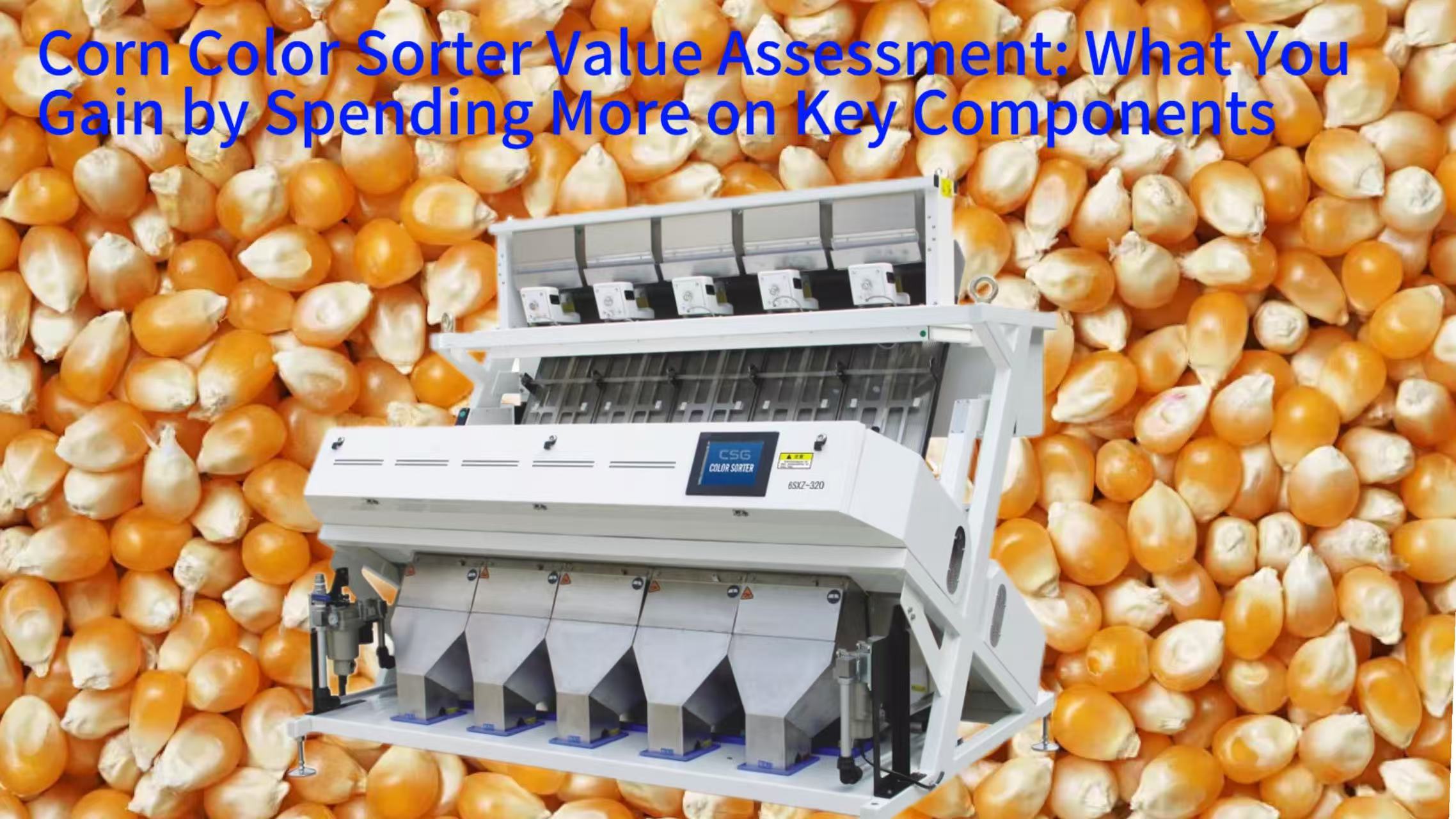
The purchase of a corn color sorting machine represents a significant capital allocation for grain processing facilities. Decision makers frequently face a fundamental question: does investing in a higher-tier machine with premium components justify its additional cost when compared to entry-level or mid-range alternatives. This question cannot be answered by examining purchase prices alone. A meaningful value assessment requires understanding how specific component choices influence long-term operational economics. Higher grade optical systems, advanced processing electronics, precision ejection mechanisms, and robust mechanical construction each contribute differently to overall sorting performance, maintenance frequency, and machine longevity. This article provides a structured analysis of these key components. It quantifies the performance differentials attributable to component quality and translates those differentials into measurable financial outcomes such as reduced product loss, lower defect rates in finished grain, decreased downtime, and extended service intervals.
Premium Component Investment Value Chain
The Optical Inspection System: Cameras, Sensors, and Illumination
The optical system functions as the sensory apparatus of a corn color sorter. Its capability to accurately distinguish between acceptable kernels and defective material directly determines the fundamental effectiveness of the entire sorting operation. Entry-level optical systems typically utilize standard charge-coupled device cameras with fixed focal lengths and conventional white light emitting diode banks. These configurations can reliably identify gross color deviations such as dark mold patches or distinctly different foreign grains. Their limitations become apparent when subtle defects must be detected or when throughput rates push the limits of the system's capture and processing speed. The consequence is a compromise between speed and accuracy that forces operators to accept either reduced throughput or higher residual defect rates.
Premium optical systems incorporate multiple advances that expand detection capabilities. Higher resolution sensors, often exceeding 5400 pixels per scan line, capture significantly more surface detail on each passing kernel. This increased data density enables the system to identify smaller defects and more subtle color variations that lower resolution systems would classify as acceptable. Full-color line scan technology maintains consistent color reproduction across the entire width of the chute, eliminating the color drift at edges that can occur with area scan cameras. Intelligent backlight systems can shift their emission spectrum to optimize contrast for specific defect types. When sorting maize contaminated with aflatoxin, for example, specific illumination wavelengths can make the characteristic fungal fluorescence more visible to the camera. This technological capability represents a key advancement in advanced detection systems for optical sorting equipment.
Optical System Performance Comparison
| Feature | Standard Optical System | Premium Optical System | Performance Improvement |
|---|---|---|---|
| Resolution | 2700 pixels per scan line | 5400+ pixels per scan line | 50% smaller detectable defect size |
| Illumination | Fixed spectrum, passive cooling | Spectral tuning, active feedback control | 30% higher contrast for subtle defects |
| Signal-to-Noise Ratio | Low quantum efficiency | High quantum efficiency sensors | 40% cleaner images at high speeds |
| Spectral Capability | Visible light only | Multi-spectral (visible + NIR) | Detects aflatoxin/invisible defects |
Resolution and Pixel Density Effects on Detection Thresholds
The relationship between camera resolution and minimum detectable defect size follows a direct proportionality. A 5400-pixel linear array inspecting a 200-millimeter chute width achieves a theoretical pixel resolution of approximately 0.037 millimeters per pixel. This resolution permits reliable detection of defects measuring just two or three pixels in diameter. A standard definition system with half the linear resolution requires a defect to be twice as large in each dimension to occupy the same pixel area. This difference means that premium systems detect stained tips, small insect damage, and early-stage mold spots that budget systems pass as acceptable grain. Over millions of kernels processed daily, these individually small defect removals accumulate into significant improvements in final product grade.
Illumination Stability and Spectral Control
Optical sorting accuracy depends on consistent, reproducible lighting conditions within the inspection zone. Standard light emitting diode systems maintain reasonable brightness stability but can experience gradual intensity decay over their operational life. More importantly, their spectral output is fixed at the factory. Premium illumination modules incorporate active feedback control that maintains constant light output regardless of ambient temperature fluctuations or component aging. Some advanced systems offer software-selectable spectral tuning, allowing the operator to shift the peak illumination wavelength to match the optical characteristics of different corn varieties or to emphasize specific defect types. This flexibility becomes valuable when the same machine must process both yellow dent corn and white corn, each requiring different contrast optimization strategies.
Signal-to-Noise Ratio in High-Speed Detection
High throughput rates demand short camera exposure times. Each kernel spends only milliseconds within the camera's field of view. To capture usable images at these speeds, the optical system must collect sufficient photons in a very brief window. Premium sensors offer higher quantum efficiency, converting a greater percentage of incident light into usable electronic signal. This efficiency produces cleaner images with higher signal-to-noise ratios at equivalent exposure times. The practical benefit is reliable detection of low-contrast defects under full production speeds. Lower grade sensors operated at the same speeds produce noisier images, forcing a reduction in either throughput or detection sensitivity to maintain acceptable false reject rates.
Multi-Spectral and Hyper-Spectral Capabilities
The most advanced corn color sorters extend beyond visible light inspection. Multi-spectral systems incorporate sensors responsive to near-infrared wavelengths. These wavelengths reveal chemical composition information invisible to human vision or conventional cameras. Aflatoxin contamination, internal insect infestation, and certain types of kernel damage exhibit characteristic spectral signatures in the near-infrared range. By integrating these sensors, premium sorters can remove contaminated material that appears visually identical to healthy grain. This capability is particularly valuable for corn destined for human food channels, where mycotoxin regulations impose strict limits that visual inspection alone cannot reliably enforce. Such systems are commonly integrated into specialized NIR sorting machines designed for chemical composition analysis.
Resolution vs. Detectable Defect Size Relationship
- Pixel Resolution: 0.074 mm/pixel
- Min Detectable Defect: 0.15 mm
- Misses: Small mold spots, insect damage
- Pixel Resolution: 0.037 mm/pixel
- Min Detectable Defect: 0.075 mm
- Detects: Stained tips, early mold, insect damage
The Ejection System: Speed, Precision, and Durability
Accurate defect identification provides no benefit if the ejection mechanism fails to remove the identified kernel from the product stream. The ejection system translates the optical processor's decision into physical action, and its performance characteristics directly determine the relationship between detection accuracy and final product purity. Standard ejection systems utilize solenoid valves with response times in the range of 0.5 to 1.0 milliseconds. These valves operate at frequencies up to 400 to 600 cycles per second. While adequate for moderate throughput applications with relatively large defects, these specifications impose limitations when processing high-value grain at maximum speeds or when removing defects only marginally larger than acceptable kernels.
Premium ejection systems represent a substantial engineering investment in materials, coil design, and manufacturing precision. High-performance solenoid valves achieve response times as brief as 0.04 milliseconds and can operate continuously at 1200 hertz. This threefold improvement in speed and twofold increase in frequency capability translate directly into sorting precision. The faster valve opens and closes more quickly, producing a shorter, more precisely aimed burst of compressed air. This precision allows the system to eject a single defective kernel without disturbing its immediate neighbors. The result is lower good product loss and higher defect removal efficiency, particularly when sorting corn with subtle defects that must be removed aggressively. This technology is central to modern high-speed ejection systems used in precision sorting applications.
Ejection System Performance Metrics
| Performance Metric | Standard Valves | Premium Valves | Economic Impact |
|---|---|---|---|
| Response Time | 0.5-1.0 ms | 0.04 ms | 92% faster activation, 3mm positional accuracy |
| Operating Frequency | 400-600 Hz | 1200 Hz | 2x higher throughput capability |
| Cycle Life | 500M-1B cycles | 10B+ cycles | 10x longer service life, 90% less replacement cost |
| Air Consumption | Baseline | 15-25% less per ton | $0.02-$0.05 savings per ton processed |
| Good Product Loss | 1.0% of throughput | 0.6% of throughput | 0.4% recovered product value |
Valve Response Time and Geometric Accuracy
The relationship between valve speed and ejection accuracy follows physical laws governing compressed gas flow and projectile motion. A kernel traveling at three meters per second moves three millimeters in one millisecond. A valve that requires one millisecond to fully open begins ejecting air when the kernel has already passed the ideal ejection point. The resulting air stream strikes the trailing edge of the target kernel or misses it entirely. Premium valves with 0.04 millisecond response times open while the kernel has moved only 0.12 millimeters, allowing precise synchronization between valve activation and kernel position. This precision enables narrower ejection windows and reduces the probability that adjacent good kernels will be caught in the air stream and ejected with the defect.
Cycle Life and Maintenance Interval Extension
Ejection valves operate continuously throughout production shifts, accumulating hundreds of millions of actuation cycles annually. Standard industrial solenoid valves typically rate for 500 million to one billion cycles before failure. Premium valves designed specifically for optical sorting applications undergo more rigorous engineering analysis. Materials selection favors advanced polymers and hardened stainless steels over conventional elastomers and plated carbon steels. Coil designs incorporate thermal management features that prevent performance degradation during sustained high-frequency operation. These engineering investments yield service life ratings of ten billion cycles or more. The maintenance implications are substantial. A machine operating at 600 valves per second for sixteen hours daily accumulates approximately 34 million cycles monthly. Standard valves may require replacement every one to two years. Premium valves can operate for a decade or longer under identical conditions.
Air Consumption Efficiency and System Operating Costs
Compressed air represents a significant operational expense for color sorting installations. Each ejection event consumes a volume of compressed air determined by valve orifice size, operating pressure, and pulse duration. Premium valves achieve equivalent or superior ejection force with shorter pulse durations due to their faster opening characteristics and optimized flow geometries. Field data from grain processing installations indicates that premium ejection systems consume fifteen to twenty-five percent less compressed air per ton of product processed when compared to standard valves operating at equivalent sorting efficiency. This reduction translates directly into lower electrical consumption by air compressors and reduced maintenance requirements for compressed air drying and filtration equipment.
Redundant Solenoid Configurations and System Reliability
Ejection system architecture influences overall machine availability. Standard configurations typically employ individual valves for each ejection channel. A single valve failure disables that channel, requiring immediate maintenance intervention or accepting reduced sorting coverage until repairs can be performed. Premium machines sometimes incorporate redundant valve configurations where two valves serve each channel, or modular block designs that allow individual valve replacement without disassembling adjacent components. These architectural choices reflect different assumptions about acceptable downtime and maintenance resource availability. Facilities operating continuous shifts without dedicated maintenance staff benefit substantially from designs that maximize mean time between failures and minimize repair complexity when failures occur.
The Processing Platform: Electronics, Software, and Control Logic
The electronic processing system occupies a unique position in the sorting machine architecture. It receives raw pixel data from the optical sensors at rates exceeding hundreds of megabytes per second. It executes detection algorithms that compare each kernel's characteristics against acceptance criteria. It tracks the position of each identified defect through the machine geometry and precisely schedules ejection valve activation at the calculated moment when that kernel reaches the air nozzle array. This real-time computational workload challenges even sophisticated embedded processing platforms. The quality and architecture of this electronic nervous system fundamentally constrain the machine's ultimate sorting capability.
Entry-level sorting machines utilize processing architectures designed for cost optimization. These systems typically employ single digital signal processors or mid-range field programmable gate arrays. Their processing capacity imposes hard limits on camera resolution, inspection speed, and algorithm complexity. Manufacturers of such systems must make compromises. They may reduce camera resolution to lower data volume, or simplify detection algorithms to complete processing within available time windows. These compromises are invisible to buyers examining specification sheets but become immediately apparent when challenging sorting applications reveal performance boundaries. Premium systems employ multi-processor architectures with dedicated field programmable gate arrays handling pixel-level preprocessing and separate digital signal processors executing classification algorithms. This parallel processing architecture sustains full-resolution inspection at maximum feed rates while executing sophisticated detection logic that would overwhelm less capable platforms. These advanced systems are characteristic of modern AI sorting machines that continuously learn and adapt to new material characteristics.
Processing Platform Architecture Comparison
- Single DSP/FPGA processor
- Sequential data processing
- Fixed threshold algorithms
- Limited to 2700px resolution at full speed
- No cloud connectivity
- Parallel multi-processor design
- Dedicated preprocessing hardware
- Machine learning algorithms
- Full 5400px resolution at max speed
- Cloud-connected optimization
Parallel Processing Architecture and Throughput Capacity
The relationship between processing capacity and sorting throughput is not linear but asymptotic. As feed rate increases, the available processing time per kernel decreases proportionally. Systems operating near their computational limits must make quality-compromising decisions when processing peaks exceed average design capacity. Premium architectures with dedicated preprocessing hardware offload the most computationally intensive tasks from the main processors. Pixel correction, background subtraction, and feature extraction occur in dedicated logic circuits before the classification algorithms receive the reduced data stream. This division of labor allows the main processors to focus entirely on the discrimination task, maintaining high classification accuracy even during sustained maximum feed rates that would cause lower-tier systems to drop frames or reduce detection sensitivity.
Algorithm Complexity and Detection Specificity
The software algorithms that convert pixel data into sorting decisions range from simple threshold comparisons to sophisticated machine learning classifiers. Basic systems compare each kernel's average color to fixed reference values. Kernels deviating beyond the acceptable range trigger ejection. This approach works adequately for gross contamination but cannot reliably distinguish between different defect types or adapt to normal color variations within acceptable grain. Premium systems implement multi-parameter classification. They analyze not only average color but also color distribution patterns, texture characteristics, and shape parameters. Machine learning models trained on thousands of labeled kernel images can differentiate between harmless color variations and genuine defects with far greater specificity. The result is higher defect removal efficiency with lower false reject rates, particularly when processing corn varieties with inherent color variability.
Cloud Connectivity and Data-Driven Optimization
Modern premium sorting machines incorporate network connectivity that enables continuous performance optimization. These systems upload operational data including rejection rates, detected defect categories, and machine settings to cloud-based analytics platforms. Aggregated data from multiple installations enables manufacturers to identify optimal parameter sets for specific corn varieties, growing regions, and quality standards. These optimized settings can be downloaded directly to connected machines, effectively allowing each installation to benefit from the collective operating experience of the entire installed base. Some platforms offer remote diagnostic capabilities that enable manufacturer technicians to assist with troubleshooting without on-site visits. This connectivity represents a fundamental shift from static, isolated equipment to continuously improving, networked production assets.
User Interface Design and Operator Effectiveness
The interface through which operators interact with the sorting system influences real-world performance independent of the machine's theoretical capabilities. Complex, unintuitive interfaces lead to operator errors, suboptimal settings, and reluctance to adjust parameters when feed conditions change. Premium systems invest substantial development resources in human-machine interface design. Touchscreen interfaces organized around production workflows rather than engineering parameters reduce training requirements and improve settings compliance. Real-time visualization of accepted and rejected product streams helps operators understand the relationship between parameter adjustments and sorting outcomes. Recipe management systems allow instant recall of proven configurations for specific products, eliminating guesswork during changeovers and ensuring consistent performance across shifts and operators. The integration of such features exemplifies smart material feeding technologies that optimize overall system performance.
Mechanical Construction and Material Handling Systems
The mechanical foundation of a corn color sorter supports and integrates all other subsystems. Vibration from rotating components must be isolated from optical systems. Material flow paths must maintain consistent kernel presentation without segregation or surging. Wear surfaces must withstand continuous abrasion from hard, dry grain traveling at high velocity. The quality of this mechanical engineering is readily apparent during physical inspection but difficult to quantify from specification sheets. Yet it profoundly influences both daily operational performance and long-term ownership costs.
Standard construction machines utilize conventional fabrication methods and commercially available components. Frames are welded from structural steel shapes. Chutes are formed sheet metal with simple surface treatments. Feed systems employ basic vibratory technology with fixed amplitude and frequency. These designs operate acceptably under ideal conditions but reveal limitations when confronted with the realities of continuous industrial production. Premium mechanical designs incorporate engineering analysis of structural dynamics, wear mechanisms, and material flow behavior. Finite element analysis optimizes frame stiffness at minimum weight. Computational fluid dynamics models guide chute geometry development for consistent kernel acceleration and trajectory. The accumulated engineering investment yields machines that maintain alignment and calibration over longer intervals, resist wear in high-abrasion zones, and deliver consistent product presentation to the optical inspection area. For facilities processing multiple grain types, the versatility of modern belt-type color sorting machines depends heavily on this mechanical refinement.
Mechanical Construction Comparison
| Component | Standard Construction | Premium Construction | Service Life Extension |
|---|---|---|---|
| Chute Design | Gravity-only acceleration, sheet metal | Precision-formed with controlled vibration | 3x longer service life, 95% trajectory consistency |
| Wear Protection | Abrasion-resistant steel liners | Chrome carbide overlay + ceramic tiles | 3-5x longer wear life, 70% less replacement cost |
| Feed System | Fixed amplitude vibration, manual control | Closed-loop control, material conditioning | 20% higher throughput at same accuracy |
| Structural Frame | Welded steel, no thermal compensation | FEM-optimized, thermally stable design | Calibration stability for months vs hours |
Chute Geometry and Kernel Presentation Uniformity
Optical sorting accuracy depends absolutely on presenting kernels to the camera in a consistent, repeatable orientation and trajectory. Variations in kernel velocity, spin, or spacing introduce uncertainty into the relationship between detection position and ejection timing. Standard chute designs rely on gravity alone to accelerate material, producing velocity distributions that vary with feed rate and kernel size. Premium chutes incorporate precision-formed acceleration sections with controlled surface textures that promote consistent kernel sliding behavior. Some designs introduce controlled vibration during acceleration to break up transient adhesion between kernels and the chute surface. The resulting improvement in trajectory consistency enables narrower ejection windows and higher precision sorting, particularly at elevated throughput rates where velocity variations are most pronounced.
Wear Protection and Service Life Extension
Corn contains abrasive dust and occasional hard contaminants that continuously erode machine surfaces in contact with the product stream. Standard machines apply conventional abrasion-resistant steel liners in high-wear zones. These liners provide reasonable protection but eventually require replacement. Premium machines employ systematic wear protection strategies that differentiate between wear mechanisms in different machine zones. Impact areas receive thick chrome carbide overlay plates that withstand deformation from heavy contaminants. Sliding wear areas utilize ceramic tile linings with hardness exceeding 1200 Vickers, substantially exceeding the 400-500 Vickers hardness of abrasion-resistant steel. These material selections extend component life by factors of three to five compared to standard construction, reducing both spare parts consumption and the labor costs associated with liner replacement.
Feed System Control and Material Conditioning
The interface between upstream material handling and the sorter feed system significantly influences ultimate sorting performance. Standard feed systems consist of a vibratory pan with fixed amplitude, typically controlled by a simple manual variable transformer. Operators adjust feed rate by observing the material bed and turning a knob. This approach yields inconsistent feed density and surging as upstream conditions change. Premium feed systems incorporate closed-loop control with sensors monitoring material bed depth or mass flow. The control system automatically adjusts vibration intensity to maintain consistent feed regardless of variations in upstream supply. Some systems include material conditioning features such as leveling bars or staged vibration zones that improve kernel singulation before the material reaches the optical inspection chute. These refinements reduce the standard deviation of kernel spacing, enabling higher average throughput at equivalent sorting accuracy. Such precision feed mechanisms are essential components of precision acceleration systems designed for uniform material presentation.
Structural Rigidity and Optical Alignment Stability
The relative alignment between cameras, illumination modules, and the inspection chute determines optical system performance. Misalignment of fractions of a millimeter shifts the inspection zone and degrades detection accuracy. Standard construction frames exhibit measurable deflection under operational loads and thermal expansion during warm-up periods. These dimensional changes require periodic recalibration and contribute to performance variation throughout the production day. Premium machines incorporate thermally stable frame materials or compensation mechanisms that maintain critical alignments across the operating temperature range. Some designs physically isolate the optical deck from the main machine frame, protecting sensitive components from vibration and mechanical stress. The result is calibration stability measured in weeks or months rather than hours or days, reducing both maintenance labor and the quality risk associated with operating between calibrations.
Dust Management and Environmental Control Systems
Corn processing generates substantial quantities of dust. This dust consists of fine particles of starch, broken kernel fragments, and adhering soils. In the optical sorting environment, dust presents multiple threats to machine performance. It accumulates on optical surfaces, gradually reducing light transmission and image clarity. It infiltrates mechanical components, accelerating wear in bearings and guides. It settles on interior surfaces, providing substrate for moisture absorption and corrosion. The effectiveness of a color sorter's dust management systems directly influences both its immediate sorting accuracy and its long-term mechanical reliability.
Basic dust management strategies rely on periodic manual cleaning. Operators must stop production, open machine access panels, and physically wipe accumulated dust from camera windows, light housings, and interior surfaces. The frequency of this cleaning varies with dust loading but may be required multiple times per shift in high-throughput applications. Beyond the direct labor cost, each cleaning event represents production downtime and exposes sensitive optical components to potential damage from improper handling. Premium dust management systems integrate multiple active and passive strategies to minimize dust accumulation. Air curtain systems maintain positive pressure zones around critical optical components, preventing particle ingress. Self-cleaning window mechanisms use wiper blades or air jets to continuously remove accumulated dust without operator intervention. Internal airflow paths are engineered to direct dust-laden air away from sensitive zones and toward collection points. These integrated approaches maintain optical clarity throughout the production shift, eliminating cleaning-related downtime and ensuring consistent detection sensitivity from startup to shutdown. The relationship between environmental control and sorting performance is particularly important for applications such as corn sorting machines operating in high-throughput facilities.
Dust Management System Effectiveness
- Manual cleaning required
- 2-4 cleanings per shift
- Contact seals on bearings
- Simple dust collection ports
- 5-10% daily accuracy degradation
- Automatic self-cleaning
- Zero cleaning downtime
- Labyrinth + pressure seals
- CFD-optimized airflow
- Consistent accuracy all shift
Optical Surface Protection and Self-Cleaning Mechanisms
Camera lenses and illumination windows represent the most dust-sensitive surfaces in the sorting machine. A thin layer of dust on these surfaces scatters and absorbs light, reducing both the intensity and the contrast of the image formed on the camera sensor. The degradation is gradual, making it difficult for operators to recognize until sorting accuracy has measurably declined. Premium machines protect these critical surfaces through multiple mechanisms. Air knives create high-velocity planar air streams that sweep across window surfaces, deflecting approaching dust particles. Some designs incorporate motorized wiper mechanisms that periodically traverse the window surface, physically removing accumulated deposits. The most sophisticated systems monitor optical transmission through reference paths and automatically initiate cleaning cycles when transmission drops below set thresholds. These automatic systems maintain consistent optical performance without requiring operator attention or production interruption.
Sealed Bearing Housings and Component Protection
Dust ingress into mechanical components causes abrasive wear that gradually increases clearances and reduces positioning accuracy. Standard bearing arrangements employ contact seals that physically wipe the rotating shaft surface. These seals are effective against coarse particles but eventually wear, particularly when exposed to continuous fine dust. Premium machines utilize multiple barrier sealing systems. Labyrinth seals create tortuous paths that particles cannot navigate. Some designs incorporate positive pressure purge systems that maintain a continuous outward flow of filtered air through seal clearances, preventing any ingress regardless of external dust concentration. These sealing strategies maintain original mechanical precision over extended operating intervals, preserving calibration accuracy and reducing the gradual performance degradation that characterizes machines with conventional sealing arrangements.
Integrated Dust Collection and Plant Interface
The relationship between the color sorter and the facility's dust collection system influences both machine performance and plant operating costs. Standard machines provide simple dust collection ports but do not actively manage airflow distribution within the enclosure. Uneven airflow creates zones of stagnation where dust settles and accumulates. Premium machines incorporate engineered airflow pathways that maintain consistent air velocity through all internal volumes. Computational fluid dynamics analysis optimizes the position and sizing of collection ports to eliminate dead zones. Some designs include integrated filtration and air recirculation systems that operate independently of plant infrastructure, simplifying installation in facilities without extensive central dust collection capacity. These integrated approaches ensure consistent dust removal regardless of variations in plant system performance. Such comprehensive environmental control is characteristic of advanced belt-type optical sorting machines designed for continuous operation in demanding conditions.
Lifecycle Cost Analysis and Investment Decision Framework
The preceding component analyses establish technical foundations for economic evaluation. Each premium component delivers measurable operational benefits: reduced product loss, lower maintenance frequency, extended service life, higher product value through superior defect removal. These benefits accrue continuously throughout the machine's operating life. Their cumulative value frequently exceeds the initial cost premium by substantial margins. However, realizing this value requires systematic evaluation methods that capture benefits distributed across multiple cost categories and time periods. Few processing facilities possess established frameworks for this type of equipment economic analysis, leading to purchase decisions disproportionately influenced by first cost.
A comprehensive lifecycle cost model for corn color sorting equipment incorporates seven distinct cost categories. Initial capital expenditure includes purchase price, transportation, installation, and commissioning. Energy consumption varies with drive system efficiency, pneumatic demand, and control system power management. Maintenance costs include both scheduled consumables replacement and unscheduled repairs. Labor costs for operation and supervision reflect interface usability and automation level. Product loss represents the value of good corn incorrectly rejected with defects. Product value enhancement captures revenue increases from achieving higher grade classifications or accessing premium markets requiring superior purity. Finally, residual value at disposal or trade-in reflects long-term durability and manufacturer support continuity. Premium components influence every category except transportation and installation, often with cumulative effects that dominate the economic comparison. These evaluation principles apply broadly across different machine types, including specialized equipment such as X-ray sorting machines for mineral processing applications.
10-Year Lifecycle Cost Analysis (20 TPH Facility)
| Cost Category | Standard Machine | Premium Machine | 10-Year Net Difference |
|---|---|---|---|
| Initial CAPEX | $180,000 | $270,000 | +$90,000 |
| Energy & Air Costs | $480,000 | $384,000 | -$96,000 |
| Maintenance & Parts | $320,000 | $128,000 | -$192,000 |
| Downtime Costs | $200,000 | $50,000 | -$150,000 |
| Product Loss | $640,000 | $384,000 | -$256,000 |
| Product Value Premium | $0 | $400,000 | +$400,000 |
| Residual Value | $18,000 | $54,000 | +$36,000 |
| TOTAL 10-YEAR COST | $1,702,000 | $1,270,000 | -$432,000 (NET SAVINGS) |
Premium Color Sorter Investment Decision Framework
Quantifying Product Loss Reduction from Precision Ejection
The financial impact of good product loss is directly calculable. If a standard ejection system incorrectly rejects one percent of acceptable corn due to imprecise valve timing and the premium system reduces this loss to 0.6 percent, the differential represents 0.4 percent of total throughput. For a facility processing 20 tons hourly over 4000 annual operating hours, the annual product loss avoided is 320 tons. At prevailing corn prices, this recovered product value alone frequently offsets the entire cost premium for premium ejection components. This calculation understates the full benefit, as it does not account for the compounding effect of this loss reduction across multiple years of operation. Accurate lifecycle analysis must incorporate this cumulative benefit stream discounted to present value using the facility's cost of capital.
Maintenance Cost Modeling and Downtime Valuation
Maintenance cost differentials between standard and premium machines extend beyond simple parts replacement economics. The direct costs include the purchase price of replacement valves, wear liners, and other consumables. More significantly, each maintenance event incurs labor costs for diagnosis, repair, and verification. Each event also involves production downtime, the value of which is the contribution margin lost during the non-productive period. For facilities operating at capacity, this downtime cost frequently exceeds the direct repair cost by substantial multiples. Premium components with extended service lives and higher reliability reduce both the frequency and duration of maintenance events. A comprehensive model captures these cascading effects rather than comparing only the unit costs of replacement parts.
Product Quality Premiums and Market Access Benefits
The relationship between sorting capability and product value is not linear but step-functional. Achieving certain purity thresholds enables access to higher-value market segments or compliance with stringent export requirements. A machine capable of consistently reducing defect levels below 0.5 percent may qualify the processor for premium pricing unavailable to suppliers operating at 1.0 percent defect rates. These quality-based price differentials often exceed 10 percent of product value, representing economic leverage far exceeding the direct cost savings from reduced product loss or lower maintenance. Accurate investment analysis must assess the machine's capability to consistently achieve the quality thresholds required for the facility's target markets, not merely its average performance under ideal conditions. Such quality-driven applications are common in specialized food sorting solutions where product purity directly determines market value.
Risk Assessment and Performance Consistency Valuation
The value of consistent performance exceeds the value of average performance. A machine that occasionally produces off-specification shipments creates commercial risk beyond the direct value of the affected product. Buyers who receive substandard material may impose penalties, demand reinspection, or permanently disqualify the supplier from future business. These relationship risks are difficult to quantify but represent real economic exposure. Premium machines with superior process control, robust calibration stability, and comprehensive monitoring systems reduce the probability and magnitude of these quality excursions. The value of this risk reduction, while not appearing in standard cost accounting, represents a legitimate economic benefit of superior component selection that should inform the investment decision.