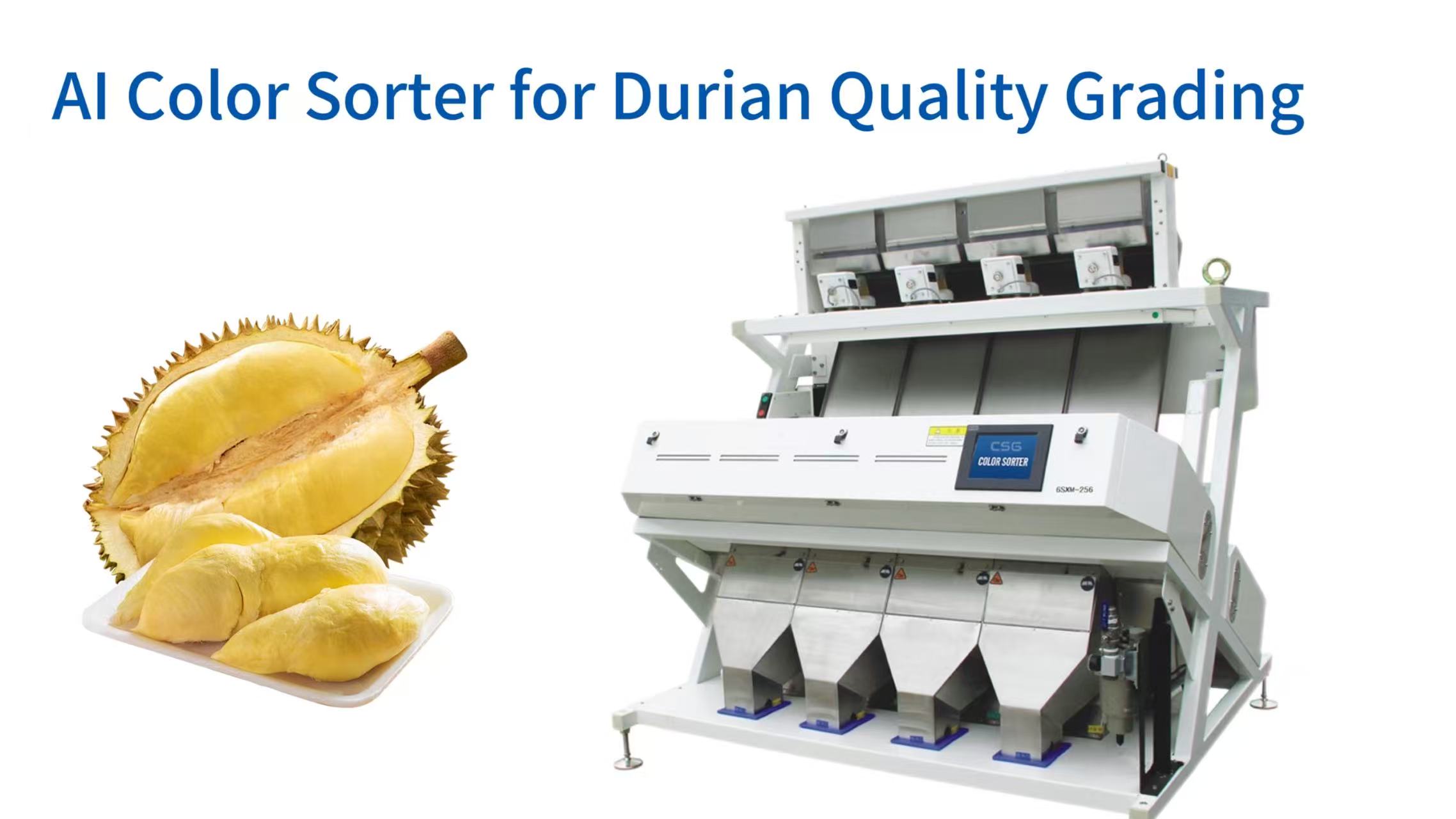
The global appetite for durian, often celebrated as the "King of Fruits," has skyrocketed, turning it into a multi-billion dollar industry. This surge in popularity brings with it a pressing demand for unwavering quality and safety, especially in premium export markets. Consumers expect every fruit to be perfectly ripe, free from internal defects, and consistent in its promise of rich, custardy flavor. For years, this responsibility fell on the shoulders of skilled, yet inherently limited, human inspectors. They relied on tapping the shell, smelling the stem, and years of experience to guess what lay inside. This manual process, however, struggles to keep pace with the volume and precision required by modern, large-scale supply chains. The challenge is no longer just about sorting; it is about seeing the unseen—detecting hidden rot, seed-boring insects, or mealy, unripe flesh without ever cutting the fruit open. Enter the AI Color Sorter for Durian Quality Grading, a technological marvel that integrates advanced imaging and artificial intelligence to redefine post-harvest handling. By automating inspection with superhuman accuracy, this solution empowers producers to eliminate waste, guarantee product excellence, and build the trust necessary to thrive in the competitive global arena. It transforms the sorting line from a bottleneck into a strategic advantage, ensuring that only the finest durians reach the consumer .
Fundamental Principles of the AI Durian Sorting System
Core Principles of AI Durian Sorting System
Penetrates husk to create internal structure radiograph, detecting hidden defects
Interprets X-ray images to classify quality and identify defects with precision
Pneumatic air jets separate durians into grade-specific collection chutes
Consistent, damage-free fruit delivery to inspection zone
The AI Color Sorter for Durian Quality Grading is far more than a simple machine; it is a sophisticated convergence of optics, mechanics, and deep learning. Specifically engineered for the unique challenges of large, thick-skinned fruit, its primary mission is to non-destructively assess the internal and external quality of each durian at high speed. Unlike traditional sorters that only see surface color, this intelligent system peers inside, leveraging technologies initially developed for medical diagnostics to ensure agricultural perfection. It replaces human guesswork with data-driven decisions, processing hundreds of kilograms of fruit per hour with a level of consistency that is impossible to achieve manually. This section breaks down the core technologies that enable this remarkable capability, explaining how they work in harmony to deliver unparalleled grading accuracy .
Food-Grade X-Ray and Internal Imaging
At the heart of the system's "superpower" lies food-grade X-ray technology, a safe and highly effective method for visualizing the interior of a durian. As each fruit passes through the scanning tunnel on a conveyor belt, the X-ray source emits rays that penetrate the thick, thorny husk. Dense materials like the seed and healthy, firm flesh absorb more radiation, while air gaps, rot, or insect damage allow more rays to pass through. A specialized sensor on the opposite side captures these varying levels of attenuation, creating a detailed grayscale image, or a "digital radiograph," of the fruit's interior. This process is entirely non-destructive and uses radiation levels that are completely safe for food products, leaving the durian untouched and perfectly edible. The image reveals the fruit's internal structure, clearly showing the number of locules (chambers), the size and condition of the flesh, and any anomalies that would otherwise remain hidden until the consumer opens it at home. This principle of internal inspection is the foundational step that separates a world-class sorter from a simple one .
The evolution from simple X-ray to a form of "CT scan" for high-speed lines represents a significant leap in capability. Advanced systems, like the FD3 model, utilize multiple X-ray angles or sophisticated processing algorithms to build a more comprehensive view of the durian's interior. This is crucial for differentiating between a harmless variation in flesh density and a genuine defect. For instance, a slight bruise near the seed might look similar to the early stages of rot on a single 2D image. However, by analyzing data from multiple perspectives, the system can map the volume and structure of the defect, making a far more accurate judgment. This technology can predict meat yield by calculating the volume of the edible pulp relative to the seed and shell. It identifies unripe fruit where the flesh hasn't fully developed and separates it from fruit with perfectly matured, ready-to-eat pulp. This level of analytical detail ensures that every grade—whether for immediate consumption or further processing—meets its precise specification, safeguarding the brand reputation of exporters and retailers .
Artificial Intelligence and Deep Learning Algorithms
The raw X-ray images are only half the story; the intelligence to interpret them comes from sophisticated artificial intelligence (AI) and deep learning algorithms. In the context of an AI sorter, these algorithms are not programmed with explicit rules like "if pixel is dark, then reject." Instead, they are trained using thousands, or even millions, of example images of durians. During this training phase, human experts show the system images of perfectly ripe durians, as well as those with various defects like seed borer infestation, internal mold, watercore, or immature pulp. The AI model, often a type of neural network, learns to recognize the subtle patterns, textures, and shapes associated with each condition. It becomes an expert in durian pathology, capable of identifying defects that would be invisible or ambiguous to the human eye. This deep learning approach allows the system to continuously improve; as it processes more fruit in the field, it gains experience and refines its accuracy, adapting to new varieties or growing conditions over time .
This AI-driven analysis is what enables the transition from simple defect removal to sophisticated quality grading. Once the internal condition is assessed, the AI can classify the durian into multiple predefined categories. A durian destined for a high-end fresh fruit market might need to meet strict criteria for pulp color, size, and a complete absence of minor defects. Another fruit, perhaps with a slight blemish that doesn't affect taste, could be perfectly suited for a paste or frozen dessert production line. The AI makes these split-second decisions based on the comprehensive internal data from the X-ray scan. It doesn't just answer "good" or "bad"; it answers, "How good?" and "Best use?" This capability allows producers to maximize the value of their entire harvest, diverting lower-grade fruit to processing while commanding premium prices for top-tier fresh fruit, fundamentally changing the economics of the packing house .
High-Speed Ejection Mechanism
After the AI makes its instantaneous grading decision, the physical act of separation must be equally fast and precise. This is the domain of the high-speed ejection mechanism, typically a sophisticated array of pneumatic air jets. As each durian travels along the conveyor at a consistent speed, the system's controller tracks its precise location in real-time. The moment the fruit reaches the ejection zone, a precisely timed blast of compressed air fires from a specific nozzle, gently nudging the durian off its trajectory and into the appropriate collection chute or onto a separate conveyor belt. The timing must be perfect—a fraction of a second too early or too late, and the wrong fruit is rejected, or a good one is missed. This system can handle the significant weight and size of a durian, demonstrating the powerful engineering behind the precision. It's a seamless choreography of detection, decision, and physical action happening in the blink of an eye .
The design of this ejection system is critical for minimizing damage and maximizing throughput. For delicate tasks, the system can be calibrated to use lower air pressure or multiple smaller blasts to move the fruit gently rather than violently "shooting" it. The number and configuration of the air jets are tailored to the width of the conveyor and the expected throughput. In high-capacity lines, you might see dozens of valves firing in rapid succession, each one responsible for a specific lane of fruit. This method is not only fast but also hygienic and low-maintenance, as it involves no moving parts that come into contact with the food. It is the final, critical step in the sorting process, transforming a digital decision into a physical reality and ensuring that the premium-grade durians destined for export are perfectly separated from those identified for alternative processing, all without a single human hand touching them .
Robust Feeding and Conveyance System
Before any scanning or sorting can happen, the durians must be presented to the sensors in a consistent, stable, and controlled manner. This is the job of the robust feeding and conveyance system, the unsung hero of the entire operation. Unlike smaller items like grains or beans that can be fed through a simple chute, durians are large, heavy, and irregularly shaped. The feeding system must singulate them—separate them from a chaotic mass into a single-file line—without causing bruising or jams. This often involves a combination of carefully designed hoppers, vibratory feeders, and indexing conveyors. The goal is to create a steady stream of fruit, each with a predictable gap from its neighbor, moving at a precise speed into the inspection zone. This controlled flow is essential because the X-ray and AI systems need a clear, unobstructed view of each individual fruit to make an accurate assessment. A well-designed feeder reduces the chance of fruits overlapping, which would confuse the detection algorithms and lead to sorting errors .
Beyond simply moving the fruit, the conveyance system is engineered to integrate seamlessly with the imaging and ejection technologies. The conveyor belt itself is made of a food-grade, X-ray transparent material to ensure it does not interfere with the internal scan. Its speed is precisely synchronized with the image capture rate of the cameras and sensors, ensuring that the images are not distorted. Encoders on the drive rollers provide constant position feedback to the central control system, allowing it to track each durian's location with millimeter accuracy from the moment it enters the tunnel to the moment it is ejected. This integrated design, where mechanical conveyance, advanced sensing, and pneumatic ejection work in perfect harmony, is what allows modern facilities to process up to 20 tons of fresh durian per day, a volume that is simply unattainable with manual methods. This efficiency is a game-changer for the industry, enabling handlers to move fruit from farm to cold storage with unprecedented speed .
Primary Types of AI Sorters for Durian Processing
Comparison of AI Durian Sorter Types
The application of AI sorting technology to durians is not a one-size-fits-all solution. Depending on the scale of the operation, the desired throughput, and the specific quality metrics being prioritized, different machine configurations offer distinct advantages. Producers can choose from systems that prioritize high-speed, high-volume sorting or those that offer the most detailed, almost laboratory-grade analysis of every single fruit. Understanding the differences between these primary types is crucial for any business looking to invest in automation. The choice often comes down to balancing the need for speed with the depth of inspection required for their target market. Whether the goal is to process thousands of tons for a mass market or to guarantee the absolute perfection of a boutique export brand, there is a specific type of AI sorter designed to meet that need .
Belt-Type AI Sorting Systems
For high-throughput packing houses that need to process massive volumes of fruit quickly, the belt-type AI sorting system is the industry workhorse. In this configuration, durians are conveyed on a wide, flat belt through the scanning tunnel. The primary advantage of this design is its immense capacity. A wide belt can carry multiple lanes of fruit simultaneously, allowing the system to achieve throughput rates that far exceed other configurations. For example, the 1400mm and 1800mm belt width models are designed specifically for such large-scale operations, moving tons of fruit per hour. The X-ray and AI systems are configured to scan the entire width of the belt, identifying and tracking each fruit in its respective lane. This type of system is ideal for the initial, high-volume sorting stage, where the primary goal is to quickly separate grossly defective fruits (like those with major rot or physical damage) from the bulk of the harvest before more detailed processing. Its strength lies in its brute efficiency and ability to keep up with the pace of modern harvesting .
Modern belt-type systems are incredibly sophisticated despite their high speed. They utilize advanced object detection algorithms to locate each fruit on the belt, even if they are not perfectly aligned. The AI can track a fruit as it moves, ensuring that the ejection mechanism, often a series of high-speed air jets mounted at the end of the belt, targets the correct item. The 2000mm-belt-width-ai-color-sorting-machine exemplifies this, offering immense coverage for massive processing facilities. While they provide less of a "360-degree" view compared to some other types, advanced belt systems are now incorporating multiple sensor arrays, including cameras and X-ray units, to inspect the fruit from above and below as it travels. This makes them exceptionally effective for a first-pass sort, drastically reducing the load on subsequent, more detailed grading steps. They represent the frontline of defense, ensuring that only fruits that pass this initial inspection consume the time and resources of more precise, and often slower, sorting technologies .
Chute-Type AI Sorting Systems
When the objective shifts from bulk sorting to high-precision, multi-grade classification, chute-type AI sorting systems come into their own. In this design, durians are fed into individual, carefully engineered chutes or channels. These chutes guide the fruit in a single-file line, accelerating it to a consistent speed and presenting it to a battery of sensors in a highly predictable manner. This controlled environment is perfect for in-depth inspection. As the fruit falls from the chute, it is illuminated and imaged from multiple sides simultaneously, allowing for a near-complete surface and, when combined with X-ray, internal analysis. This design is particularly effective for tasks like detailed size grading based on volume, sophisticated color sorting of the shell, and the detection of subtle external blemishes that might not be visible on a fast-moving belt. Each channel operates independently, making this configuration highly modular .
The precision of the chute-type system enables a much higher number of sorting grades. A single machine can be configured with dozens of channels, like the 12-chutes-768-channels-ai-sorting-machine, each capable of sorting fruit into multiple categories based on a combination of factors. For durians, this could mean grades like "Premium Export," "Domestic Grade A," "Processing Grade," and "Reject," with the AI making the call based on internal quality, size, and external appearance. The high-speed air ejection system at the bottom of the chute is incredibly precise, firing in the exact millisecond the fruit reaches its designated collection point. This level of control minimizes mis-sorting and ensures that a valuable, premium fruit is never accidentally directed to a lower-value stream. For packers focused on building a strong brand with consistent, top-tier fruit, the chute-type sorter is an indispensable tool for delivering on that promise .
Multi-Sensor Optical Sorting Systems
The pinnacle of durian grading technology lies in multi-sensor optical sorting systems, which fuse data from different types of sensors to create a holistic "fingerprint" for each fruit. These machines are not content with just one view; they combine information from high-resolution color cameras, X-ray units, and often near-infrared (NIR) spectrometers. The color cameras detect surface defects like scarring, sunburn, or fungal spots. The X-ray, as described, looks inside for rot, insects, and pulp development. The NIR sensor, a more advanced addition, analyzes the fruit's chemical composition by measuring how it absorbs and reflects light at near-infrared wavelengths. This allows the system to predict internal quality metrics like dry matter content, which is a key indicator of sweetness and flavor, or to detect specific types of internal disorders that even X-ray might miss. By correlating these diverse data streams, the AI builds a complete picture of quality that goes far beyond simple "good or bad" .
The power of sensor fusion is in its ability to make nuanced decisions based on a comprehensive understanding of the fruit. For example, a durian might pass the X-ray test for internal structure and have perfect color, but the NIR sensor might detect a lower-than-acceptable sugar content, indicating it's not yet ripe enough for the premium fresh market. The system, like a multi-sensor-optical-sorter, could then divert this fruit to a different channel for controlled ripening or processing. This level of detail was previously only possible through destructive sampling—cutting the fruit open. Now, it can be done non-destructively on 100% of the crop at line speed. This technology empowers producers to guarantee not just the safety and appearance of their fruit, but its very taste and eating quality, creating an unprecedented level of trust and transparency with consumers and commanding a significant premium in the process .
Core Functions of the AI Durian Color Sorter
Core Functions of AI Durian Color Sorter
X-ray based detection of rot, insects, immature pulp & meat yield calculation
High-res camera scanning for cracks, scars, mold & color consistency grading
Dimensional analysis + in-line weighing for market-specific size categorization
Real-time defect tracking + individual fruit traceability via QR/code marking
The primary mission of an AI Color Sorter for Durian Quality Grading is to automate and perfect the complex task of quality assessment. It achieves this by executing a series of distinct, highly specialized functions. These functions work in concert to transform a chaotic inflow of harvested fruit into a precisely categorized output, ready for different markets and purposes. From the initial inspection that sees through the thorny shell to the gentle, physical separation of each fruit, every function is optimized for speed, accuracy, and care. This integrated suite of capabilities is what allows modern packhouses to achieve levels of efficiency and quality consistency that were unimaginable just a decade ago, directly addressing the core challenges of waste reduction, brand protection, and market expansion .
Non-Destructive Internal Quality Inspection
The most transformative function of the AI sorter is its ability to perform a non-destructive internal quality inspection on every single durian. This is the modern equivalent of a medical CT scan, applied to agriculture. Using food-grade X-ray technology, the system penetrates the thick, spiky husk to visualize the fruit's interior. It creates a detailed image that reveals the condition of the flesh—the aril—that is the only part consumers care about. The AI algorithm, trained on thousands of images, analyzes this scan to detect a host of internal defects that are invisible from the outside. This includes "seed borer," where insects have tunneled into the fruit and damaged the flesh; internal rot or mold that can start near the seed and spread outward; and "immature pulp," where the flesh is underdeveloped, pale, and lacking the characteristic creamy texture and intense flavor. By identifying and removing these defective fruits, the system prevents a catastrophic consumer experience—the disappointment of opening a expensive durian only to find it inedible .
Beyond defect detection, this function also enables sophisticated quality grading based on internal characteristics. The system can analyze the X-ray image to predict the fruit's "meat yield"—the percentage of its weight that is edible flesh. This is a critical economic factor, as fruits with a higher flesh-to-seed ratio are more valuable. It can also assess the size and condition of the individual pulp lobes within each locule. A durian destined for the high-end fresh market might need to have plump, uniform lobes in all chambers. The AI can confirm this, ensuring that only the most impressive specimens earn the "premium" label. This capability turns a subjective guess into an objective, data-driven measurement, allowing producers to confidently market their fruit based on verified internal quality, build a reputation for reliability, and justify higher prices in quality-conscious markets .
External Defect Detection and Color Sorting
While internal quality is paramount for edibility, external appearance plays a massive role in marketability and perceived value, especially for whole fruit sold in retail. The AI sorter's vision system, equipped with high-resolution color and sometimes 3D cameras, performs a meticulous inspection of the durian's exterior as it passes through the machine. It scans the entire surface, identifying and characterizing a wide range of external defects. These can include physical damage like cracks or punctures sustained during harvest or transport, sunburn or sunscald that discolors the shell, scarring from branches or insects, and the presence of fungal or mold spots. By precisely mapping these imperfections, the system can make nuanced decisions. A fruit with a minor, superficial scar might be perfectly acceptable for a local market, while the same scar would disqualify it from an export grade where cosmetic perfection is required. This automated visual inspection is far more consistent and objective than human sight, which can vary with fatigue and lighting conditions .
Simultaneously, the system performs sophisticated color sorting. The color of a durian's shell can be an indicator of variety, maturity, and even growing conditions. The AI can be calibrated to sort fruit based on very specific color hues. For example, a packer might want to create a batch of uniformly golden-yellow durians for a special promotion. The sorter can be set to select only fruits that fall within a narrow, pre-defined color band, ejecting those that are too green or too brown. This goes beyond simple green-or-brown judgment to a continuous spectrum of color grading. This function, a core feature of any color sorter, is essential for creating visually appealing, uniform product lines that catch the consumer's eye. It ensures that every box of fruit meets a consistent visual standard, reinforcing brand identity and meeting the stringent specifications of supermarket chains and high-end distributors who demand a perfect, uniform appearance .
Precision Size and Weight Grading
In the world of agricultural commodities, size matters—and it directly impacts price. The AI sorter integrates precision size and weight grading as a core function, often using data from the same sensors that perform quality inspection. The vision system calculates the fruit's dimensions—length, width, and volume—with high accuracy. Simultaneously, in-line weighing scales, often integrated directly into the conveyor or chute system, capture the fruit's exact weight. By combining these two data points, the system can calculate density, which is another indicator of internal quality (a hollow or damaged fruit might be lighter for its size). This data is then used to automatically route each durian to the appropriate output lane based on its size class. This automated grading eliminates the need for manual sizing, a slow and labor-intensive process, and ensures that every fruit in a "Size A" box is truly a Size A, meeting the strict requirements of wholesale buyers who sell by count and weight .
The precision of this function allows for a highly flexible and granular grading system. Producers can define their own size categories based on market demands, not just a few standard buckets. For example, they could create distinct grades for fruits weighing 1.5-2.0 kg, 2.0-2.5 kg, and 2.5-3.0 kg. The AI sorter can handle this seamlessly, diverting each fruit to the correct lane. This is far more efficient than using mechanical sizing graders, which can be prone to jams and are less accurate with irregularly shaped items. For the durian industry, where fruit shape can be highly variable, this precision is invaluable. It allows exporters to perfectly match their product to the specific demands of different international markets, some of which prefer smaller, personal-sized fruits while others demand large, show-stopping specimens for sharing and gifting. This ability to optimize size grading for maximum market value is a key driver of return on investment .
Automated Data Collection and Traceability
In today's complex global supply chain, knowing your product is not enough; you must be able to prove it. A cutting-edge function of modern AI sorters is automated data collection and traceability. As the machine sorts each fruit, it generates a vast amount of data. It records not just the final destination of each fruit (e.g., "Grade A bin"), but also the reasons for that decision. The system logs how many fruits were rejected for internal rot, how many for being undersized, and how many for external blemishes. This data is compiled into real-time dashboards and reports, providing the packhouse manager with an unprecedented window into the quality of the incoming harvest. They can see at a glance the percentage of defects, track trends over time, and make informed decisions about which orchards or growing regions are producing the highest quality fruit. This information is invaluable for improving agricultural practices and negotiating with suppliers .
Furthermore, advanced systems are now capable of individual fruit traceability. After being sorted, each durian can be automatically marked with a unique identifier, often using a food-safe laser printer. This code can be as simple as a batch number or as complex as a QR code. A consumer or retailer could scan this code and access a detailed history of that specific fruit: its farm of origin, the date and time it was harvested, the results of its AI quality inspection (e.g., "internal quality verified, dry matter content 35%"), and its entire journey through the supply chain. This level of transparency, achievable with an ai-xray-sorting-machine, is a powerful tool for building brand trust and authenticity. In the event of a quality issue, it allows for pinpointed recalls, isolating only the affected batch rather than an entire shipment. This function transforms the packing line from a cost center into a source of strategic data and brand equity .
Durian Varieties and Applications in Sorting
The durian family is diverse, with dozens of cultivated varieties, or cultivars, each boasting unique characteristics in terms of size, shape, shell color, flesh texture, and flavor profile. A Mongthong, known for its mild sweetness and large size, presents a different sorting challenge compared to a small, intensely flavored Musang King with its distinctive bright yellow flesh and complex aroma. A high-performance AI Color Sorter must be versatile enough to handle this diversity. The magic lies in the machine's ability to be trained and configured for different cultivars. By selecting the appropriate pre-programmed settings or training a new AI model, operators can instantly switch the line from sorting one variety to another, ensuring that the specific quality parameters for each are applied correctly. This adaptability is crucial for packhouses that handle fruit from multiple growers or cater to markets with varying preferences. The underlying technology—X-ray for internals, cameras for externals—remains the same, but its application is finely tuned to the unique biology of each durian type .
Sorting for Premium Fresh Export Markets
For durians destined for the premium fresh fruit export market, the sorting criteria are exceptionally stringent. The goal is to select only the "perfect" fruit that will command the highest prices in destinations like major cities across Asia. The AI sorter is configured to enforce a strict pass/fail standard. Internally, the fruit must be free from any defect—no rot, no worms, and perfectly mature, creamy pulp. The X-ray analysis must show well-developed flesh filling the locules. Externally, the requirements are equally demanding. The shell must be free from significant blemishes, scars, or cracks, with a color that is characteristic of its variety and appealing to the consumer's eye. The size and weight must be highly uniform within a specific, premium grade, such as 2.0-2.5 kg. Fruit meeting this top-tier standard is often individually wrapped, branded, and sold at a significant premium. The AI sorter acts as the final, most stringent quality gatekeeper, ensuring that every single fruit bearing the exporter's premium label is flawless and consistent, thereby protecting and enhancing the brand's reputation in a competitive landscape .
The economic impact of using AI for this premium application is profound. Manual sorting for such high standards is incredibly difficult and inconsistent. A tired inspector might let a marginally defective fruit pass, which ends up being the one a VIP customer opens, damaging the buyer's trust and potentially costing millions in future contracts. The AI sorter removes this risk. It applies the same objective standard to every fruit, 24/7, without fatigue. Furthermore, by accurately identifying fruit that meets the premium standard, it maximizes the volume that can be sold into this high-value channel. In the past, packers might have been overly conservative, downgrading good fruit to avoid the risk of a complaint. The AI's confidence allows them to accurately capture every possible premium-grade sale, directly boosting revenue. The data from the sort also provides feedback to growers, helping them understand how practices influence the production of export-quality fruit, creating a virtuous cycle of continuous improvement .
Sorting for Processing and Value-Added Products
Not every durian harvested will meet the exacting standards of the fresh market, but that does not mean it lacks value. A significant portion of the crop is destined for processing into a wide range of value-added products such as frozen durian pulp, durian paste, ice cream, chips, and candies. For this stream, the AI sorter plays a different but equally critical role. The sorting objectives shift from cosmetic perfection to food safety and yield optimization. The primary function here is to guarantee that any fruit sent for processing is safe and free from defects that would compromise the final product's quality. The X-ray system remains essential for detecting internal rot or insect infestation, as a single rotten fruit could contaminate an entire batch of paste. However, external blemishes like scarring or minor color variations become irrelevant, as the shell will be removed during processing. The AI is configured to accept fruit that is internally sound, even if it is not pretty, thereby maximizing the volume of usable material and minimizing waste .
Beyond simple safety checks, the AI sorter can also perform a crucial function for processors: optimizing yield for specific products. For example, a company specializing in frozen whole-pulp lobes might need fruit of a certain size range to meet portion control standards. The sorter can be set to divert medium-sized, internally perfect fruit to this line. Meanwhile, very large fruits might be directed to a line for whole fruit sales, and smaller, but still good, fruits could be routed to the paste production line. Some advanced systems can even predict, based on the X-ray analysis, the likely texture or dryness of the pulp, helping processors sort fruit for different culinary applications. This level of sorting efficiency, achievable with a machine like the fruits sorting solution, ensures that processing plants receive a consistent, high-quality raw material stream, which is essential for producing consistent finished goods and running their operations efficiently. It turns what was once a lower-value "grading out" pile into a valuable, and often highly profitable, product stream .
Technical Principles of Durian Grading Technology
To truly appreciate the capabilities of an AI durian sorter, it helps to look under the hood at the specific technical principles that make its magic possible. This is a story of convergent technologies: precision mechanics to handle the fruit, advanced physics to see through it, and cutting-edge computer science to understand what is seen. The machine is essentially a high-speed laboratory, combining principles from mechanical engineering, optics, nuclear physics, and artificial intelligence into a single, reliable industrial system. Each component is the result of years of research and development, optimized for the specific challenge of non-destructively grading a large, complex agricultural product. The seamless integration of these diverse technologies is what elevates the sorter from a simple machine to an intelligent system .
Advanced X-Ray Fluorescence and Transmission Principles
The core principle for internal inspection relies on the physics of X-ray transmission. As explained earlier, an X-ray source emits high-energy photons that pass through the durian. The key is differential absorption. Dense materials, like a healthy, tightly packed durian lobe or the large seed, contain atoms that absorb more X-rays, resulting in fewer photons reaching the detector behind the fruit—creating a darker area on the resulting image. Less dense materials, such as the air gap inside a hollow fruit, a pocket of rot which is mostly water and air, or an insect tunnel, allow more photons to pass through, creating a brighter area on the image. The detector, a sophisticated sensor panel, captures this "shadow" and converts the varying intensities of X-rays into a high-contrast digital image. This is a pure application of transmission radiography, the same principle used by doctors to see bones, scaled and adapted for safe, industrial food inspection. The challenge lies in doing this fast enough for a high-speed production line and with enough resolution to spot a small worm hole .
While transmission gives us a density map, it doesn't always give us the chemical composition. This is where more advanced principles like X-ray Fluorescence (XRF) could potentially come into play in more advanced sorters, though its primary use is for mineral and metal sorting. In the context of durian, the primary technology remains high-resolution transmission. However, the "food-grade" aspect is a critical engineering principle. The X-ray systems are designed with strict safety standards, using lead shielding and safety interlocks to ensure that radiation exposure is confined to the inspection tunnel and poses absolutely no risk to operators or to the food product itself. The energy levels used are carefully controlled to be effective for imaging but well below any threshold that could alter the fruit's DNA or leave any residual radiation. It is a safe and powerful tool that has been successfully transferred from the medical to the agricultural world .
Hyperspectral and Multispectral Imaging Analysis
Beyond simple color cameras and X-rays, some of the most advanced sorters employ principles of hyperspectral or multispectral imaging to assess food quality. This technology goes far beyond what the human eye can see. While a standard camera captures light in three broad bands (red, green, and blue), a hyperspectral sensor captures light from dozens or even hundreds of narrow, contiguous bands across the electromagnetic spectrum. Every material has a unique spectral "fingerprint"—a specific pattern of how it reflects and absorbs light at different wavelengths. For a durian, the perfect, ripe flesh has one spectral signature, while a rotting area, an insect-damaged section, or even flesh with a different sugar content will have subtly different signatures. The AI is trained to recognize these fingerprints. As the fruit passes through the inspection zone, the hyperspectral sensor captures its complete spectral data, and the AI instantly compares it to its library of signatures to determine the fruit's true condition. This is a far more sensitive and accurate method than relying on density (X-ray) or visible color alone .
Multispectral imaging is a related but slightly simpler principle, using a select number of specific, narrow wavelength bands that are known to be highly indicative of quality. This approach can be faster and more cost-effective for specific tasks. For example, a system might use specific near-infrared (NIR) bands to accurately measure the dry matter content of the durian flesh, a key indicator of sweetness and maturity. As the NIR light penetrates the shell (to a limited extent) and interacts with the flesh, water and sugar molecules absorb specific wavelengths. By analyzing the reflected light, the system can quantify these components. This application of physics and chemistry on a high-speed line allows for the non-destructive prediction of taste, an achievement that was purely in the realm of laboratory analysis just a few years ago. The integration of these imaging principles, often found in a full-spectrum-sorting-machine, represents the frontier of food quality assurance .
Deep Learning Neural Networks for Defect Recognition
The "intelligence" that interprets all this rich sensor data comes from deep learning neural networks. This is a branch of artificial intelligence loosely inspired by the structure of the human brain. A neural network consists of layers of interconnected nodes, or "neurons." In a process called training, the network is fed millions of labeled images of durians—some good, some with specific defects like "seed borer," "rot," or "immature." As the network processes these images, it adjusts the strength of the connections between its neurons. Initially, its guesses are random, but through a process of backpropagation, it learns which features matter. It might learn that a combination of a certain texture, shape, and density pattern in the X-ray is a strong indicator of a wormhole. The key power of deep learning is that it doesn't need to be told these rules by a human programmer; it discovers the intricate, often subtle, patterns itself from the training data. This allows it to recognize defects that are too complex or variable to be defined by simple, rule-based logic .
This neural network model is then deployed on a high-performance industrial computer within the sorter. As a durian flies through the machine at several meters per second, the sensor data is streamed into this trained model. The model performs a "forward pass," pushing the data through its millions of connections, a process that takes milliseconds. The output is a probability score for each of the categories it was trained on: e.g., 99% chance it's a "Premium Grade A," 0.5% chance it's "Internal Rot." The system's logic then uses this output to make a split-second decision, triggering the air jets if the probability of a defect exceeds a user-defined threshold. The system can also get smarter over time through "edge learning." If an operator notices a new type of subtle defect that the system is missing, they can show it a few examples, and the AI can fine-tune its model on the spot without needing a complete retraining. This adaptability, a hallmark of modern ai-sorter systems, ensures the technology remains effective as new varieties and growing conditions emerge .
Core Value and ROI for Durian Industry Players
Core Value & ROI of AI Durian Sorters
ROI Contribution Breakdown
For businesses in the durian supply chain, from large-scale plantations to specialized packing houses and processing plants, investing in an AI Color Sorter is a strategic decision driven by a clear return on investment (ROI). The value proposition is multifaceted, extending far beyond the simple reduction of labor costs. It touches upon the most critical aspects of a modern food business: brand integrity, operational efficiency, market access, and sustainability. By automating the most complex and critical step in post-harvest handling, the technology transforms what was once a subjective, error-prone, and labor-intensive bottleneck into a source of competitive advantage. The benefits are tangible, measurable, and directly impact both the top line (revenue) and the bottom line (profitability) of the operation .
Significant Reduction in Labor Dependency and Costs
The most immediate and calculable benefit for most companies is the dramatic reduction in labor dependency and associated costs. Manual durian grading is a physically demanding and highly skilled job that requires significant training. Inspectors must learn to judge ripeness by sound and smell and spot subtle external defects, all while working quickly. Finding and retaining a large, reliable workforce to do this day in and day out is a major operational challenge and expense, especially during peak harvest seasons. A single AI sorter, like the FD3 system, can process as much fruit as 10 to 20 human sorters in a day, with a daily capacity of up to 20 tons . This automation allows companies to redeploy their workforce to less strenuous and more value-added tasks, such as quality assurance oversight, packaging, and equipment maintenance. The reduction in headcount directly translates to lower payroll, fewer training costs, and a significant decrease in management overhead .
The financial model is compelling. While the initial capital outlay for an AI sorter is substantial, the payback period is often remarkably short. By eliminating the wages, benefits, and associated costs of a large sorting team, companies can free up significant cash flow. In many documented cases, the investment in such automation is recovered within one to two years. Beyond direct wages, there are also hidden savings. Manual sorting lines can be a source of workplace injuries due to repetitive strain and the physical demands of handling heavy fruit. Automating this process reduces the risk of such injuries, leading to lower workers' compensation claims and a safer, more positive work environment. When these savings are combined with the revenue gains from improved quality, the economic case for investing in an chute-type-ai-color-sorting-machine or other models becomes overwhelmingly positive .
Elevated Product Quality and Brand Protection
For companies selling a branded product, perhaps the most critical value is in brand protection and the elevation of product quality. In the premium food market, a brand is a promise of a consistent, excellent experience. One bad experience—a customer buying an expensive branded durian only to find it rotten or tasteless inside—can undo years of brand building. The AI sorter acts as the ultimate guarantor of that promise. It ensures that every single fruit bearing the company's label has been objectively verified for internal quality, size, and appearance. This 95%+ accuracy rate in detecting internal defects, such as seed borer or rot, eliminates the risk of a "bad" fruit ever reaching the consumer . This builds immense trust and loyalty, encouraging repeat purchases and positive word-of-mouth, which are invaluable in a competitive market.
Furthermore, the system elevates the overall quality of the product line. By precisely and consistently sorting fruit into multiple grades based on objective criteria, companies can create differentiated product tiers. They can offer a "Super Premium" grade of consistently flawless, large-sized fruit at a high price point, alongside a more affordable "Choice" grade of still-excellent fruit that might have a minor cosmetic imperfection. This strategy maximizes the value extracted from the entire harvest, as nothing that meets safety standards is wasted. The data from the sorter also provides verifiable proof of quality to buyers. An exporter can provide a potential client with a data report showing that the shipment of 10,000 fruits has been 100% X-ray inspected for internal defects. This level of transparency is a powerful sales tool that builds confidence and justifies a premium price, opening doors to the most demanding and lucrative markets .
Enhanced Efficiency, Scalability, and Data-Driven Insights
The AI sorter is not just a tool for today; it is an investment in a company's future capacity for growth. By automating the sorting bottleneck, it unlocks unprecedented efficiency and scalability. A manual line can only process fruit as fast as the inspectors can work, and adding more people eventually leads to diminishing returns. An AI line, on the other hand, can run continuously at high speeds, processing over 1,200 durians per hour with perfect consistency . This allows a company to handle larger volumes of fruit without a proportional increase in labor, facilitating business growth and enabling them to take on larger contracts. The speed and reliability of the automated line mean that fruit can be processed and moved into cold storage much faster, preserving its freshness and extending its shelf life, a critical advantage for export logistics. This efficiency is key to scaling up operations to meet growing global demand .
Beyond raw speed, the system provides invaluable data-driven insights that can optimize the entire business. The real-time dashboards and reports generated by the sorter give management a clear, objective view of the quality of their incoming supply. They can track defect rates over time, comparing the performance of different growing regions, farms, or even specific sections of an orchard. This information allows for data-backed conversations with suppliers, encouraging best practices and potentially leading to premium payments for higher-quality fruit. This feedback loop can drive continuous improvement all the way back to the farm. In the long term, the data collected on consumer preferences (e.g., which size or internal quality grade sells best in which market) can inform strategic decisions about which varieties to plant and how to target marketing efforts. This transforms the packing house from a simple processing facility into a hub of strategic intelligence, a key advantage enabled by technology like the x-ray-sorter .
Conclusion: Securing the Future of Durian with Intelligent Grading
AI Durian Sorting - Key Outcomes
The journey of the durian from a spiky, mysterious fruit to a globally trusted and consistent premium product is paved with technology. The AI Color Sorter for Durian Quality Grading stands at the forefront of this transformation. It masterfully addresses the industry's most profound challenges: the need for unwavering quality, the reduction of costly waste, and the ability to scale operations efficiently to meet surging global demand. By replacing subjective, manual inspection with the objective, superhuman precision of X-rays and artificial intelligence, it gives producers an unprecedented level of control over their product. It ensures that every single fruit that leaves the packing house is a perfect ambassador for the brand, free from hidden defects and graded to exact specifications. This technology is not just an upgrade to a production line; it is a fundamental shift in how quality is defined, measured, and guaranteed in the agricultural sector.
The value unlocked by this intelligent grading extends far beyond the packing house. It builds trust with consumers, who can purchase with confidence. It opens doors to premium international markets with the most stringent quality requirements. It creates new economic opportunities by maximizing the value of every harvested fruit, diverting them to the most profitable channels. And it provides growers and distributors with a wealth of data, creating a feedback loop that can improve practices from the farm to the retailer. As the appetite for high-quality durian continues to grow, the adoption of AI-driven sorting technology is no longer just a competitive advantage; it is becoming the standard for any player serious about long-term success. For more information on how these advanced systems can be integrated into your specific operation, please explore our comprehensive range of sorting solutions.
We encourage you to contact our team of specialists to discuss your unique grading needs and discover how a tailored AI sorting solution can drive efficiency, enhance quality, and propel your business toward a more profitable and sustainable future. Visit our website or reach out today to begin the conversation.